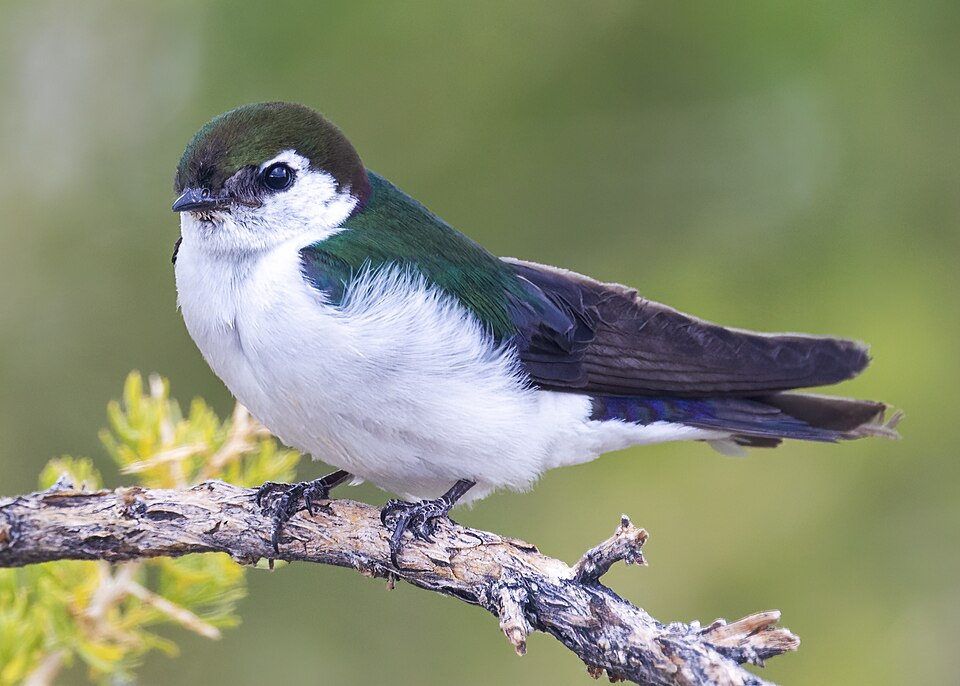
The Violet-green Swallow is one of the small treasures of the American West, a compact, fast-flying swallow that seems almost too brightly colored to be real when sunlight catches it. Seen against an open sky it can look plain and dark, but when it banks and the light hits just right, its back flashes metallic bottle-green and its rump shows washes of violet and bronze-purple. It is a bird of canyons, mountain forests, foothill oak woodlands, and increasingly the suburbs and small towns of the West, where it nests in tree cavities, rock crevices, and nest boxes.
For backyard birders in the western states, this is one of the more approachable swallows because it readily accepts nest boxes and will often raise a family right alongside people. It spends most of its waking hours on the wing, coursing high overhead in loose, twittering flocks and hawking insects out of the air. Its closest relative and frequent companion is the Tree Swallow, and learning to separate the two is one of the satisfying small challenges of western birding.
This is a small, slim swallow with long, narrow wings and a short, slightly notched tail. In flight it looks compact and almost wing-heavy, with quick, fluttery wingbeats broken by glides. The clinching field marks are on the face and rump, so try to get a look as the bird banks and turns rather than judging it as a dark silhouette overhead.
| Face | Clean white extends up onto the cheek and above the eye, so the white wraps around behind and over the dark eye, a key separator from Tree Swallow. |
| Upperparts | Glossy metallic green on the crown and back, blending to bronze-purple and violet on the rump and lower back, brightest in good light. |
| Rump patches | Two white patches on the sides of the rump nearly meet over the tail, often showing as a near-complete white band, visible from below and behind. |
| Underparts | Bright clean white from chin to undertail, with no breast band or smudging. |
| Shape | Small and slim with long, pointed wings that extend past the tip of the short, shallowly notched tail at rest. |
| Size | Noticeably smaller and more delicate than a Tree Swallow when the two fly together. |
Male vs. female
The sexes look broadly similar, and at typical flight distances they are usually not safely separable. Adult males are the most brilliant, with the cleanest white face, the most vivid green back, and strong violet tones on the rump. Adult females are slightly duller overall, often with a faint dusky wash across the face or crown that makes the white look a touch less crisp, and somewhat less intense iridescence. These are subtle, light-dependent differences best judged on perched birds at close range rather than on birds zipping overhead.
Juveniles
Juveniles and first-year birds are noticeably plainer. They lack the metallic green and violet of adults, appearing gray-brown to dusky above with little or no gloss, and the bright white face pattern is muted, so the clean wraparound-the-eye look is reduced or absent. The white rump patches and white underparts are still present, which usually keeps them identifiable as Violet-green Swallows, but young birds are a frequent source of confusion with juvenile Tree Swallows and even Bank Swallows until they molt into adult plumage.
The Violet-green Swallow is not a songster in the musical sense. Its voice is a series of dry, thin, twittering and chipping notes, often given in flight as flocks move overhead. The contact call is a soft, scratchy chee-chee or tsip, and birds run these notes together into a rapid, slightly buzzy chatter.
One of its most distinctive vocalizations is a pre-dawn song that males give from high in the air, well before sunrise, a repeated, rising tsip-tseet, tsip-tseet that carries through the dark and can be a memorable sound on a spring camping trip in the mountains. Around the nest, birds use sharp, excited twitters when changing places at the cavity or when scolding intruders.
The Violet-green Swallow is a bird of western North America. It breeds from Alaska and western Canada south through the mountains and foothills of the western United States, from the Pacific Coast east to the Rocky Mountains, and on into the highlands of Mexico. It favors open woodlands, conifer and oak forests, canyon country, and increasingly western towns and suburbs, often nesting at surprisingly high elevations in mountain forests.
It is a long-distance migrant. Most birds withdraw from the United States in fall and winter in western and southern Mexico and Central America, with a small number lingering in the warmest parts of the Southwest and along the Pacific Coast. It is one of the earlier spring migrants, with the first birds appearing in the southwestern states as early as February and reaching the northern breeding grounds through spring. Fall departure is mostly from late summer into early fall.
Violet-green Swallows are aerial insectivores, catching nearly all of their food on the wing. They feed on flies, flying ants, beetles, leafhoppers, true bugs, small wasps and bees, and other small flying insects, plus airborne spiders drifting on silk. They typically forage higher in the air than many other swallows, often coursing well above the treetops or hillsides in loose flocks, then dropping lower over water, meadows, or clearings when insects concentrate there.
Their flight is buoyant and acrobatic, full of quick turns and glides as they snap up prey one insect at a time. They drink and bathe on the wing, dipping to the surface of ponds and rivers in flight. Because they feed entirely on flying insects, they do not visit seed or suet feeders.
This is a cavity nester. Pairs use natural tree hollows, old woodpecker holes, crevices in cliffs and rock faces, and readily take to nest boxes, sometimes nesting in loose, semi-colonial groups where good cavities are clustered. They will also use crevices and openings in buildings. Inside the cavity, the female builds a cup of grasses, fine plant stems, and weed fibers, lined heavily with feathers, sometimes white feathers that may even help insulate or signal the nest.
The female lays a clutch of typically four to five pure white eggs and does the incubating, which lasts roughly two weeks. Both parents then feed the nestlings a steady stream of insects, and the young fledge at around three weeks of age. Most pairs raise a single brood per season, though a second is possible in the southern part of the range. They compete for cavities with Tree Swallows, bluebirds, House Sparrows, and other cavity nesters, so available holes can be in high demand.
Yes, within its western range, the Violet-green Swallow is a genuine backyard bird, and one of the easier swallows to host because it takes readily to nest boxes. You will not draw it with feeders, since it eats only flying insects, but you can offer it a home and good airspace to hunt over.
- Put up a nest box sized for swallows and bluebirds, with a 1.5-inch entrance hole, mounted 8-15 feet up on a post, pole, or building eave with an open approach.
- Choose an open setting, boxes near a clearing, field edge, water, or hillside give the birds room to forage and an unobstructed flight path to the entrance.
- Mount boxes on a smooth metal pole with a baffle to keep climbing predators out, and skip the perch, which mainly helps competitors and predators.
- Provide multiple boxes spaced out, since Violet-green Swallows tolerate loose colonies and you will also reduce fights with Tree Swallows and bluebirds.
- Keep a nearby water source like a pond or birdbath; the birds drink and bathe in flight and the insects over water draw them in to feed.
- Avoid pesticides in the yard, a healthy population of flying insects is exactly what these swallows need to raise a brood.
- Tree Swallow: Larger and chunkier with steely blue-green upperparts; its white stops below the eye, so the dark cap comes down to the eye, it lacks the white that wraps above and behind the eye and lacks the white rump-side patches.
- Bank Swallow: Brown above rather than glossy green, and shows a distinct brown breast band across the white underparts, which Violet-green never has.
- Northern Rough-winged Swallow: Plain brown above with a dingy brown throat and chest blending into white; lacks any green gloss, white face pattern, or white rump patches.
- Purple Martin: Much larger; adult males are uniformly dark glossy purple-blue below, and even females and young are far bigger and lack the clean white face and rump patches.
How do I tell a Violet-green Swallow from a Tree Swallow?
Look at the face and rump. On a Violet-green Swallow the white cheek extends up above and behind the eye, so white nearly surrounds the dark eye, and it shows two white patches on the sides of the rump that almost meet over the tail. On a Tree Swallow the dark cap comes down to the eye (white stops below it) and there are no white rump patches. Violet-greens are also smaller and slimmer.
Why does the bird look green sometimes and dark other times?
The green and violet colors are structural iridescence, not pigment, so they only flash when light hits the feathers at the right angle. Against a bright sky or in shadow the bird can look plain dark or black; when it banks and the sun catches its back, the metallic green and violet suddenly appear.
Will Violet-green Swallows use a nest box?
Yes. They are cavity nesters and readily accept nest boxes with a 1.5-inch entrance hole, mounted in an open spot 8 to 15 feet up. They will share areas in loose colonies, so multiple boxes can host several pairs while easing competition with Tree Swallows and bluebirds.
What do Violet-green Swallows eat, and will they come to a feeder?
They eat only flying insects, flies, flying ants, beetles, small wasps, leafhoppers, and the like, caught entirely on the wing. They will not visit seed, suet, or nectar feeders. The best way to support them is to offer nest boxes, keep open airspace and water nearby, and avoid pesticides.
Where and when can I see a Violet-green Swallow?
They are found across western North America in spring and summer, in mountain forests, canyons, oak and pine woodlands, and western towns. They are early migrants, arriving in the Southwest as early as February and spreading north through spring, then leaving for Mexico and Central America by fall.