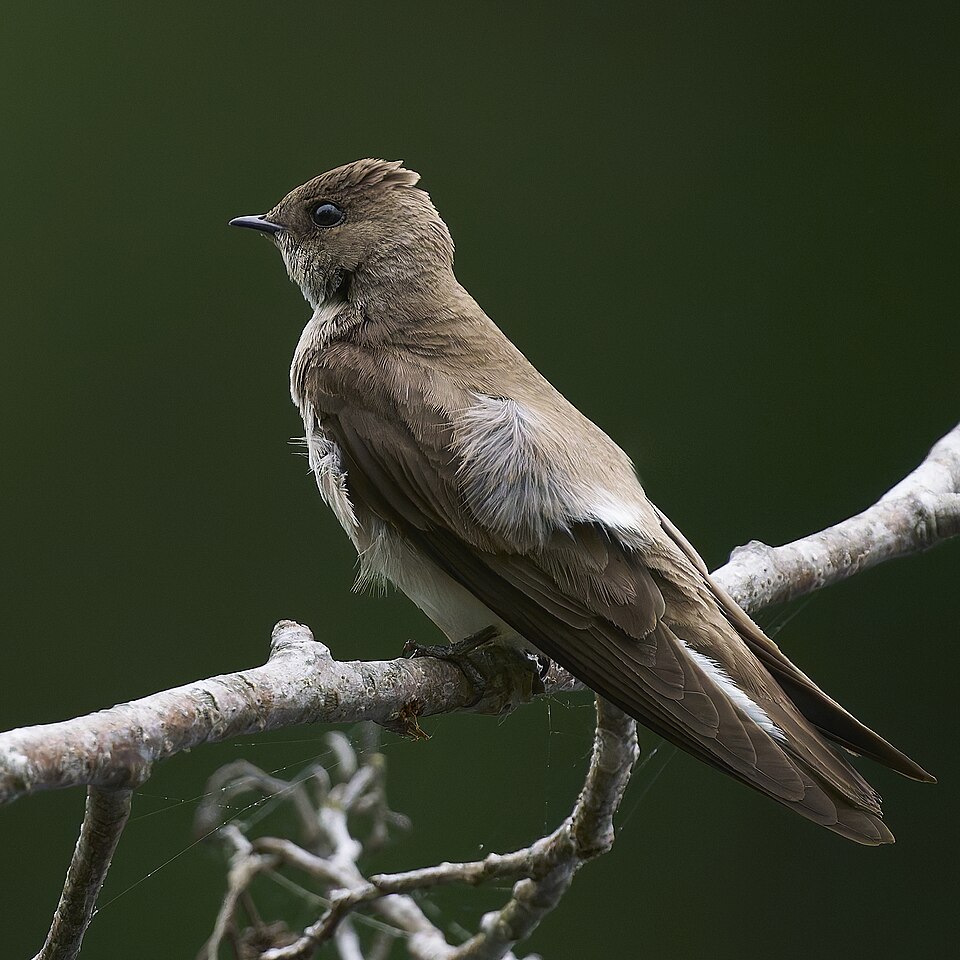
The Northern Rough-winged Swallow is the quiet, unassuming member of North America's swallow family. While its cousins flash blue-green backs or build mud cups under your eaves, this bird wears plain mouse-brown above and dingy white below, and it tends to fly low and alone or in loose handfuls rather than swirling clouds. If you spend much time near rivers, gravel pits, road cuts, or culverts in summer, you have almost certainly seen one coursing back and forth over the water on slow, easy wingbeats, snapping up insects just above the surface.
Its odd name comes from a real anatomical quirk: the outer edge of each wing's leading flight feather is lined with tiny hooked barbs, giving the feather a rough, file-like texture you can feel if you ever hold one in the hand. Nobody is entirely sure what the rough edge is for, though it may produce sound during courtship. The species ranges across much of North America in summer and is a familiar sight wherever there are dirt banks or man-made cavities for nesting, yet because it is so plain and so widely scattered, plenty of birders overlook it entirely.
This is a small, slim swallow with long, pointed wings and a short, only slightly notched tail. In flight it looks longer-winged and more relaxed than other brown swallows, flapping in slow, deliberate bursts between glides and rarely climbing high. The overall impression is of a drab brown bird with no bold marks at all, which is itself a useful clue.
| Upperparts | Uniform plain brown from crown to tail, with no contrasting cap or pale collar |
| Throat & chest | Dusky brownish wash across the throat and upper breast that fades gradually into the pale belly |
| Underparts | Dingy grayish-white below, never crisp white; the brown of the throat blends in rather than forming a sharp line |
| Tail | Short and squared with only a shallow notch, lacking long forked streamers |
| Flight style | Slow, fluttery wingbeats with frequent glides; flies low over water and ground |
| Wings | Long and pointed; the namesake rough leading edge is visible only in the hand |
Male vs. female
Males and females look alike in the field. The sexes share the same plain brown upperparts and dusky throat, and there is no reliable difference in color or pattern that a birder can use to tell them apart at a distance. The rough barbs on the outer wing feather tend to be more developed in males, but this is something you would only notice with a bird in the hand, not through binoculars.
Juveniles
Juveniles closely resemble adults but are even warmer and browner overall, often showing rusty or cinnamon edges to the wing coverts that form pale wingbars. Freshly fledged birds can look distinctly tawny across the wing, which sometimes causes confusion, but the plain face and diffuse dusky throat still point to a Rough-winged. These rufous feather edges wear away over the first months, so by late summer young birds look much more like their parents.
The Northern Rough-winged Swallow is not much of a singer. Its main vocalization is a low, harsh, buzzy note often written as brrrt or preet, harsher and more grating than the bright twitter of a Tree Swallow or the liquid chatter of a Barn Swallow. The call has a flat, slightly rising or doubled quality, sometimes rendered as brzzt-brzzt.
You will most often hear it as a contact note given in flight, especially as birds pass over water or arrive at the nest. There is no elaborate song; instead the bird repeats its rough buzzy calls, and a small group near a nesting bank will keep up a soft, scratchy conversation of these notes.
Northern Rough-winged Swallows breed across most of the United States, southern Canada, and well down into Mexico, occupying nearly any region that offers suitable nesting banks or cavities near open foraging space. They are long-distance migrants in the northern part of this range, arriving in spring (often a bit later than Tree Swallows) and departing by early fall.
In winter they retreat to the southern United States, Mexico, and Central America, with some lingering along the Gulf Coast and in the desert Southwest. Southern and Mexican populations are largely resident year-round. During migration they often join mixed swallow flocks over lakes and marshes, where their plain plumage and slow flight help pick them out from the busier crowd.
Like all swallows, this is an aerial insectivore that catches its food on the wing. Its diet is made up almost entirely of flying and emerging insects, including flies, midges, mosquitoes, flying ants, beetles, mayflies, and small wasps and bees. It hunts low, typically within a few feet of the water surface or just above open ground, taking advantage of the dense insect life that hatches over rivers, ponds, and wetlands.
Compared with other swallows, Rough-wings tend to forage lower and more methodically, cruising back and forth along a stretch of shoreline rather than wheeling high in the sky. They will occasionally pick prey directly off the water's surface or from streamside vegetation. Because they feed entirely on insects in flight, they do not visit feeders.
Northern Rough-winged Swallows are cavity and burrow nesters, but unlike Bank Swallows they do not usually dig their own tunnels in colonies. Instead a pair typically nests singly, taking over an existing hole: an old kingfisher or Bank Swallow burrow in a dirt bank, a crevice in a road cut or quarry wall, or man-made cavities such as drainage pipes, culverts, gutters, holes in bridges, and gaps in stone walls. This flexibility lets them thrive around human structures.
The female builds a loose nest of grasses, twigs, and leaves at the back of the cavity, lined with finer material. She typically lays a clutch of white eggs and incubates them for roughly two weeks; both parents then feed the nestlings, which fledge a few weeks after hatching. Pairs are not strongly colonial, though several may nest near one another where good cavities are concentrated, such as along a bridge or a riddled bank.
This is not a feeder bird, and it will not use a typical birdhouse, so you cannot draw it in with seed or suet. It is, however, an insect-eater that responds to habitat, and you can encourage it if your property borders the kind of open water and earthy nesting structures it favors.
- Provide open water nearby. Rough-wings hunt insects over ponds, streams, and lakes, so properties along water are far more likely to host them.
- Leave earthen banks, road cuts, or eroded slopes intact, since these provide the crevices and old burrows the birds use for nesting.
- Tolerate man-made cavities like drainage pipes, culverts, gaps in stone walls, and bridge openings, which this adaptable species readily adopts.
- Avoid pesticides on or near your property to keep the flying-insect populations these swallows depend on healthy.
- Skip the nest box. Unlike Tree Swallows and bluebirds, Rough-wings rarely take to standard birdhouses, preferring tunnels and crevices instead.
- Protect existing kingfisher and Bank Swallow burrows in nearby banks, as Rough-wings often reuse these abandoned holes.
- Bank Swallow: Smaller, with a clean white throat and a distinct dark breast band; nests in dense colonies of self-dug burrows, unlike the solitary, plain-throated Rough-winged.
- Tree Swallow: Adults are iridescent blue-green above and bright clean white below; far whiter underparts and a glossier back separate it from the drab brown Rough-wing.
- Barn Swallow: Has a deeply forked tail, rusty underparts and forehead, and steel-blue upperparts; the Rough-wing's short squared tail and plain brown plumage are very different.
- Cliff Swallow: Shows a pale buff rump and rusty face with a square tail; builds mud nests in colonies, while the Rough-wing is plain-rumped and uses burrows and crevices.
How do I tell a Northern Rough-winged Swallow from a Bank Swallow?
Look at the throat and chest. A Bank Swallow has a clean white throat with a sharp dark band across the breast, while a Rough-winged has a dingy brown throat that blends gradually into the belly with no band. Bank Swallows also nest in big colonies of burrows they dig themselves, whereas Rough-wings nest singly in existing holes.
Why is it called a rough-winged swallow?
The outer edge of the leading flight feather on each wing carries a row of tiny stiff hooks, giving the feather a rough, file-like feel. You can only detect this with a bird in the hand. Its likely purpose is making a sound during courtship, though it is not fully understood.
Will Northern Rough-winged Swallows use a birdhouse or nest box?
Rarely. Unlike Tree Swallows or bluebirds, they prefer tunnels and crevices, such as old burrows in dirt banks, drainage pipes, culverts, and gaps in walls or bridges. A standard nest box is unlikely to attract them, but they readily use man-made cavities like pipes and openings in structures.
Do Northern Rough-winged Swallows come to feeders?
No. They are aerial insectivores that catch flying insects on the wing over water and open ground, so they have no interest in seed, suet, or any feeder food. The best way to support them is to keep nearby water and insect populations healthy and to leave earthen banks undisturbed.
Where do Northern Rough-winged Swallows go in winter?
Northern breeders migrate south to the southern United States, Mexico, and Central America for the winter. Some remain along the Gulf Coast and in the desert Southwest, and populations in Mexico and Central America are largely resident year-round.
Are Northern Rough-winged Swallows social like other swallows?
Less so. They are generally solitary or nest in small, loose groups rather than the large, dense colonies of Bank or Cliff Swallows. You will usually see them alone or in small numbers foraging low over water, though they do join mixed swallow flocks during migration.