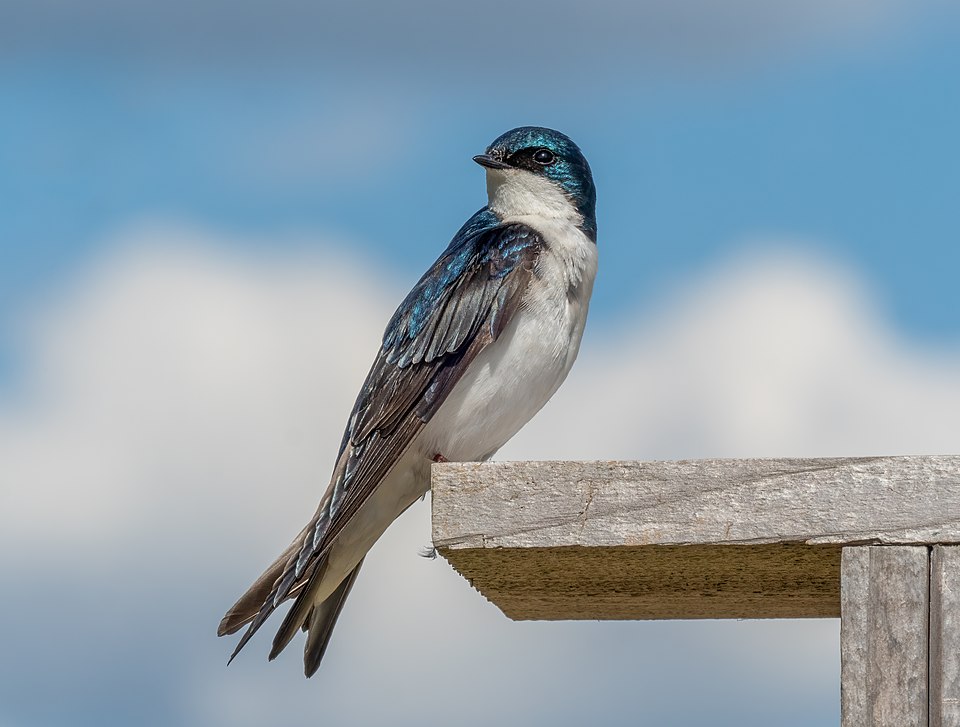
The Tree Swallow is one of the most familiar and beloved swallows across North America, a small, streamlined aerialist that catches insects on the wing over ponds, marshes, and open fields. Adults gleam an iridescent blue-green on the back and head that flashes like polished metal in good light, set off by clean, snow-white underparts. For many backyard birders, this is the swallow that takes over a nest box in spring, perching on the entrance hole and chattering its bright, liquid notes from the first warm days of the season.
Beyond its good looks, the Tree Swallow is remarkable for its adaptability. Unlike most swallows, which eat almost nothing but flying insects, it can switch to bayberries and other fruit when cold snaps ground the bugs. That dietary flexibility lets it winter farther north than any other American swallow and arrive on its breeding grounds weeks ahead of its relatives. Its eagerness to use human-made nest boxes has also made it one of the best-studied songbirds on the continent, a feathered stand-in for understanding how birds breed, migrate, and respond to a changing climate.
Tree Swallows are small, compact birds with the classic swallow build: a short, slightly notched tail, long pointed wings, a tiny flat bill, and a smooth, fast, gliding flight. At rest the wingtips reach about to the tail tip. The crisp two-tone pattern, dark above and bright white below with no streaking, is the quickest way to separate them from most other swallows.
| Upperparts | Iridescent blue-green to blue-black, shining like metal in sunlight; can look plain blackish in dull light |
| Underparts | Clean, unbroken white from chin to undertail, with no streaks, spots, or breast band |
| Face | Dark cap extends down to just below the eye; the dark/white border is sharp and falls right at eye level |
| Wings & tail | Long, pointed wings; short, only slightly forked tail (shallow notch, not deep streamers) |
| Bill & legs | Very small, flat black bill; short dark legs, usually seen only when perched at a nest box |
| Size | Small swallow, a touch larger and chunkier than a Bank or Barn Swallow's slim build |
Male vs. female
Adult males and females look broadly alike, both showing the brilliant blue-green back and white underparts, so they are tricky to tell apart in the field. The surest difference is subtle: adult females, especially younger breeders, often show slightly duller, greener, or more brownish-tinged upperparts than the glossy males. Females can take two or even three years to acquire the full adult blue-green sheen, which is unusual among songbirds. A bird in dull brown-and-white plumage in summer near a nest is more likely to be a breeding female than a male.
Juveniles
Juvenile Tree Swallows are easy to misidentify because they lack all the iridescent color: they are plain gray-brown above and white below, looking quite different from glossy adults. Their key field mark is a diffuse, dusky grayish wash across the upper breast, a smudgy partial band that can recall a Bank Swallow but is far less crisp and never forms a clean dark collar. By their first spring most have begun showing some blue-green feathering, and the brown-and-white look is mostly a feature of fledglings and birds on fall migration.
Tree Swallows are cheerful, talkative birds, especially around the nest. The song is a bright, liquid series of chirps, gurgles, and whistled notes, often rendered as chirp, chirp-chirp, weet-trit-weet, delivered rapidly and with a sweet, bubbling quality. Males sing most actively at dawn, sometimes well before first light, while perched on the nest box or circling above it.
Their everyday contact calls are a liquid, slightly metallic chee-deep or silip given in flight, and an agitated, buzzy chattering when a predator or rival approaches the nest. The overall impression is musical and conversational rather than harsh, a soft, watery twittering that carries well over open water on a calm morning.
Tree Swallows breed across nearly all of Canada and the northern and central United States, from Alaska east to the Maritimes and south to about the central states, favoring open habitats near water such as marshes, lake edges, beaver ponds, wet meadows, and field edges with dead trees or nest boxes. They are absent as breeders from the deep Southeast and the arid Southwest.
They are strongly migratory but winter farther north than any other North American swallow, thanks to their ability to eat berries. Wintering birds concentrate along the southern U.S. coasts, through Florida and the Gulf states, and south into Mexico and Central America, where they gather in spectacular roosting flocks that can number in the hundreds of thousands. In late summer and fall, migrating Tree Swallows form huge swirling clouds, particularly along the Atlantic coast, that wheel down into reedbeds to roost at dusk.
For most of the year the Tree Swallow is an insect specialist, hawking flies, midges, mosquitoes, flying ants, beetles, and other small insects out of the air. It feeds on the wing in graceful, low, looping flights over water and open ground, often skimming just above the surface and even snatching insects right off the water. They frequently feed in loose flocks and will follow concentrations of emerging aquatic insects.
What sets this species apart is its fondness for fruit. When cold or rainy weather grounds flying insects, Tree Swallows readily switch to bayberries, wax myrtle, and other small fruits and seeds. This flexibility is the reason they can arrive so early in spring and linger so late in fall, when other swallows would starve, and why large wintering flocks thrive in coastal areas rich in bayberry.
Tree Swallows are cavity nesters. In the wild they use old woodpecker holes and natural cavities in dead trees (snags), especially those standing in or near water, but they took readily to human-made nest boxes and now nest abundantly in bluebird trails and backyard boxes across the continent. They are fiercely competitive for cavities and will battle bluebirds, House Wrens, and other Tree Swallows over a good site.
The female builds a cup of grasses and weed stems inside the cavity and lines it with feathers, often white ones, which she collects with obvious enthusiasm. She lays a clutch of pale, unmarked white eggs and does almost all of the roughly two-week incubation, while both parents feed the nestlings a steady supply of insects until they fledge at about three weeks old. Most pairs raise a single brood per year, occasionally attempting a second in southern parts of the range.
Tree Swallows are not feeder birds, but they are one of the easiest swallows to attract to your yard if you have the right setting: open space and, ideally, water nearby. The single best way to draw them in is a properly designed and placed nest box.
- Put up a nest box with a 1.5-inch entrance hole, mounted on a smooth pole 5-6 feet up in an open area, facing away from prevailing wind.
- Place boxes near or over water or open fields with a clear flight path; Tree Swallows avoid heavily wooded or cramped sites.
- Add a predator guard (baffle) on the pole to keep raccoons, snakes, and cats from raiding the nest.
- If bluebirds also use your yard, mount two boxes 15-20 feet apart so a Tree Swallow pair and a bluebird pair can coexist instead of fighting.
- Offer white feathers nearby in spring; Tree Swallows love them for nest lining and will chase them down in midair.
- Skip the pesticides so a healthy supply of flying insects stays available over your yard and any nearby pond.
- Violet-green Swallow: Western species with white that wraps up onto the face and sides of the rump as two white patches; greener back. Tree Swallow's white stops below the eye and lacks rump patches.
- Bank Swallow: Brown above, not iridescent, with a distinct clean brown breast band. Juvenile Tree Swallows are browner but show only a smudgy, incomplete band.
- Northern Rough-winged Swallow: Plain brown above with a dingy brownish throat and breast, never bright white below or glossy above.
- Barn Swallow: Long, deeply forked tail streamers and rusty underparts; Tree Swallow has a short, shallow-notched tail and white belly.
How do I tell a Tree Swallow from a bluebird at my nest box?
Both can be blue, but a Tree Swallow is solid white underneath with a small flat bill and long pointed wings, and it spends most of its time flying and catching insects in the air. An Eastern Bluebird has a rusty-orange breast, perches upright on wires and posts, and drops to the ground to grab insects.
Will Tree Swallows use a bluebird box?
Yes, readily. They use the same boxes with a 1.5-inch hole and often compete with bluebirds for them. A common solution is to pair two boxes 15 to 20 feet apart so a Tree Swallow and a bluebird can each claim one, since both species defend a territory against their own kind but tolerate the other.
Do Tree Swallows come to bird feeders?
No. Tree Swallows eat flying insects and, in cold weather, berries, so they will not visit seed or suet feeders. The way to attract them is open space, nearby water, and a nest box rather than food.
When do Tree Swallows arrive in spring?
They are among the earliest migrant songbirds, often showing up in March or early April, weeks ahead of other swallows. Their ability to eat bayberries lets them survive early-season cold snaps when flying insects are scarce.
Why do Tree Swallows fly in such huge flocks in fall?
After breeding, Tree Swallows gather in enormous flocks to migrate and roost, sometimes hundreds of thousands of birds swirling into coastal marshes at dusk. Flocking offers safety in numbers and helps them exploit rich local food sources like emerging insects and bayberry.