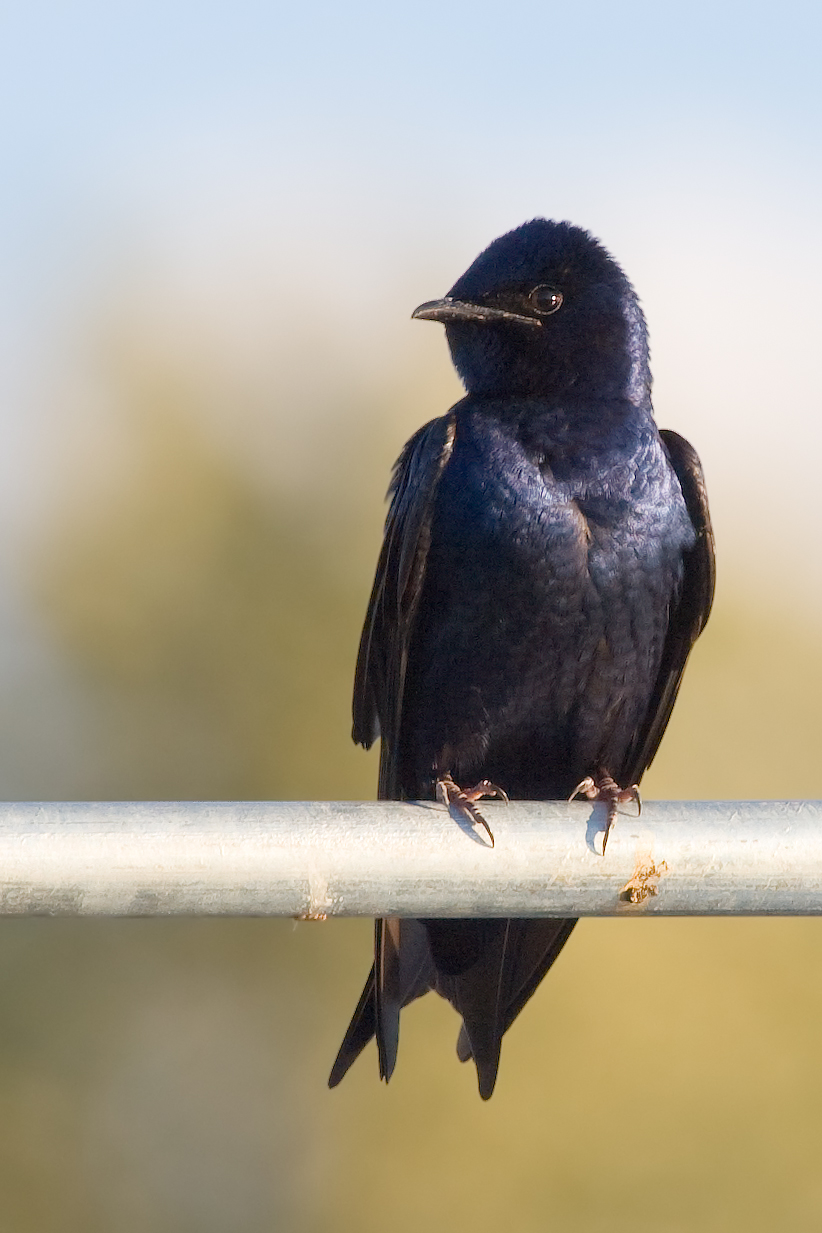
The Purple Martin is the biggest swallow in North America and one of the most beloved birds a person can host. East of the Rockies, it has become almost completely dependent on people, nesting in the clustered "martin houses" and hanging gourds that landlords put up for it. That relationship goes back centuries, which makes the martin less a wild visitor and more a returning tenant that families wait for each spring with real anticipation.
In flight, a martin is pure grace: long, tapered wings, a forked tail, and a buoyant style that alternates quick flaps with long, circling glides as it hunts insects high overhead. Adult males glow an iridescent blue-purple all over, a color so dark and saturated it can read as black until the light catches it. Beyond the looks, martins are sociable and chatty, gurgling and chirping from the housetop all day, which is a big part of why "martin people" get so attached to them.
Purple Martins are large, broad-chested swallows with long pointed wings and a moderately forked tail. They look noticeably bigger and bulkier than other swallows, and their slow, sailing glides on flat or slightly drooped wings are a good first clue even at a distance.
| Adult male | Entirely glossy blue-black with a purple sheen; the only swallow in North America that is dark all over, with no pale belly |
| Size & shape | Largest North American swallow; stocky body, broad pointed wings, forked tail, short stout bill |
| Flight style | Rapid flaps broken by long circular glides; soars more than smaller swallows |
| Female & young | Grayish below with a smudgy, mottled chest and pale belly; duller, sootier upperparts |
| Bill & gape | Short, slightly hooked, wide-gaping bill suited to catching insects in midair |
| Voice clue | Rich, gurgling, chortling calls given constantly from perches and in flight |
Male vs. female
Adult males and females are easy to separate once you know the trick: only the adult male is uniformly dark, glossed deep blue-purple from head to tail with no light underparts. Females are duller and grayer, with a dingy, lightly scaled or mottled gray throat and chest fading to a whitish belly and undertail. Their backs show some purple iridescence but mixed with brownish-gray. This makes a perched pair quite distinctive: a near-black bird beside a soft gray-and-white one.
Juveniles
Juveniles and first-year birds look much like adult females, brownish-gray above and pale below with a grayish-brown wash across the chest. Confusingly, young males do not gain full glossy plumage until they are nearly two years old, so a "female-plumaged" bird at a colony may actually be a yearling male (often called a subadult). These subadults frequently show a few random dark blue-purple feathers blotched in among the gray, which is a reliable sign you're looking at a young male rather than an adult female.
Purple Martins are wonderfully vocal, and the sound of a colony is one of the great pleasures of hosting them. Their everyday song is a rolling series of rich, liquid gurgles and chortles, often described as pew-pew notes tumbling into a low, throaty, almost laughing churr. Males give a more elaborate "dawn song," a complex croaking, gurgling phrase delivered high in the predawn dark, thought to help attract other martins to the colony.
Common calls include a clear, downslurred cher or chew used as a contact note, and a sharp, rattling alarm call when a hawk or other threat appears overhead. The overall impression is bubbly and conversational rather than melodic, a constant background chatter from birds coming and going at the housetop.
Purple Martins breed across much of the eastern United States and southern Canada, with scattered populations in the West and a desert subspecies in the Southwest that nests in saguaro cavities. They are long-distance migrants and one of our earliest spring arrivals: the first "scouts" reach the Gulf Coast in late January and February, with the wave pushing north into the upper Midwest and Canada through April and May.
Every fall the entire population funnels to South America, gathering first in enormous premigratory roosts that can hold tens of thousands of birds before crossing the Gulf of Mexico. They winter mainly in the Amazon Basin of Brazil and surrounding countries, then turn around and do it all again. Note that the familiar "scout" is simply the first adult to return to a known site, not a bird sent ahead to report back.
Purple Martins are aerial insectivores, meaning they catch and eat flying insects almost entirely on the wing. Their diet is a broad mix of dragonflies, flies, beetles, wasps, flying ants, moths, and other airborne bugs, often taken surprisingly high in the sky where the day's insects rise on warm air. They drink and even bathe in flight, skimming low over ponds to dip the water's surface.
A popular myth credits martins with eating thousands of mosquitoes a day; in truth mosquitoes make up only a tiny part of their diet, since martins feed high and by day while mosquitoes hug the ground at dusk. Their real value is as voracious general insect predators. Because they depend completely on flying insects, prolonged cold, wet weather in spring can be deadly, cutting off their food supply for days at a time.
East of the Rockies, Purple Martins nest almost exclusively in human-supplied housing: multi-compartment martin houses and clusters of hollow gourds raised on poles in open areas. This colonial habit is what makes them such rewarding birds to host. In the West and in the desert Southwest, martins still nest the old-fashioned way, in natural tree cavities and old woodpecker holes in saguaros.
Both sexes build the nest of grass, twigs, and mud, and many martins add green leaves, which may help control parasites. The female lays a clutch of white eggs and does most of the incubating for about 15-18 days; both parents then feed the nestlings, which fledge roughly four weeks after hatching. Most pairs raise a single brood per year. Successful colonies depend heavily on landlords managing competition from House Sparrows and European Starlings, which will take over and destroy martin nests if allowed.
The Purple Martin is the ultimate backyard bird in one specific sense: in the East it will not nest anywhere except housing you provide, so hosting a colony is genuinely up to people. It is not a feeder bird (it eats only flying insects), but if you have open space and patience you can become a martin landlord.
- Put up a multi-compartment house or a cluster of gourds on a tall, easily lowered pole (about 12-20 ft), since martins are colonial and want neighbors.
- Choose a wide-open site at least 30-40 ft from buildings and trees, ideally near water; martins need clear flyways and dislike crowding by foliage.
- Aggressively control House Sparrows and starlings with starling-resistant entrance holes and by removing their nests, or martins will be driven out.
- Time your opening to your region's arrival; in the South open housing by late winter, farther north by April or May, and consider waiting to attract subadults if you have no colony yet.
- Add predator guards on the pole to stop snakes, raccoons, and cats, and owl/hawk guards if needed; predation can wipe out a young colony.
- Be patient: establishing a new colony often takes a season or two, and playing recorded dawn song can help draw passing birds down.
- Tree Swallow: Much smaller and slimmer; iridescent blue-green above with a clean white belly, never dark underneath like a male martin.
- Barn Swallow: Smaller and slimmer with a deeply forked tail, rusty throat, and cinnamon underparts; never the uniform dark of a martin.
- European Starling: Similar dark glossy look at a glance but has a longer pointed yellow bill, short triangular tail, and direct, non-soaring flight.
- Tree Swallow: Western swallow with green back and white face patches; far smaller and paler-bellied than a Purple Martin.
Do Purple Martins really eat thousands of mosquitoes a day?
No, that's a long-standing myth. Martins feed high in the air during the day, while mosquitoes stay low and are active mostly at dusk, so mosquitoes are only a tiny fraction of their diet. Martins are still valuable, eating large numbers of flies, beetles, dragonflies, wasps, and flying ants.
How do I attract Purple Martins to my yard?
Put up a multi-compartment martin house or a cluster of gourds on a tall, easily lowered pole in a wide-open area at least 30-40 feet from buildings and trees, ideally near water. Open it at the right time for your region, control House Sparrows and starlings, and add predator guards. New colonies often take a year or two to establish.
What is the difference between a male and female Purple Martin?
Adult males are entirely glossy blue-black with a purple sheen and no pale belly, making them the only all-dark swallow in North America. Females are grayer, with a dingy mottled chest and a whitish belly. Young males look female-like for nearly two years but often show a few stray dark purple feathers.
When do Purple Martins arrive in spring?
It depends on latitude. The first 'scouts' reach the Gulf Coast in late January and February, and the migration pushes north through March, April, and into May, reaching the upper Midwest and Canada last. Open your housing a bit before martins are expected in your area.
Why do my martin houses attract sparrows and starlings instead?
House Sparrows and European Starlings are aggressive cavity competitors that will occupy and destroy martin nests. They are not protected, so landlords should remove their nests and use starling-resistant entrance holes. Without active management, these invaders can prevent martins from ever colonizing.