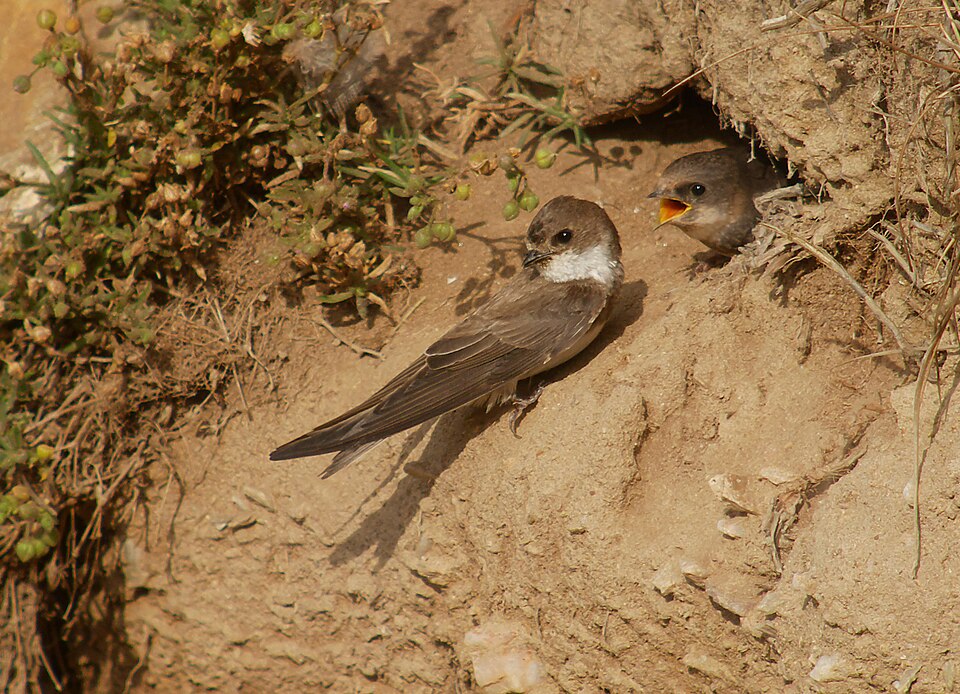
The Bank Swallow is the tiniest swallow in North America, a brown-and-white sprite that swarms over rivers, lakes, and gravel pits in restless, twittering flocks. What it lacks in flashy color it makes up for in lifestyle: these birds nest in dense colonies, tunneling burrows into the vertical faces of sandy banks, eroding bluffs, and quarry walls. A busy colony in summer is a remarkable sight, with dozens or hundreds of birds streaming in and out of a honeycomb of holes.
Found on nearly every continent, the Bank Swallow is one of the most widespread songbirds on Earth (it is known as the Sand Martin across Europe and Asia). Despite that broad range, North American populations have declined sharply over recent decades, partly because the raw, crumbling earthen banks they need are often stabilized, mined away, or lost to shoreline development. Spotting a colony is a reminder that even abundant birds depend on very specific, sometimes fragile, conditions.
Think small, slim, and brown. The Bank Swallow has a compact body, long pointed wings, and a notched tail, and it flies with quick, fluttery, almost erratic wingbeats rather than the smooth glides of larger swallows. The single best field mark is a clean brown band across a white chest.
| Breast band | A distinct brown band crossing the white underparts is the diagnostic mark, often looking like a smudgy collar or necklace. |
| Upperparts | Plain grayish-brown above with no gloss or iridescence, unlike the blue-backed Tree and Barn Swallows. |
| Throat | White throat that wraps up behind the cheek, contrasting with the brown band below and the brown cheek above. |
| Size and shape | Smallest North American swallow, slim-bodied with long narrow wings and a shallowly notched tail. |
| Flight | Fast, fluttery, somewhat jerky wingbeats; flies low over water with frequent quick direction changes. |
| Underwing | Pale below with a slightly darker undertail, lacking any rusty or buffy wash on the belly. |
Male vs. female
Males and females look alike. There is no reliable difference in plumage, size, or color between the sexes in the field, so a lone bird cannot be sexed by sight. Both sexes share the brown upperparts, white throat, and brown breast band. In the hand, breeding females may show a developed brood patch, but for backyard and field observers the sexes are effectively identical.
Juveniles
Juvenile Bank Swallows resemble adults but look slightly warmer and scalier above, with pale buffy or cinnamon edges to the feathers of the back and wings that can give a faintly fringed appearance. The breast band is usually present but may be softer or more diffuse, and the throat can show a faint buffy tint rather than crisp white. These edgings wear away over the first months, so by late summer young birds look much like adults.
The Bank Swallow is not a songster in the musical sense. Its voice is a dry, buzzy, grating chatter, often written as a harsh brrrt or tschr-tschr, with a distinctly insect-like, scratchy quality. Birds give these notes constantly in flight, and a colony produces a low, continuous buzz of overlapping calls.
Listen for a rougher, more electric sound than the sweeter twitters of Tree or Barn Swallows. The flight call is a short, rasping speet or jrrt, and excited birds near the burrows run these notes together into a rapid, churring rattle.
Bank Swallows breed across much of North America, from Alaska and across Canada south through the northern and central United States wherever suitable earthen banks occur. They are long-distance migrants, wintering in South America, and they pass through the southern U.S. and Mexico in spring and fall.
Migration is a notable spectacle: large flocks gather over wetlands, lakeshores, and river valleys, often mixing with other swallow species. They arrive on breeding grounds from mid-spring and depart relatively early, with southbound movement underway by mid- to late summer once young have fledged. Globally the same species (the Sand Martin) breeds across Europe and Asia and winters in Africa and southern Asia.
Bank Swallows are aerial insectivores, catching nearly all their food on the wing. They feed low over water and open ground, snapping up flying insects such as midges, mosquitoes, flies, flying ants, small beetles, mayflies, and other soft-bodied prey. Water-rich habitats are favored because they produce dense clouds of emerging insects.
They forage in loose, fast-moving flocks, coursing back and forth just above the surface with quick turns and dips. During cold or wet spells when flying insects are scarce, the whole colony may forage together over the best available patch, and prolonged bad weather can cause local hardship since these birds have little to fall back on besides airborne prey.
Nesting is the most distinctive thing about this bird. Bank Swallows are colonial burrow-nesters, excavating tunnels into vertical or near-vertical faces of sand, silt, or fine gravel, such as river cutbanks, eroding lake bluffs, road cuts, and active sand and gravel pits. Both members of a pair dig the burrow, using their bill and feet to work a tunnel that often runs a foot or two (sometimes more) horizontally into the bank, ending in a chamber lined with grass, rootlets, and feathers.
Colonies range from a handful of pairs to many hundreds of closely spaced burrows. The female lays a clutch of typically 3 to 5 white eggs, and both parents incubate for roughly two weeks, then feed the nestlings until they fledge a few weeks later. Because they depend on raw, eroding banks that are constantly reshaped by water, colonies frequently shift location from year to year as old banks slump and new ones are exposed.
The Bank Swallow is not a backyard or feeder bird, and there is no food you can put out to draw one in. It eats only flying insects and nests communally in bare earthen banks, so attracting it is about habitat at a landscape scale rather than anything you can offer in a yard.
- This species will not visit feeders or birdhouses; it nests only in self-dug burrows in vertical earthen banks, not in boxes.
- To see them, visit the right habitat: sandy river cutbanks, lake bluffs, and active gravel pits near water, especially in late spring and summer.
- Scan low over rivers, ponds, and wetlands at dusk when swallows gather to feed on emerging insects.
- If you own riverfront or pit land, you can help by leaving bare, eroding banks unstabilized rather than armoring or planting them over.
- Bring binoculars and watch for the brown breast band to separate them from the similar Northern Rough-winged Swallow.
- Look for active colonies as a honeycomb of holes in a bank face, but observe from a distance so you do not disturb nesting birds.
- Northern Rough-winged Swallow: Also brown above, but has a dingy brownish throat that blends into a plain chest with NO clean breast band; flies with smoother, more relaxed wingbeats.
- Tree Swallow: Larger, with glossy blue-green upperparts and bright clean white underparts; lacks any brown breast band.
- Barn Swallow: Larger with a deeply forked tail, steely blue back, and rusty throat and underparts; never plain brown above.
- Cliff Swallow: Stockier with a pale forehead, rusty rump, and square tail; builds mud nests under eaves and bridges rather than digging burrows.
How do I tell a Bank Swallow from a Northern Rough-winged Swallow?
Look at the chest. The Bank Swallow has a clean, distinct brown band across a white breast, while the Northern Rough-winged Swallow has a dingy brown throat that fades into a plain chest with no band. Bank Swallows are also smaller and flutter more, and they nest in dense colonies, whereas rough-wingeds nest singly or in small numbers.
Why do Bank Swallows dig burrows in dirt banks?
They are natural cavity nesters that excavate their own tunnels in vertical faces of sand, silt, or fine gravel. The tunnel and end chamber protect eggs and chicks from weather and many predators. They need raw, eroding banks because firm, vegetated, or stabilized ground is too hard to dig and too exposed to predators.
Are Bank Swallows endangered?
Globally the species is listed as Least Concern and remains widespread, but North American populations have declined significantly over recent decades. Much of the decline is tied to the loss of natural eroding banks through shoreline stabilization, development, and changes in gravel mining, which removes the very nesting habitat they depend on.
Where can I see a Bank Swallow colony?
Look at vertical earthen faces near water: river cutbanks, eroding lake bluffs, road cuts, and active sand or gravel pits, especially from late spring through summer. An active colony looks like a cluster of holes in the bank with small brown swallows streaming in and out. Watch from a distance so you do not disturb nesting birds.
Do Bank Swallows use birdhouses or nest boxes?
No. Unlike Tree Swallows and Purple Martins, Bank Swallows will not use boxes. They nest only in burrows they dig themselves in bare vertical banks, so the best way to help them is to protect natural and man-made earthen banks rather than offering structures.