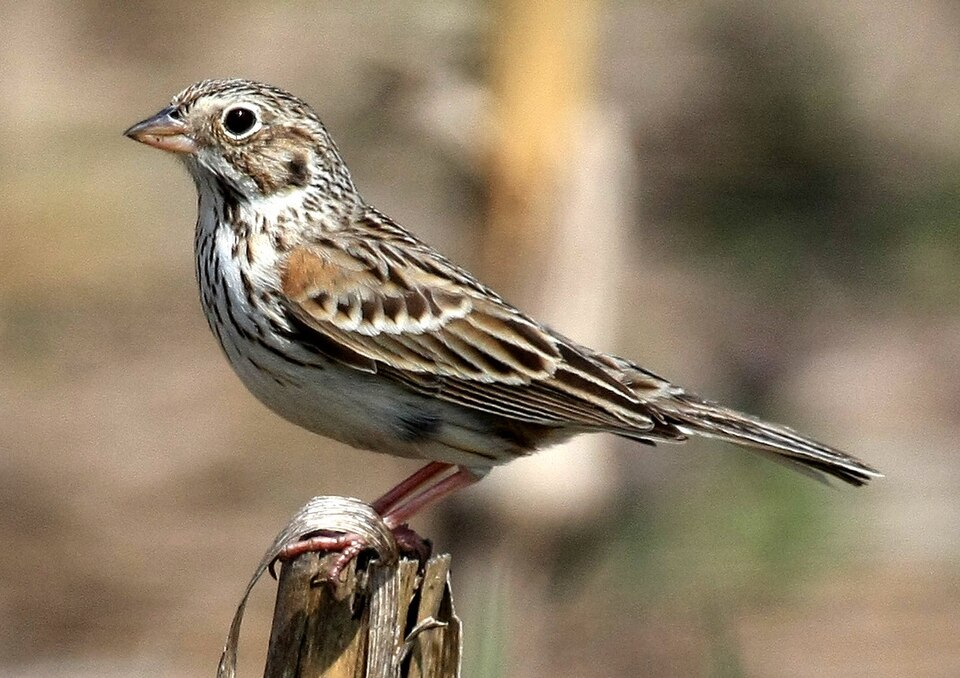
The Vesper Sparrow is a sturdy, streaky brown sparrow of open country, the kind of bird that flushes from a roadside, flashes white in the tail, and drops back into the weeds before you can get your binoculars up. It earned its poetic name from the 19th-century naturalist John Burroughs, who noticed it sings most enthusiastically in the fading light of evening, around the hour of vespers. That habit of pouring out a rich, musical song at dusk sets it apart from the busy daytime chipping of most other grassland sparrows.
Found across the prairies, sagebrush flats, hayfields, and overgrown pastures of North America, the Vesper Sparrow is a classic "little brown job" that rewards a patient look. The two field marks that give it away, a thin white eye-ring and bright white outer tail feathers that fan open in flight, are subtle on a perched bird but unmistakable once you learn them. It's a ground-loving species through and through, nesting, feeding, and even dust-bathing on bare soil rather than in trees or shrubs.
Vesper Sparrows are medium-large, big-headed sparrows with a relatively long, notched tail and a stout, conical seed-eating bill. On the ground they look chunky and a bit dull at first glance, heavily streaked grayish-brown above and on the breast, but two clean marks and a flight flash separate them from the crowd of look-alike sparrows.
| Eye-ring | Thin but distinct white eye-ring, giving a gentle, wide-eyed expression, one of the best perched field marks |
| Tail | Bright white outer tail feathers that flash conspicuously when the bird flushes; the tail is long and notched |
| Shoulder | A small chestnut (rufous) patch at the bend of the wing, often hidden, but diagnostic when visible |
| Underparts | Whitish below with crisp dark streaking across the breast and along the flanks, fading on the belly |
| Upperparts | Streaky grayish-brown back and crown; face plain compared to many sparrows, lacking bold head stripes |
| Bill & legs | Pinkish, conical seed bill and pale pinkish legs |
Male vs. female
Male and female Vesper Sparrows look alike, there's no reliable way to tell the sexes apart in the field by plumage. Both show the same streaked brown body, white eye-ring, chestnut shoulder, and white-edged tail. Singing birds perched up on a fence post, weed stalk, or low shrub are almost always males defending a territory, so behavior is a better clue than feathers. Females tend to stay lower and more hidden, especially when tending a nest.
Juveniles
Juvenile Vesper Sparrows, seen in mid- to late summer, look much like adults but are buffier overall with finer, more diffuse streaking on the breast and a less crisp pattern. The white eye-ring and white outer tail feathers are already present, so even a young bird flushing from a field shows the key flight mark. The chestnut shoulder patch may be duller or harder to see on fresh juveniles.
The song is the Vesper Sparrow's signature, and it's genuinely beautiful, far more musical than most grassland sparrows. It typically opens with two slurred, low whistles followed by two higher ones, then breaks into a tumbling, descending series of trills and buzzes. Birders often render the opening as a clear here-here, there-there before the cascade of churry trills. The overall effect is sweet and rich, and the bird sings most persistently in the calm of dawn and especially dusk.
Its call note is a sharp, high chip or tsip, often given as the bird flushes. The song carries well across open ground, and a singing male perched on a fence wire at sunset is one of the quintessential sounds of the prairie and sagebrush evening.
Vesper Sparrows breed across a broad swath of the northern and central United States and southern Canada, from the Great Plains and Intermountain West through the upper Midwest and into the Northeast. They favor open, dry habitats: shortgrass and mixed-grass prairie, sagebrush steppe, fallow fields, hayfields, and the weedy edges of farmland.
They are migratory across most of their range, withdrawing in fall to winter across the southern United States and into Mexico, where they gather in grasslands, weedy fields, and desert scrub. Spring migration brings them back north through April and May, and breeders are typically on territory by late spring. During migration they can turn up in a wide variety of open weedy spots well outside the breeding range.
Vesper Sparrows are ground foragers that eat a seasonal mix of seeds and insects. Through much of the year, especially fall and winter, they rely on the seeds of grasses and weeds, hopping and walking over bare ground and short vegetation to pick them up. In the breeding season their diet shifts heavily toward insects and other small invertebrates, grasshoppers, beetles, caterpillars, and the like, which provide the protein needed to raise young.
They feed almost entirely on the ground, often in open, sparsely vegetated areas where they can move freely. You'll rarely see one foraging up in vegetation the way a goldfinch might. They also regularly take grit and dust-bathe in dry soil, a behavior that can give them away along quiet dirt roads.
The Vesper Sparrow is a ground nester. The female builds a cup of grasses and rootlets, lined with finer material and sometimes hair, tucked into a shallow scrape or natural depression in the soil, often sheltered beside a clump of grass, a low plant, or a dirt clod. The placement keeps the nest hidden but leaves it vulnerable to trampling and to ground predators.
A typical clutch is 3 to 4 eggs, pale and blotched with brown. Pairs commonly raise two broods in a season where conditions allow, and the female does most or all of the incubation. Both parents feed the nestlings, which leave the nest before they can fully fly, scrambling into nearby cover where the adults continue to tend them.
The Vesper Sparrow is not a typical backyard or feeder bird, it's a creature of open, dry grasslands and won't show up at a hanging seed feeder in a suburban yard. That said, there are still ways to encounter and even host them if you have the right setting.
- If you live near or own open grassland, pasture, or sagebrush, the single best thing you can do is preserve unmowed, weedy, open habitat, they need bare ground mixed with sparse vegetation.
- Delay mowing of hayfields and field margins until after the nesting season to avoid destroying ground nests and flightless young.
- On rural properties, leaving patches of bare dirt and short grass gives them places to forage and dust-bathe.
- If you do feed birds in a rural, open setting, ground-scattered white millet and cracked grains near field edges are far more likely to draw them than an elevated feeder.
- Avoid broadcast insecticides on open land, grasshoppers and beetles are critical breeding-season food.
- Watch and listen at dawn and dusk along quiet country roads bordering open fields; that's when singing males perch up and are easiest to find.
- Savannah Sparrow: Also a streaky grassland sparrow, but smaller with a shorter, more sharply notched tail, often a yellowish wash near the eye, and NO white outer tail feathers or white eye-ring.
- Song Sparrow: Larger and longer-tailed with heavier breast streaking that often forms a central spot; lacks the white eye-ring, chestnut shoulder, and white tail edges, and favors brushier, wetter habitats.
- Lark Sparrow: Shares white in the tail, but the tail shows white corners and a dark center (not white outer edges), and the head has a bold chestnut-and-white harlequin pattern Vesper Sparrows never show.
- Savannah Sparrow: Pipits also flash white outer tail feathers in open country, but they are slimmer, walk rather than hop, have thin pointed bills, and bob their tails, not a true sparrow.
Why is it called a Vesper Sparrow?
The name comes from its habit of singing most enthusiastically at dusk, around the time of evening prayers known as vespers. The naturalist John Burroughs popularized the name after noticing how the bird's rich song carries through the calm of fading light.
How do I tell a Vesper Sparrow from a Savannah Sparrow?
Look at the tail and eye. A Vesper Sparrow flashes white outer tail feathers in flight and shows a clean white eye-ring and a small chestnut shoulder patch. A Savannah Sparrow is smaller, lacks white in the tail, has no white eye-ring, and often shows a yellowish smudge in front of the eye.
What does a Vesper Sparrow's song sound like?
It's sweet and musical, typically two low slurred whistles followed by two higher ones, then a tumbling cascade of trills and buzzes. Birders often describe the opening as a clear here-here, there-there before the song breaks into churry trills, sung especially at dawn and dusk.
Will Vesper Sparrows come to my feeder?
Usually not. They are open-grassland birds that forage on the ground and rarely visit suburban feeders. In rural settings near open fields, ground-scattered white millet or cracked grain at a field edge gives you the best chance, but they are far more often seen along quiet country roads than in yards.
Where do Vesper Sparrows go in winter?
They migrate south to spend the winter across the southern United States and into Mexico, gathering in grasslands, weedy fields, and desert scrub. They return north to breed across the northern U.S. and southern Canada in spring, typically arriving through April and May.