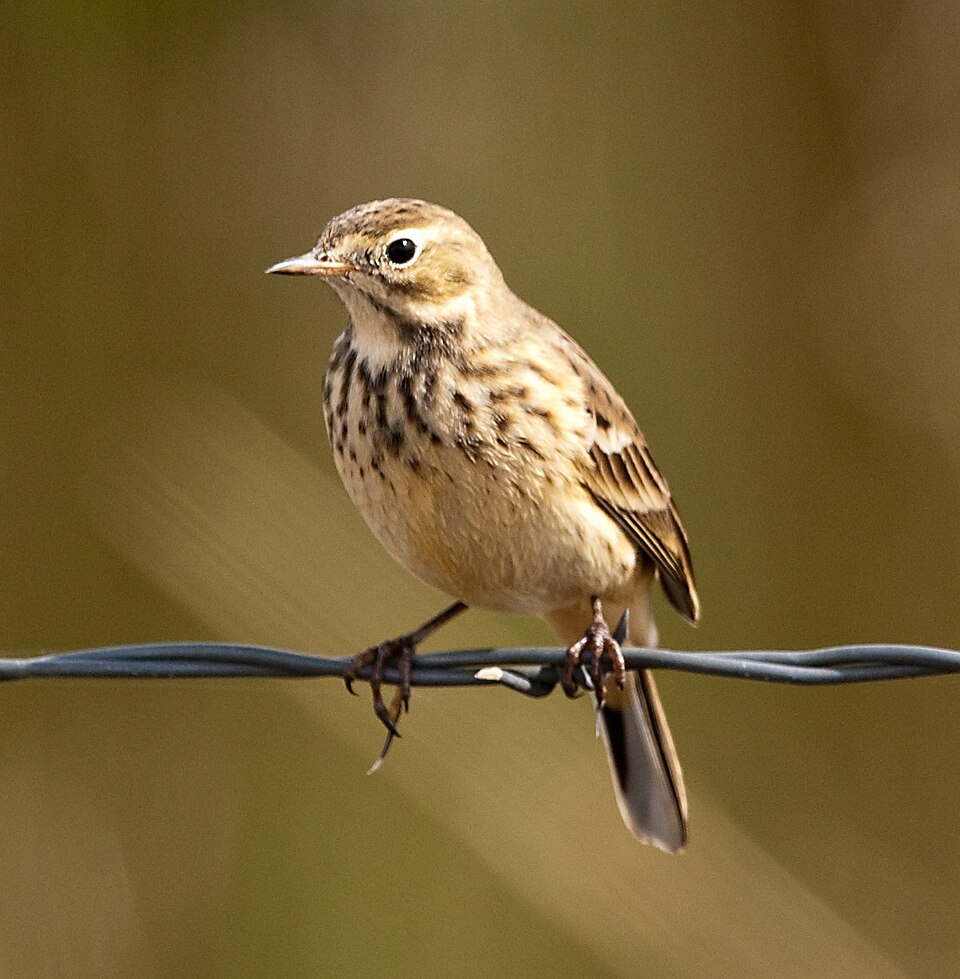
The American Pipit is a slim, sparrow-sized songbird that earns a second look mostly through its restless habits rather than flashy color. Dressed in muted grays and buffs, it spends its life walking, not hopping, across open ground while constantly bobbing its tail up and down. If you spot a brownish bird strolling across a bare field, a muddy shoreline, or a rain-soaked parking lot in fall and winter, pumping its tail with every few steps, there is a good chance you are looking at a pipit.
Despite its plain looks, this is a bird of dramatic places. It breeds on windswept arctic and alpine tundra, often above treeline among the rocks and low mats of vegetation where few other songbirds nest. Come autumn it pours south in loose, twittering flocks to spend the colder months on farm fields, beaches, and flooded pastures across much of the United States and Mexico. Watching a flock flush and scatter in bounding, undulating flight, all the while giving their sharp pip-it calls, is one of the quiet pleasures of open-country birding.
Pipits are built for life on the ground: slender bodies, long legs, a thin pointed bill, and a relatively long tail with white outer feathers that flash in flight. The constant tail-wagging and a walking (rather than hopping) gait are the quickest ways to separate a pipit from the sparrows it often shares fields with.
| Overall | Slim, streamlined ground bird with a thin bill and long tail, larger and lankier than a sparrow |
| Tail | Long, edged with white outer feathers that show as it flushes; pumped up and down almost constantly |
| Underparts | Buffy to whitish below with variable streaking on the breast and flanks (heavier in winter, often plainer in summer) |
| Upperparts | Plain grayish-brown back with little patterning; breeding birds can show a warm buff face and breast |
| Legs | Dark in most birds, though leg color varies; long and made for walking |
| Eyebrow | Pale supercilium (eyebrow stripe) giving a gentle, open-faced look |
Male vs. female
Male and female American Pipits look essentially identical in the field. There is no reliable plumage difference you can pick out at normal viewing distance, so birders do not attempt to sex them visually. Both sexes show the same gray-brown upperparts, streaky buff underparts, white outer tail feathers, and the signature tail-wagging behavior.
Juveniles
Recently fledged juveniles look much like adults but tend to be a bit more crisply and heavily streaked above and below, with a slightly scalier, more patterned back before their first molt. By the time most people encounter pipits in migration and winter, young birds have largely sorted into the streaky, buff-and-brown nonbreeding look shared by all ages, so distinguishing a first-year bird from an adult in the field is rarely practical.
The most familiar sound is the flight call that gives the bird its name: a thin, sharp pip-it or pi-pit, often given repeatedly as flocks fly over or flush from a field. Once you learn it, you will start picking pipits out of the sky overhead during fall migration even when you never see the birds.
On the breeding grounds the male performs a flight song display, climbing high into the air and then parachuting down on stiff, set wings while delivering a long, tinkling, repetitive series, often written as chwee-chwee-chwee-chwee or a rapid cheedle-cheedle-cheedle. The song is simple and somewhat monotonous but carries well across the open tundra where there is little to muffle it.
The American Pipit breeds across the Arctic tundra of Alaska and northern Canada and southward along the high alpine zones of the Rocky Mountains and other western ranges, nesting above treeline where summers are short. It is a long-distance migrant that largely abandons these breeding areas in winter.
In fall and winter it spreads widely across the southern United States, Mexico, and Central America, favoring open habitats: plowed and stubble fields, shortgrass pastures, mudflats, lakeshores, beaches, and even airport edges and large parking lots. Migration brings the species through nearly the entire Lower 48, so a flock walking across a winter field is possible far from any mountain or tundra.
American Pipits are primarily insectivores. They feed by walking steadily across open ground, picking small insects, spiders, and other invertebrates from the soil surface, low vegetation, and the edges of water. On the breeding grounds they take advantage of the brief flush of arctic and alpine insects, including flies, beetles, and their larvae.
In migration and winter the diet broadens to include seeds and waste grain from harvested fields, especially when cold weather makes insects scarce. Shorelines and mudflats are favorite winter feeding spots, where pipits glean tiny aquatic insects and other invertebrates at the water's edge, often in loose flocks that drift across the open ground together.
Nesting takes place on the ground in open tundra and alpine meadows, where the female builds a cup of grasses and sedges tucked into a natural hollow, often sheltered beside a rock, tuft of vegetation, or overhanging bank to break the wind. The nest is lined with finer grasses and sometimes hair.
A typical clutch is several eggs, grayish or buff and heavily marked with brown speckling and blotches. The female does most or all of the incubation, and both parents feed the nestlings on a steady supply of insects. In the short northern summer the pair may attempt one brood, with the timing tightly compressed to fit the brief window when food is abundant.
The American Pipit is not a backyard or feeder bird in any practical sense. It is a bird of wide-open ground, not gardens, and it will not visit seed feeders or nest boxes. Instead of trying to attract it, the way to enjoy pipits is to go where they are and learn their habits.
- Scan open habitats in fall and winter: plowed fields, stubble, shortgrass pastures, mudflats, and beaches are prime pipit territory.
- Watch for the tail-wagging walk on bare ground, which instantly separates pipits from hopping sparrows.
- Learn the sharp pip-it flight call so you can detect flocks passing overhead during migration.
- Check flooded fields and shorelines after rain, where pipits gather to feed at the water's edge.
- Bring binoculars and patience; pipits often feed at a distance and flush in loose, bounding flocks, so let them settle and watch their gait.
- Horned Lark: Shares open fields and a walking gait, but has bold black face markings, a yellow wash, and tiny horn tufts; it does not constantly pump its tail.
- Vesper Sparrow: Also shows white outer tail feathers in flight, but it is a chunkier sparrow with a thick conical bill, a chestnut shoulder patch, and a hopping habit rather than the pipit's thin bill and tail-wagging walk.
- Sprague's Pipit: A close relative of grasslands; it is buffier with a scalier back and pale legs, behaves more secretively, and does not wag its tail nearly as much as the American Pipit.
- Savannah Sparrow: A streaky open-country sparrow often in the same fields, but it has a stout seed-eating bill, frequently a yellow eyebrow, and lacks the pipit's slim shape and persistent tail bob.
Why does the American Pipit constantly wag its tail?
Tail-wagging (or pumping) is a hallmark pipit behavior, used while walking and feeding on open ground. Its exact purpose is debated, with ideas ranging from flushing insect prey to signaling alertness to predators, but for birders the constant up-and-down motion is one of the most reliable ways to identify a pipit at a glance.
Is the American Pipit a sparrow?
No. Although it lives in open fields alongside sparrows and is similar in size, the American Pipit belongs to the pipit and wagtail family (Motacillidae), not the sparrow family. Its thin, pointed bill, slender build, walking gait, and tail-wagging set it apart from the stout-billed, hopping sparrows.
When and where can I see American Pipits?
Most people see them in fall and winter, when pipits leave their arctic and alpine breeding grounds and spread across open habitats farther south. Look on plowed fields, stubble, pastures, mudflats, shorelines, and beaches, often in loose flocks that walk across bare ground and flush with a sharp pip-it call.
How do I tell an American Pipit from a Horned Lark?
Both walk on open ground, but the Horned Lark has a boldly marked black-and-yellow face with tiny feather horns and does not pump its tail. The American Pipit is plainer brown, has a thin bill and pale eyebrow, flashes white outer tail feathers, and wags its tail almost constantly.
Where do American Pipits nest?
They nest on the ground in remote places, on arctic tundra across Alaska and northern Canada and on high alpine meadows above treeline in the western mountains. The female builds a grassy cup sheltered beside a rock or tuft of vegetation, well away from the lowland fields where the species spends the winter.