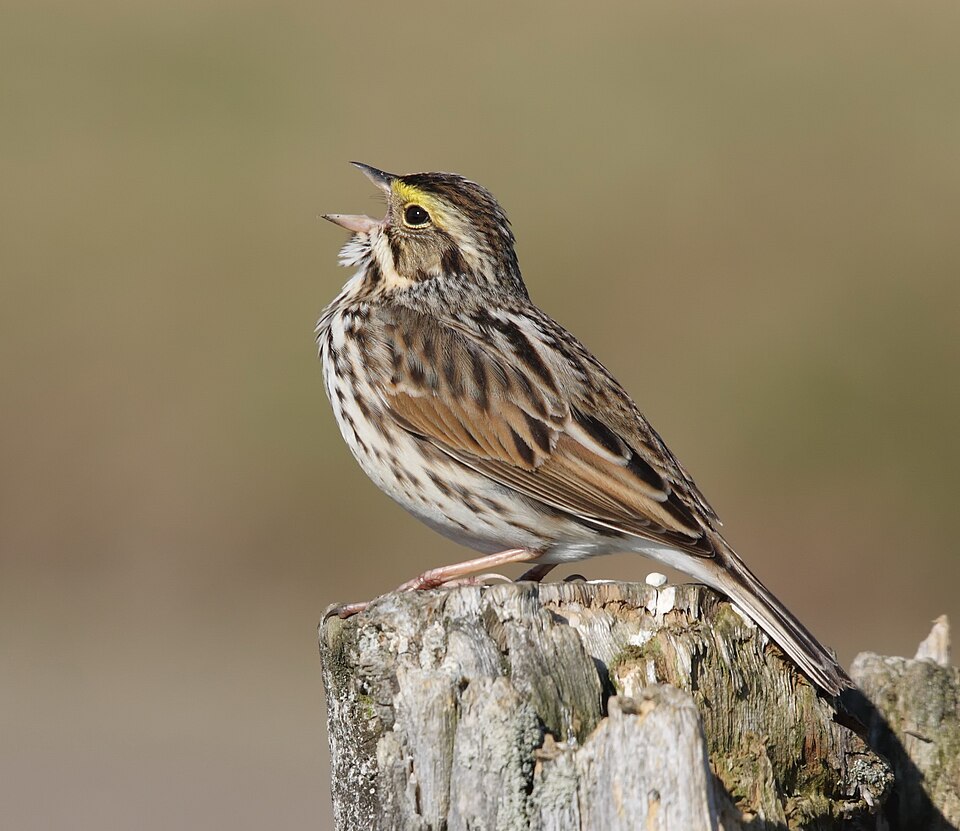
The Savannah Sparrow is one of the most widespread open-country sparrows in North America, and once you learn it, you'll start seeing it everywhere: perched on a fencepost over a hayfield, flushing from a grassy roadside, or singing from a weed stalk in a coastal marsh. It is a small, streaky brown sparrow that can be easy to write off as "just another little brown bird," but it carries a couple of reliable field marks that set it apart, the most famous being a wash of yellow in front of the eye. Despite the name, it has nothing to do with savannas in the tropical sense, it was named after Savannah, Georgia, where an early specimen was collected.
This is a bird of grasslands, meadows, pastures, tundra edges, and salt marshes rather than woods or backyards, and it thrives in the kind of weedy, open habitat that many other species avoid. It is abundant across its range and shows remarkable geographic variation, with everything from pale interior birds to the very large, gray "Ipswich" form of the Atlantic coast and dark, heavy-billed coastal forms in the West. For backyard birders, it is more of a "learn it on a walk" species than a feeder visitor, but it rewards attention with a charming, buzzy song and a satisfying ID once the yellow eyebrow clicks into place.
The Savannah Sparrow is a small, compact, short-tailed sparrow with a relatively flat-headed look and a notched tail. It is heavily streaked brown above and below, but the streaking is crisp and well organized rather than messy, and its overall impression is of a neat, alert little bird that often crouches low in the grass before flushing.
| Yellow lores | A yellow or yellowish wash in the eyebrow just in front of the eye is the classic mark; it varies in intensity and can be faint, but when present it is diagnostic. |
| Streaked breast | Fine, dark brown streaks across the breast and flanks, often converging toward a small central breast spot. |
| Tail | Short and notched, giving a stubby look in flight, unlike the long, rounded tail of Song Sparrow. |
| Head pattern | A pale median crown stripe, dark lateral crown stripes, and a pale eyebrow give a striped-face appearance. |
| Pink legs | Legs and feet are pale pinkish, a useful supporting clue. |
| Size and shape | Smaller and more compact than a Song Sparrow, with a flatter crown and shorter tail. |
Male vs. female
Males and females look essentially alike; there is no reliable plumage difference you can pick out in the field. Both sexes show the streaked brown plumage, striped face, and yellow lores. Males do the singing, so a bird belting out a buzzy song from an exposed perch in spring is almost certainly a male, but you cannot sex a silent perched bird by appearance alone.
Juveniles
Juveniles look much like adults but are buffier overall, with fuzzier, softer-edged streaking and often little or no yellow in the lores, which can make them confusing in late summer. They show the same general striped face and short notched tail, and by their first fall they molt into a plumage nearly identical to adults, including the developing yellow eyebrow.
The song is the easiest way to confirm a Savannah Sparrow once you know it. It is a high, thin, buzzy phrase that sounds almost insect-like, often written as tsip-tsip-tsip-seeeee-saaay or tsit tsit tsit tseee tsaaaay, with two or three short introductory notes followed by a buzzy trill that drops at the end. Many birders describe it as easy to overlook because it blends in with the buzz of grasshoppers and katydids on a warm day.
The common call note is a thin, high tsip or seep, given when the bird is flushed or moving through grass. These short contact notes are easy to miss but are a good clue that sparrows are present in a field.
Savannah Sparrows breed across an enormous swath of northern North America, from Alaska and across nearly all of Canada south through the northern and central United States, including the Great Plains, the Mountain West, the Upper Midwest, and the Northeast. They favor open grassy habitats throughout: meadows, hayfields, pastures, prairie, tundra, and coastal grasslands.
They are strongly migratory in the northern part of the range, moving south in fall to winter across the southern United States, the Pacific Coast, and Mexico, with some reaching Central America and the Caribbean. In parts of the West and along temperate coasts, populations are year-round residents. During migration and winter they are common in weedy fields, roadsides, agricultural land, and salt marshes, often in loose groups.
Savannah Sparrows eat a mix of insects and seeds, shifting seasonally. In the breeding season they take large numbers of insects and other small invertebrates, including beetles, grasshoppers, caterpillars, spiders, and other soft-bodied prey, which provide the protein needed for raising young. In fall and winter they switch heavily to seeds, especially the seeds of grasses and low weeds.
They forage mostly on the ground, walking and hopping through grass and along bare patches, gleaning food from the soil surface and low vegetation. Coastal birds also feed along the wrack line and in salt marshes, picking at small invertebrates. They tend to stay low and out of sight while feeding, flushing up to a fencepost or weed stalk when disturbed.
Savannah Sparrows nest on the ground, a habit typical of grassland sparrows. The female builds a cup nest of grasses, often tucked into a depression and well hidden under a clump of vegetation, sometimes with a partial canopy of grass overhead and a runway leading in. This concealment makes nests very hard to find and helps protect them from predators.
A typical clutch is three to five eggs, pale with brown speckling, and pairs often raise two broods per year where the season is long enough. The female does most or all of the incubation, which lasts roughly twelve days, and both parents feed the nestlings. Young leave the nest before they can fly well, scattering into the grass where the adults continue to feed them.
The Savannah Sparrow is not really a backyard or feeder bird, so the honest answer is that you usually go to it rather than expecting it to come to you. It is a grassland specialist that wants open, weedy, grassy space, not trees, lawns, or hanging feeders. That said, there are still ways to encounter it and, if you have the right property, to give it habitat.
- Look in the right habitat: grassy meadows, hayfields, pastures, prairie, and coastal salt marshes are where you'll reliably find them, not wooded yards.
- Leave grass unmowed if you have acreage; tall native grasses and weedy field edges provide the nesting and foraging cover they need.
- Check fences and weed stalks in spring and summer, where singing males perch in the open to deliver their buzzy song.
- Scatter seed on open ground rather than using elevated feeders if your property borders open fields; migrants and wintering birds forage low on bare soil.
- Avoid pesticides on open land, since insects are critical food for breeding birds and their young.
- Bird them in migration and winter along weedy roadsides and agricultural fields, where they gather in loose flocks.
- Song Sparrow: Larger and longer-tailed with a rounded tail (not notched), bolder messy streaking that converges into a heavy central breast spot, and no yellow lores. Its song is musical and varied, not buzzy.
- Vesper Sparrow: Grayer overall with a bold white eye-ring, chestnut shoulder patch, and white outer tail feathers that flash in flight; lacks the yellow lores.
- Lincoln's Sparrow: Has a buffy wash across the finely streaked breast and a buffy malar stripe, a grayer face, and no yellow lores; tends to be shy and skulky in dense cover.
- Grasshopper Sparrow: Flat-headed with a plain, unstreaked buffy breast, a short tail, and a thin insect-like song; lacks the breast streaking of Savannah Sparrow though it may show yellow at the bend of the wing.
How do I tell a Savannah Sparrow from a Song Sparrow?
Look at the tail and the face. Savannah Sparrows have a short, notched tail, crisp fine streaking, and usually a yellow wash in front of the eye. Song Sparrows are larger with a longer, rounded tail, messier streaking with a bold central breast spot, and no yellow lores. Their songs also differ: Savannah is buzzy and insect-like, Song Sparrow is musical and varied.
Why is it called a Savannah Sparrow if it doesn't live in savannas?
It is named after the city of Savannah, Georgia, where an early specimen was collected and described, not after savanna habitat. The bird actually favors grasslands, meadows, pastures, and salt marshes across North America.
Do Savannah Sparrows come to bird feeders?
Not usually. They are ground-feeding grassland birds and rarely visit elevated feeders. If your property borders open fields, you may occasionally see migrants or wintering birds foraging on seed scattered on bare ground, but they are far more often found in weedy fields than in backyards.
What does a Savannah Sparrow's song sound like?
It is a high, thin, buzzy phrase often written as tsip-tsip-tsip-seeeee-saaay, with a few short notes followed by a buzzy trill that drops at the end. It sounds so insect-like that it is easy to mistake for a grasshopper on a warm day.
Where do Savannah Sparrows nest?
They nest on the ground, hidden in grass. The female builds a grass cup in a depression, often with a canopy of vegetation and a runway leading in, and typically lays three to five speckled eggs. Pairs frequently raise two broods in a season.
Is the yellow eyebrow always visible?
No. The yellow lores are the classic field mark, but their intensity varies and they can be faint, especially on juveniles and some western or coastal forms. When the yellow is clearly present it is diagnostic, but you should also rely on the short notched tail, fine breast streaking, and striped face.