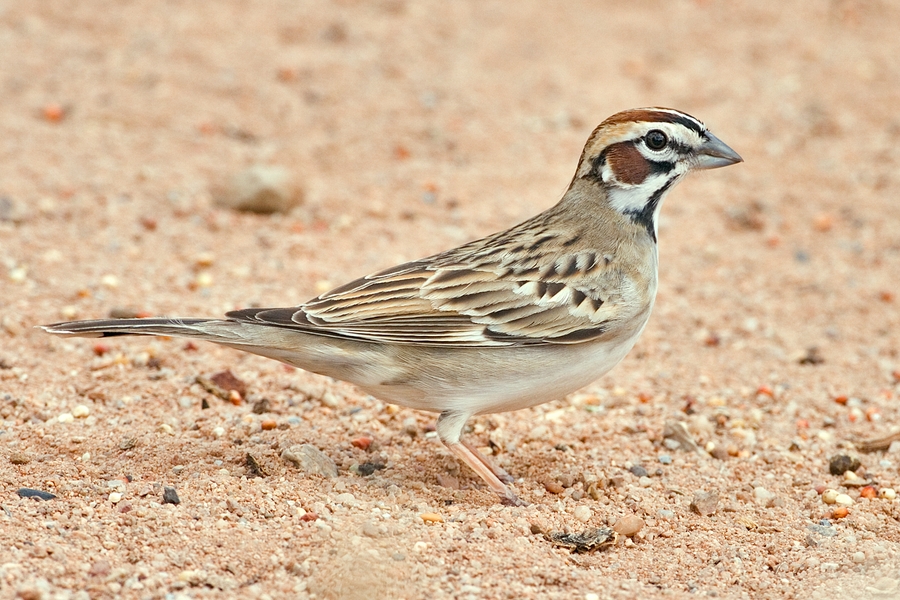
The Lark Sparrow is one of the easiest sparrows to identify, which is saying something in a group of birds famous for looking maddeningly alike. While most sparrows wear muted browns and grays, this one sports a boldly painted head: chestnut, black, and white arranged in a clean, almost ornamental pattern that birders sometimes call a "harlequin" face. Add a long, rounded tail edged in white and you have a sparrow that announces itself the moment it flushes up from a roadside or fence line.
It is a bird of open and semi-open country across the central and western United States, favoring grasslands dotted with shrubs, pastures, savanna, orchards, and the weedy edges where fields meet brush. The name "lark" comes from its rich, varied song and its habit of feeding on the ground in open spaces, much as true larks do. Though not a backyard feeder regular for most people, it is a familiar and welcome sight to anyone who birds prairies, ranchland, or the dry edges of the West.
The Lark Sparrow is a fairly large, long-tailed sparrow with a chunky body, a rounded head, and a stout pinkish bill. In flight or when perched, the standout features are the patterned face and the long tail tipped and edged with white, which flashes conspicuously as the bird flies away from you.
| Head pattern | Bold chestnut crown stripes and ear patches set off by white stripes and a black mustache and central crown stripe, a unique, painted face |
| Breast spot | Clean whitish underparts with a single dark central spot on the breast, recalling a smaller version of a meadowlark's mark |
| Tail | Long and rounded, dark with broad white corners and edges that flash in flight, one of the best field marks |
| Bill | Stout, conical, pinkish to pale horn-colored, a typical seed-eating sparrow bill |
| Back and wings | Brown streaked with darker brown; plainer and grayer below than many sparrows |
| Size | Noticeably larger and longer-tailed than a Chipping or Song Sparrow |
Male vs. female
Male and female Lark Sparrows look alike. There is no seasonal plumage change to speak of either, so the bold face pattern is present year-round in both sexes. Birds you see in spring and summer simply look a bit crisper; worn late-summer adults can appear slightly duller, but the diagnostic head pattern and white-cornered tail remain obvious. The only reliable way to tell the sexes apart is behavior during the breeding season, when males sing and perform display, not by appearance.
Juveniles
Juvenile Lark Sparrows are the main source of confusion because they lack the clean, bold head pattern of adults. Young birds show a more muted, brownish face with the chestnut areas only faintly suggested, and they have fine streaking across the breast and flanks rather than the crisp single spot of the adult. Crucially, even juveniles already show the long, dark, white-cornered tail, which is the giveaway that you are looking at a young Lark Sparrow rather than some other streaky young sparrow. They molt into adult-like plumage by their first fall.
The Lark Sparrow earns its name with one of the most musical songs of any North American sparrow. The song is a long, rambling, melodic jumble of clear sweet notes, buzzes, trills, and churrs, often delivered from an exposed perch such as a fence post, shrub top, or low wire. It does not follow a tidy formula like a Chipping Sparrow's trill; instead it spills out as a varied, almost improvisational performance, frequently with pauses and sudden buzzy or churring passages mixed among the clear whistles.
The most distinctive call is a sharp, metallic tsip or tink, sometimes given in a thin series. Flushed birds often give these crisp notes as they fly up and away, flashing the white tail corners.
The Lark Sparrow breeds widely across the central and western United States, from the Great Plains and prairies westward through the intermountain West and into parts of the Southwest, reaching north into the southern Prairie Provinces of Canada and south into northern Mexico. Its stronghold is open and brushy country: shortgrass and mixed-grass prairie, pastures, savanna, sagebrush edges, and farmland margins.
It is migratory across most of the breeding range, with birds heading to the southern United States and Mexico for the winter; populations in parts of the Southwest and the Pacific states may be present year-round or only short-distance migrants. East of the Mississippi it is mostly a scarce or local breeder and a notable find, and it turns up as an occasional vagrant along the Atlantic coast, where birders prize it.
The Lark Sparrow is primarily a ground forager, walking and hopping across open dirt, short grass, and weedy patches as it gleans food. Its diet shifts with the seasons: in the cooler months it eats mostly seeds, including grass seeds, weed seeds, and waste grain, while in spring and summer it takes large numbers of insects and other invertebrates such as grasshoppers, beetles, caterpillars, and bugs. Those insects are especially important for feeding the rapidly growing nestlings.
Birders often notice Lark Sparrows feeding in loose groups outside the breeding season, foraging along roadsides, field edges, and bare ground. They are comfortable in the open and tend to feed where vegetation is sparse rather than skulking in dense cover the way some sparrows do.
Lark Sparrows nest on or near the ground, often at the base of a grass clump, shrub, or other low vegetation, though they will sometimes place a nest a few feet up in a shrub, low tree, or even an old nest of another bird. The female builds a cup of grasses, stems, and rootlets, lined with finer material. One unusual habit worth noting is that Lark Sparrows occasionally reuse old structures or nest off the ground, giving them more flexibility than many strictly ground-nesting sparrows.
The female lays a clutch of typically 3 to 5 eggs, which are whitish and distinctively marked with dark scrawls, spots, and squiggles concentrated toward the larger end. She handles most or all of the incubation, and both parents feed the young. Pairs commonly raise two broods in a season where the climate allows. Lark Sparrows are sometimes parasitized by Brown-headed Cowbirds, which lay their eggs in the sparrow's nest.
The Lark Sparrow is not a typical backyard or feeder bird for most people, it is a creature of open prairie, pasture, and brushy field edges, and it spends most of its time foraging on bare and grassy ground far from suburban feeders. That said, if you live within its range and your property borders open country, there are real ways to make it more likely to visit.
- Provide open, short, or bare ground for foraging, Lark Sparrows feed in the open and avoid dense, tidy lawns and heavy cover
- Scatter millet and other small grass seeds on the ground or on a low platform rather than in hanging tube feeders
- Leave weedy edges and patches of native grasses to seed out, which supplies both food and the insects they hunt in summer
- Keep some low shrubs or scattered brush near open ground for perching, singing, and nesting cover
- If you live near pasture, prairie, or ranchland, watch fence posts and wires in spring where males perch to sing, that is where you are most likely to find them
- Avoid heavy pesticide use so that grasshoppers, beetles, and caterpillars remain available as food
- Chipping Sparrow: Much smaller and shorter-tailed, with a plain gray breast and a rusty cap but none of the Lark Sparrow's chestnut-and-white face pattern or white tail corners
- Vesper Sparrow: Shares the white outer tail feathers and open-country habitat but is streaky brown overall with a streaked breast, a plain face, and a chestnut shoulder patch rather than a bold painted head
- Song Sparrow: Heavily streaked below with a streaky brown face and a central breast spot, but lacks the clean chestnut head stripes and white-cornered tail; prefers wetter, brushier habitat
- Sage Sparrow: Another open-country sparrow with a breast spot, but it is gray-headed and plain-faced with a white eyering, not boldly patterned with chestnut
How do I identify a Lark Sparrow?
Look for the boldly patterned head with chestnut cheek patches and crown stripes set off by white and black, a clean whitish breast with a single dark central spot, and a long dark tail with white corners that flash when the bird flies. That combination is unique among North American sparrows.
What does a Lark Sparrow sound like?
It has a long, varied, melodic song that mixes clear sweet whistles with buzzes, trills, and churrs in a rambling, improvisational way, much richer than most sparrows. Its common call is a sharp metallic tsip or tink, often given as it flushes.
Where do Lark Sparrows live?
They favor open and brushy country, prairies, pastures, savanna, farmland edges, and sagebrush margins, across the central and western United States, reaching into southern Canada and northern Mexico. They are scarce and local east of the Mississippi.
Will Lark Sparrows come to a backyard feeder?
Not usually. They are open-country ground foragers and rarely visit standard hanging feeders. If you live near prairie or pasture, scattering millet on the ground or a low platform near open, weedy areas gives you the best chance.
Are male and female Lark Sparrows different?
No, the sexes look alike, both showing the same bold chestnut-and-white head pattern year-round. Juveniles are the tricky ones: they have a duller, browner face and fine breast streaking, but they already show the telltale white-cornered tail.