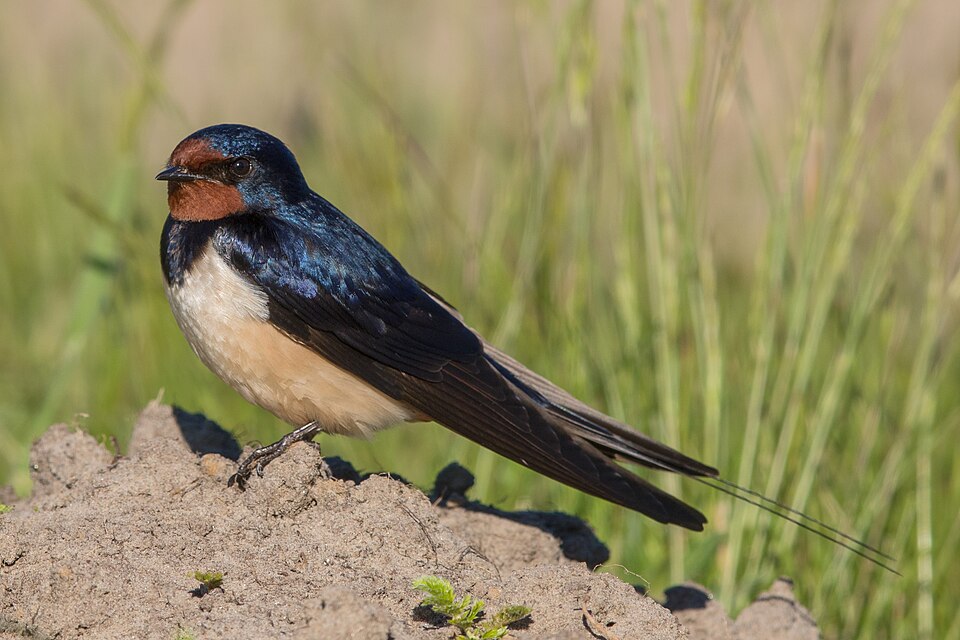
The Barn Swallow is the most widespread swallow in the world, and for many people in North America it is the very picture of summer: a sleek, blue-backed bird slicing low over a hayfield or pasture, twittering as it goes. Its deeply forked tail and effortless, banking flight set it apart from almost any other songbird sharing the open country. Where there is open air to hunt over and a sheltered ledge to build on, you will usually find Barn Swallows.
As the name suggests, this is a bird that has thrown its lot in with people. Once it nested mainly in caves and on cliffs, but for centuries now it has chosen barns, sheds, porches, bridges, and culverts almost everywhere humans build. That close relationship makes it one of the easiest swallows to watch closely, and a beloved presence on farms and rural roads across the continent. Its mud-cup nests, plastered to a beam or rafter, are a familiar sight to anyone who has spent time around old buildings.
Barn Swallows are slender, long-winged birds built for sustained flight. The clearest field mark is the long, deeply forked tail with thin "streamers" trailing behind, unique among common North American swallows. In flight the bird looks pointed at both ends, and it flies with smooth, sweeping wingbeats interrupted by graceful glides, usually low over the ground or water.
| Tail | Long and deeply forked with thin outer streamers, the signature mark, unlike the short notched tails of other swallows |
| Upperparts | Glossy steel-blue back, crown, and wings |
| Throat & forehead | Rich rusty-chestnut to brick-red, bordered by a dark blue breast band |
| Underparts | Warm buffy-orange to cinnamon, palest in some birds, deeper in others |
| Tail spots | Row of white spots across the spread tail, visible from below |
| Size & shape | Slim body, long pointed wings; smaller and more streamlined than a sparrow |
Male vs. female
Males and females look broadly alike and both show the blue back, dark breast band, and rusty throat. With a good look, males average more richly colored, with deeper orange underparts and noticeably longer tail streamers; females tend to be a bit paler below with slightly shorter streamers. These differences are averages rather than firm rules, so a single bird can be hard to sex with certainty. Tail-streamer length matters to the birds themselves, females tend to favor males with the longest, most symmetrical streamers.
Juveniles
Juvenile Barn Swallows resemble adults but are duller and less glossy on the back, with paler, more washed-out buff underparts and a paler, less saturated throat. Most tellingly, young birds have much shorter tail streamers, so a fresh juvenile can look almost short-tailed compared to its parents. By their first migration they have the basic adult pattern, and the long streamers grow in fully with later molts.
The Barn Swallow's song is a long, cheerful, somewhat scratchy warble, a continuous twittering jumble of squeaky notes that often ends in a dry, mechanical rattle sometimes described as sounding like a creaky hinge or a wind-up toy. Males sing in flight and from perches such as wires, and the bubbling, conversational quality is a classic sound of summer farmland.
The most familiar call is a sharp, repeated vit vit or wit-wit given in flight. When a hawk, cat, or person comes near the nest, the birds switch to an urgent, agitated cheep and a harsh alarm note, often mobbing the intruder while calling.
Barn Swallows breed across most of North America, from Alaska and central Canada south through nearly all of the lower 48 states and into Mexico. They favor open habitats, farmland, meadows, marshes, lakeshores, and roadsides, anywhere with open air to forage over and a structure to nest on.
This is a true long-distance migrant. North American breeders winter in Central and South America, with many traveling all the way to southern South America. They move in loose flocks, often feeding low over fields and water along the way, and gather in large numbers at staging areas in late summer before heading south. Spring arrival in much of the U.S. comes in March and April; most have departed by October.
Barn Swallows are aerial insectivores, catching virtually all of their food on the wing. Flies are the staple, but they also take beetles, wasps, winged ants, moths, mayflies, grasshoppers, and other flying insects. They typically hunt low, often just a few feet above a field, pond, or pasture, twisting and banking to snap up prey in mid-air, and they will follow farm machinery or grazing livestock to grab the insects these flush into the open.
Because they depend entirely on flying insects, Barn Swallows are sensitive to cold, wet spells that ground their prey, and they tend to forage lowest in damp or cool weather when insects fly close to the ground. They drink and even bathe in flight, skimming the surface of a pond and scooping up water as they pass.
The nest is the bird's calling card: an open cup of mud pellets reinforced with grass and lined with feathers, built by both sexes one beakful of mud at a time. Nests are plastered to a vertical wall or, more often, set on a beam, rafter, ledge, or other sheltered surface under an overhang, inside barns and sheds, beneath bridges and docks, and under the eaves of porches. Pairs often nest in loose colonies and may reuse and repair a nest from a previous year.
Both parents incubate the eggs, which hatch in about two weeks, and both feed the young, making constant trips with mouthfuls of insects. Older young from a first brood, and unrelated "helper" birds, will sometimes assist in feeding nestlings, an unusual behavior among songbirds. The chicks fledge at roughly three weeks but continue to be fed in the air for a time afterward.
Barn Swallows do not visit seed feeders, they eat only flying insects, so you cannot lure them with food. Instead, the way to host them is to offer safe nesting space and good insect-rich foraging habitat. If you have a barn, open shed, carport, or porch with a sheltered ledge, you are already a candidate, and a few small steps can make your property far more inviting.
- Leave a door, window, or gap open on a barn or outbuilding so swallows can reach interior beams and rafters to nest.
- Mount a small wooden nest shelf or ledge under an eave or overhang to give pairs a ready foundation for their mud cup.
- Keep a patch of bare, damp mud available in spring, puddle edges or a shallow muddy spot give birds the building material they need.
- Maintain open foraging habitat nearby: fields, lawns, ponds, or pastures where flying insects are abundant.
- Avoid spraying broad-spectrum insecticides, which wipe out the flying insects swallows depend on.
- Tolerate the droppings below an active nest, a board or newspaper laid beneath catches the mess until the young fledge.
- Cliff Swallow: Has a short, square tail (no streamers), a pale buffy forehead, and a rusty rump; builds enclosed gourd-shaped mud nests rather than open cups.
- Tree Swallow: Clean white underparts with no buff or breast band, blue-green back, and a short notched tail; nests in cavities and boxes, not on open ledges.
- Purple Martin: Much larger and bulkier; adult males are dark glossy purple all over with no rusty throat, and the tail is only shallowly forked.
- Bank Swallow: Smaller and brown above (not blue), with a distinct brown breast band across white underparts and a short notched tail; nests in burrows in dirt banks.
How can I tell a Barn Swallow from other swallows?
Look at the tail. The Barn Swallow is the only common North American swallow with a long, deeply forked tail trailing thin streamers. Combined with its glossy blue back, rusty throat and forehead, and warm orange-buff underparts, it is hard to confuse once you see the tail clearly.
Why do Barn Swallows fly so low to the ground?
They hunt flying insects on the wing, and in cool or damp weather those insects stay close to the ground and water. So the swallows follow them down, sweeping low over fields and ponds. The old folk belief that low-flying swallows mean rain has a grain of truth, falling air pressure and humidity push insects lower.
Are Barn Swallow nests a problem on my house?
They are messy below an active nest because of droppings, but the birds are harmless and eat huge numbers of insects. A board or sheet of newspaper under the nest catches the mess until the young fledge in a few weeks. Note that, like most native songbirds, Barn Swallows and their active nests are legally protected, so it is best not to remove a nest with eggs or chicks.
How many broods do Barn Swallows raise in a year?
Often two broods per season, and sometimes a third in the southern part of the range where summers are long. Pairs frequently reuse and repair the same nest between broods and from one year to the next.
Where do Barn Swallows go in winter?
North American Barn Swallows are long-distance migrants that winter in Central and South America, with many reaching the southern end of the continent. They leave most of the U.S. by October and return the following March and April.