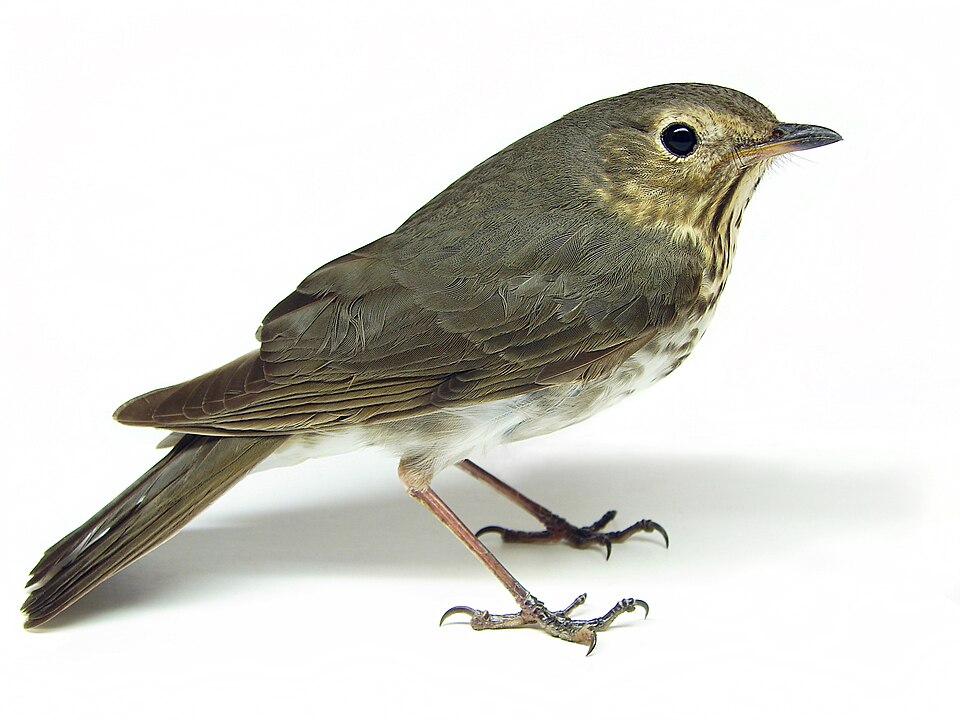
The Swainson's Thrush is one of North America's "spotted thrushes," a group of shy, ground-loving birds in the genus Catharus that are far easier to hear than to see. Plain olive-brown above and softly spotted below, it spends most of its life in the shadowy understory of coniferous and mixed forests, slipping through the leaf litter and low branches in search of food. What gives it away is its voice: a flutelike song that spirals upward like a question, drifting through damp northern woods on long summer evenings.
For many birders, this is a species defined by movement. It breeds across the boreal forest of Canada and Alaska, down through the western mountains and the higher Appalachians, then makes one of the longest migrations of any North American thrush, wintering deep in Mexico, Central America, and South America. During spring and fall it passes through backyards and city parks almost everywhere, often detected at night by its soft, liquid flight call drifting down from the dark sky.
Swainson's Thrush is a medium-small, round-bodied thrush with a fairly short tail, a straight thin bill, and an upright, alert posture when it pauses on the ground or a low perch. The single most reliable field mark is its face: bold buffy "spectacles" formed by a buff eyering joining a buff line in front of the eye, giving it a gentle, wide-eyed expression unlike any of its close relatives.
| Upperparts | Uniform warm olive-brown to gray-brown from crown to tail, without contrasting rufous tones in most populations |
| Face | Distinct buffy eyering and buff lores together form 'spectacles', the key ID mark |
| Breast | Warm buff wash across the upper breast with crisp dark spots that fade on the lower belly |
| Underparts | Whitish belly and flanks, flanks often washed grayish; throat buffy and lightly marked |
| Size & shape | Robin-relative but much smaller, plump-bodied, short-tailed, with a slim straight bill |
| Coastal form | Pacific 'russet-backed' birds are warmer and more rufous-toned than interior 'olive-backed' birds |
Male vs. female
Males and females look alike. The sexes share the same olive-brown plumage, buffy spectacles, and spotted breast, and they cannot be reliably told apart in the field by appearance. In the hand, breeding females may show a brood patch and males are very slightly larger on average, but for backyard and field observation you should treat any Swainson's Thrush as unsexable by sight.
Juveniles
Recently fledged young are browner and scruffier than adults, with pale buff spots and streaks on the back and wing coverts that give them a faintly spangled look, plus messier, more diffuse spotting below. They lose most of this juvenile patterning by late summer, though many retain buff-tipped wing coverts (a useful aging clue) through their first fall and winter. By their first spring they are essentially indistinguishable from adults in the field.
The song is the bird's signature: a series of flutelike phrases that spiral upward in pitch, often written as whip-poor-will-a-will-eee rising at the end. This ascending, "going up the spiral staircase" quality separates it instantly from the Veery, whose very similar song spirals downward. The notes are breezy, slightly reedy, and carry well through dense forest at dawn and dusk.
Calls are equally useful. A common daytime call is a soft, liquid whit or peep; an alarm note can sound like a sharp pwit. Most distinctive is the nocturnal flight call given during migration, a short, spring-peeper-like queep or heep that birders listen for on clear fall nights as flocks pass overhead in the dark.
Swainson's Thrush breeds across the vast boreal forest of Alaska and Canada, south through the Rocky Mountains, the Cascades and Sierra Nevada, the Pacific Northwest coast, the northern Great Lakes and New England, and the higher elevations of the Appalachians. It favors cool, moist coniferous and mixed forest, often near streams, willow thickets, or dense second growth.
It is a true long-distance migrant. After breeding it heads to wintering grounds stretching from western Mexico through Central America and into northern and western South America. Migration is largely nocturnal, and during spring and fall passage the species turns up almost anywhere with trees, including suburban yards, woodlots, and urban parks far from its breeding habitat.
Swainson's Thrush is an omnivore that shifts its diet with the seasons. Through spring and summer it feeds heavily on insects and other invertebrates, beetles, ants, caterpillars, flies, and spiders, gleaned from the forest floor, low foliage, and bark. It forages by hopping through leaf litter and flicking debris aside, and it will also sally out to snatch flying insects from the air, a more aerial habit than most of its ground-feeding relatives.
In late summer, fall, and on the wintering grounds, fruit becomes a major part of the diet. It eats berries and small soft fruits of many kinds, which fuels its long migration and helps disperse seeds across the landscape. This fruit-eating habit is the main reason a migrant Swainson's might pause in a yard with berry-bearing shrubs.
The female builds a bulky open cup nest of twigs, moss, bark strips, leaves, and grass, usually lined with finer material and lichen. The nest is typically placed low in a conifer, shrub, or sapling, often just a few feet off the ground, and well hidden in dense vegetation. In the Pacific coastal "russet-backed" populations, nests are frequently in shrubs and small trees rather than directly on conifer boughs.
A typical clutch is three to four pale blue-green eggs, lightly speckled with brown. The female does the incubating, which lasts about twelve to fourteen days, and both parents feed the nestlings, which leave the nest after roughly ten to fourteen days. Most pairs raise a single brood per season, a constraint of their short northern summers, occasionally attempting a second where the season allows.
Swainson's Thrush is not a feeder bird and won't come to seed, but you can absolutely host one as a migrant, especially in spring and fall when birds drop into wooded yards to rest and refuel. The key is habitat and food on the ground and in shrubs, not a feeder pole.
- Plant native fruiting shrubs and trees, dogwood, elderberry, serviceberry, viburnum, and wild cherry are migration magnets for this fruit-loving thrush.
- Leave the leaf litter under shrubs and trees so the bird can forage for insects the way it does in the forest floor.
- Offer water, a ground-level birdbath or a dripping/moving water feature is one of the best ways to draw a shy migrant thrush into the open.
- Keep a brushy, layered yard with dense understory cover where a nervous bird feels safe pausing during the day.
- Keep cats indoors, ground-foraging migrants are highly vulnerable to predation, and a safe yard sees far more visitors.
- Watch and listen at dawn and dusk during migration, and listen overhead on clear fall nights for the soft queep flight call.
- Veery: Warmer, more uniform reddish-brown above with much fainter, smudgier breast spots and a plainer face lacking bold spectacles; its song spirals downward instead of up.
- Hermit Thrush: Has a contrasting rufous tail it slowly raises and lowers, a whitish (not buff) eyering, and cleaner white underparts; song begins with a clear introductory whistle.
- Gray-cheeked Thrush: Grayer overall with a plain gray face lacking buffy spectacles, and grayer cheeks; very similar but colder-toned with a thinner, partial eyering.
- Wood Thrush: Larger, rich rusty-brown above brightest on the head, with bold round black spots on a clean white breast and a famous fluty ee-oh-lay song.
How do I tell a Swainson's Thrush from a Veery?
Look at the face and breast: Swainson's has bold buffy spectacles and crisp breast spots, while the Veery has a plainer face and faint, washed-out spots over warmer reddish-brown upperparts. By ear it's even easier, Swainson's song spirals upward in pitch, the Veery's spirals downward.
Why do I only hear Swainson's Thrushes and never see them?
They are shy understory birds that stay low in dense cover and forage on shaded ground, so they're far more often heard than seen. Their carrying, flutelike song and soft call notes give them away long before you spot the bird itself.
What does the Swainson's Thrush song sound like?
A breezy, flutelike series of phrases that rises in pitch as it goes, often described as a spiral or an ascending staircase, ending on an upward note. The nocturnal flight call during migration is a short, spring-peeper-like 'queep.'
Will a Swainson's Thrush come to my bird feeder?
Not to seed feeders. It eats insects and fruit, so the way to attract one is with native berry-bearing shrubs, undisturbed leaf litter for foraging, and a ground-level water source, especially during spring and fall migration.
When is the best time to see a Swainson's Thrush?
For most of the U.S. outside its mountain and northern breeding range, the best chances are during spring (roughly May) and fall (September into October) migration, particularly at dawn and dusk in wooded yards and parks.