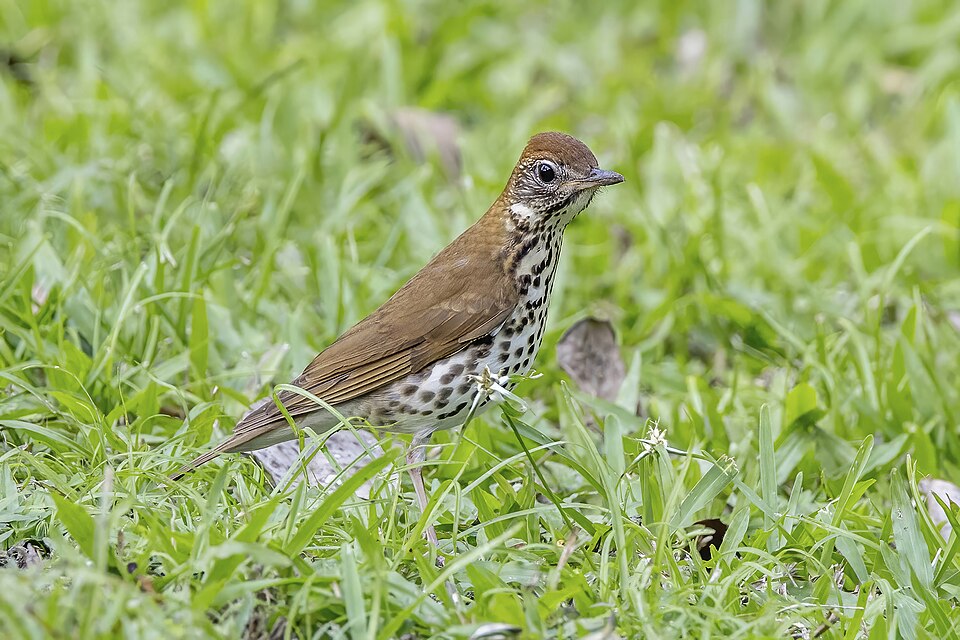
The Wood Thrush is one of the great voices of the eastern deciduous forest. Plump and round-shouldered, with a warm cinnamon head shading to olive-brown across the back and a clean white breast peppered with bold dark spots, it looks like a smaller, more boldly marked cousin of the American Robin. But it is the song that makes birders stop in their tracks. On still June evenings in the shaded understory, the male delivers a liquid, fluting ee-oh-lay that seems to echo through the woods, a sound so pure it has inspired poets from Walt Whitman to Henry David Thoreau.
Despite its beauty and its status as a familiar summer bird across the East, the Wood Thrush has become a symbol of conservation concern. Populations have fallen sharply over the past half-century, driven by forest fragmentation on its breeding grounds, nest parasitism by cowbirds, and the loss of tropical forest where it winters in Central America. A bird that once seemed to belong to every woodlot is now a species that birders and scientists watch carefully, listening each spring to hear whether the flute returns.
The Wood Thrush is a medium-sized, potbellied thrush with an upright posture, a fairly short tail, and a rounded head it often holds slightly cocked. At rest it looks compact and sturdy, frequently flicking its wings or freezing in place on the forest floor. The combination of a rich rusty crown and nape contrasting with heavy round spots on a white underside is distinctive among the brown thrushes.
| Head & upperparts | Bright rusty-cinnamon crown and nape fading to warm olive-brown on the back, wings, and tail |
| Underparts | Crisp white breast and belly covered with large, distinct round black spots that extend well down the flanks |
| Face | Bold white eye-ring on a streaked white-and-dark cheek, giving a clean, wide-eyed expression |
| Size & shape | Plump, big-headed, short-tailed thrush; smaller and rounder than an American Robin |
| Bill & legs | Straight dark bill with a pale pinkish base to the lower mandible; pinkish legs |
| Spotting pattern | Spots are larger and more sharply defined than on Hermit, Swainson's, or Veery thrushes |
Male vs. female
Male and female Wood Thrushes look essentially identical in the field. Both sexes share the rusty head, spotted breast, and white eye-ring, and there is no reliable plumage difference visible to a backyard observer. The surest way to tell them apart is behavior during the breeding season: only the male sings the full, ringing flute song. In the hand, banders can sometimes use measurements and the presence of a brood patch on females, but for ordinary birding, assume the singing bird is a male and accept that a silent foraging thrush could be either sex.
Juveniles
Juvenile Wood Thrushes, seen in summer shortly after fledging, are easy to puzzle over. They show the same rusty tones on the head and back but are heavily marked with buff or tawny spots and streaks on the upperparts, giving them a spangled, scaly look that adults lack. Their underpart spotting is less crisp and somewhat smudgier. As they molt into first-winter plumage in late summer, they lose the pale spotting above and come to resemble adults, though some retain a few buff-tipped wing coverts into their first year.
The Wood Thrush's song is justly famous and one of the most beautiful in North America. The male sings a three-part phrase: a soft, often inaudible introductory note, followed by the loud central flourish that birders render as ee-oh-lay or ay-o-lee, and ending in a high, complex, trilling jumble. Because the bird has a divided voice box, it can sing two notes at once, producing the ethereal, harmonizing quality that gives the song its haunting, flute-like resonance. Males sing most at dawn and dusk from the shaded mid-story.
Calls are quite different and useful for identification. The most common is a rapid, scolding pit-pit-pit or bup-bup-bup, often given when the bird is agitated or sees an intruder. There is also a sharper, more nasal alarm note. Once learned, that machine-gun pit-pit-pit is a reliable clue that a Wood Thrush is nearby even when it stays hidden.
The Wood Thrush breeds across the eastern United States and the extreme southern edge of eastern Canada, from southern Maine and the Great Lakes south to the Gulf states and east Texas, reaching its highest densities in mature deciduous and mixed forests of the Appalachians and the Northeast. It favors moist, shady woodland with a tall canopy and a well-developed understory, and it generally needs sizable blocks of forest rather than small fragments.
It is a long-distance migrant. In fall, Wood Thrushes funnel south through the eastern states and across or around the Gulf of Mexico to winter in the lowland tropical forests of southern Mexico and Central America, from the Yucatan to Panama. Spring migration brings them back north from April into May. During migration they may turn up briefly in parks, gardens, and woodlots well outside their breeding habitat, often detected by their call notes as they forage in leaf litter.
Wood Thrushes are ground foragers that spend much of their time hopping through the leaf litter of the forest floor, flicking aside dead leaves with the bill to expose hidden prey. During the breeding season they eat mainly invertebrates: beetles, ants, caterpillars, flies, spiders, millipedes, sowbugs, and earthworms. This protein-rich diet fuels egg production and feeds the fast-growing nestlings.
As summer turns to fall, and especially on the wintering grounds, fruit becomes far more important. They take the berries of spicebush, dogwood, Virginia creeper, pokeweed, elderberry, blueberry, and many other native plants, and this fruit-rich diet helps them build the fat reserves needed for migration. The shift between insects in the breeding season and fruit at other times is typical of many woodland thrushes.
The female builds the nest, usually placed in the fork or on a horizontal branch of a sapling or shrub, typically 6 to 15 feet above the ground in the forest understory. The cup is constructed of grasses, leaves, stems, and bark, with a distinctive middle layer of mud or wet decayed leaves that hardens to give the nest structure, then lined with fine rootlets. The result resembles a tidy, smaller version of an American Robin's nest.
A typical clutch is three to four pale, unmarked greenish-blue eggs, again much like a robin's. The female incubates for about 12 to 14 days, and both parents feed the nestlings, which fledge roughly 12 to 13 days after hatching. Pairs often raise two broods in a season. Wood Thrushes are frequent hosts to Brown-headed Cowbirds, whose parasitism is one of the pressures contributing to the species' long-term decline, particularly near forest edges.
The Wood Thrush is not a feeder bird, so you won't lure it with seed or suet. It is a creature of shaded, leafy woodland, and the way to host one is to offer the kind of habitat it needs. Birders living near or adjacent to mature forest have the best chance, but thoughtful native landscaping can help, especially during migration when birds wander more widely.
- Preserve or plant native fruiting shrubs and trees such as spicebush, dogwood, elderberry, serviceberry, and Virginia creeper to provide the berries thrushes rely on in late summer and fall.
- Leave a layer of leaf litter under shrubs and trees rather than raking it all away; thrushes forage by flipping dead leaves for insects.
- Maintain a shaded, multi-layered understory with shrubs and saplings beneath a tall canopy, which mimics their preferred breeding habitat.
- Provide a ground-level or shallow birdbath with moving or dripping water, which can draw thrushes in to drink and bathe.
- Avoid pesticides so the insect, worm, and spider prey they depend on stays abundant.
- Protect large blocks of forest where possible, since Wood Thrushes need sizable woodland and suffer near fragmented edges where cowbirds and predators concentrate.
- Hermit Thrush: Smaller and grayer-brown with a contrasting rusty tail it slowly raises and lowers; spots are finer and fade on the lower belly. Winters in the U.S., unlike the Wood Thrush.
- Swainson's Thrush: Uniform olive-brown above with no rusty head, and shows a bold buffy eye-ring and buffy face; breast spots are smaller and set on a buff-washed chest.
- Veery: Warm reddish overall but with only faint, blurry spots limited to the upper breast, looking much plainer below; its downward-spiraling song is very different.
- American Robin: Much larger with an unspotted brick-red breast and a gray back; shares the bluish eggs but is a familiar lawn bird rather than a forest-floor skulker.
What does a Wood Thrush sound like?
The male sings a clear, flute-like, three-part phrase often written as ee-oh-lay, ending in a high trill. Because of its divided voice box it can sound two notes at once, giving the song an ethereal, harmonizing quality. Its alarm call is a rapid, machine-gun-like pit-pit-pit.
How is a Wood Thrush different from an American Robin?
Both have bluish eggs and a similar shape, but the Wood Thrush is smaller, has a rusty head, and shows a white breast covered in bold black spots rather than the robin's plain brick-red breast. Robins forage on open lawns, while Wood Thrushes skulk on the shaded forest floor.
Will a Wood Thrush come to a bird feeder?
Not for seed or suet. Wood Thrushes eat insects and fruit, so they ignore typical feeders. You're far more likely to attract one with native fruiting shrubs, leaf litter to forage in, and a ground-level birdbath, especially if you live near woodland.
Why are Wood Thrush populations declining?
Several pressures combine: fragmentation of breeding forests, heavy nest parasitism by Brown-headed Cowbirds near forest edges, acid rain affecting the calcium-rich invertebrates they eat, and loss of tropical forest on their Central American wintering grounds.
Where do Wood Thrushes go in winter?
They are long-distance migrants that leave the eastern U.S. in fall and winter in the lowland tropical forests of southern Mexico and Central America, from the Yucatan Peninsula south to Panama, returning north to breed from April into May.