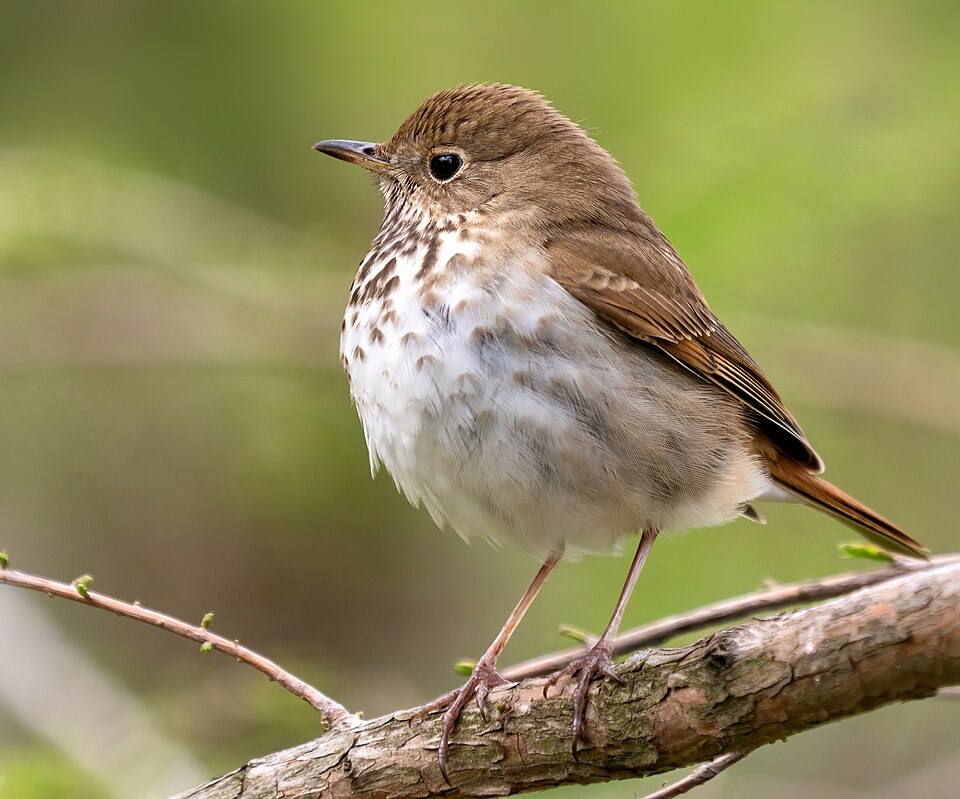
The Hermit Thrush is a quiet, ground-loving songbird of North American forests, more often heard than seen. About the size of a sparrow but with the upright, alert posture of a small robin, it spends much of its time foraging in leaf litter and shadow at the woodland edge. What gives it away is the reddish tail, which it flicks upward and slowly lowers, often paired with a soft, dry chup note from deep cover. For many birders, this tail-pumping habit is the single most reliable field mark.
Despite its plain brown plumage, the Hermit Thrush is widely regarded as one of the finest singers on the continent. Its ethereal, spiraling song rings through northern and mountain coniferous forests in spring and summer. It is also the hardiest of the spot-breasted Catharus thrushes: while its relatives fly to the tropics, the Hermit Thrush winters across much of the southern and coastal United States, making it the one brown thrush a backyard birder is most likely to encounter in winter.
A small, compact thrush with a rounded head, a fairly short, straight bill, large dark eyes, and longish legs built for hopping on the forest floor. Plumage is warm brown above and pale below with bold dark spots on the throat and breast. The standout feature is the contrast between a dull grayish-brown back and a noticeably rusty, reddish tail.
| Tail | Rufous (reddish) and contrasting with the browner back; frequently flicked up and slowly lowered |
| Breast | Whitish to buffy with crisp dark spots that fade into smudges toward the belly |
| Eyering | Thin, complete whitish eyering on a plain face, giving a gentle, wide-eyed look |
| Upperparts | Olive-brown to grayish-brown; western birds tend grayer, eastern birds warmer |
| Size & shape | Small and plump, robin-like posture but sparrow-sized, with a fairly short tail |
| Flanks | Often washed with gray or pale brown, contrasting with the white belly |
Male vs. female
Males and females look alike. There is no reliable plumage difference you can see in the field, and the sexes are similar in size. In the breeding season, the singing bird is almost always the male, so song is the best behavioral clue to sex, but a silent foraging bird cannot be sexed by eye.
Juveniles
Recently fledged juveniles show pale buff spotting and streaking on the back and wing coverts, giving a scaly, speckled look that adults lack, along with a softer, less defined breast pattern. They still show the diagnostic rusty tail. This juvenile plumage is brief; by their first fall, young birds molt into a plumage that closely matches adults and are difficult to age in the field.
The song is the Hermit Thrush's claim to fame: a clear, flutelike opening note followed by a soft, spiraling, ethereal phrase that seems to shimmer and rise or fall before fading. Each song begins on a different pitch, and a singing bird cycles through several pitches, giving the impression of a musician retuning between verses. It carries beautifully through still forest air at dawn and dusk and has an almost meditative, otherworldly quality.
Calls are far less musical. The common contact note is a low, dry chup or tuck, often given as the bird flicks its tail. When agitated it may give a sharp, rising pay or a thin, high seee. In migration, listen at night for a soft, buzzy flight call.
Hermit Thrushes breed across the boreal forest of Canada and Alaska, south through the northern United States, the Appalachians, and the western mountains down through the Rockies, Sierra Nevada, and Cascades. They favor coniferous and mixed woods, often near clearings, bogs, or forest edges.
In winter they retreat from the far north but, unlike their tropics-bound relatives, large numbers stay in the United States, occupying the Southeast, the Gulf states, the Southwest, the Pacific Coast, and parts of Mexico and Central America. This makes the Hermit Thrush the brown, spot-breasted thrush most North American birders see in the colder months. Spring and fall migration brings them through nearly every part of the Lower 48, often skulking quietly in woodlots, hedgerows, and parks.
Hermit Thrushes are primarily ground foragers. In the breeding season they eat insects and other invertebrates, including beetles, ants, caterpillars, flies, spiders, and earthworms, which they find by hopping along the forest floor, pausing, and flicking aside leaves. They sometimes use a foot-quivering motion to stir up hidden prey.
In fall and winter their diet shifts heavily toward fruit. They eat the berries of plants such as dogwood, holly, sumac, juniper, pokeweed, wild grape, and serviceberry, which helps them survive cold months farther north than the other spotted thrushes. This fruit-eating habit also makes them important seed dispersers in many woodlands.
Hermit Thrushes typically build a bulky, open cup nest of grasses, moss, bark strips, and leaves lined with finer material such as rootlets and pine needles. In the East they often nest on or near the ground, tucked at the base of a small tree or in low vegetation, while in the West they more frequently place nests low in shrubs or conifers. The female does most or all of the building.
The female lays a clutch of pale greenish-blue eggs, usually unmarked, and incubates them on her own for roughly two weeks. Both parents feed the nestlings, which leave the nest about a week and a half after hatching. Pairs commonly raise two broods in a season where the breeding period is long enough.
The Hermit Thrush is not a classic feeder bird, but it is one of the more approachable woodland thrushes and can be drawn to yards that mimic its forest-floor habitat, especially in winter and migration when it is hunting for fruit and sheltered cover.
- Plant native fruiting shrubs and trees such as dogwood, holly, serviceberry, juniper, sumac, and pokeweed to provide the berries they rely on in fall and winter.
- Leave a layer of leaf litter under shrubs and at woodland edges so they can forage for insects the way they do in the wild.
- Offer a ground-level or shallow birdbath, ideally with moving or dripping water, which thrushes find very attractive for drinking and bathing.
- Provide dense, low cover like brush piles, hedgerows, or thickets where these shy birds feel safe foraging.
- In hard weather, try offering raisins, chopped fruit, or mealworms on the ground or a low platform rather than at a hanging feeder.
- Keep cats indoors, since ground-feeding thrushes are especially vulnerable to predation.
- Wood Thrush: Larger and chunkier with bold, large round spots covering the whole underside, a bright reddish-brown head and back (not just the tail), and a famous ee-oh-lay song.
- Swainson's Thrush: Uniform olive-brown above with no rusty tail contrast, a buffy face and bold buffy eyering ('spectacles'), and an upward-spiraling song; does not winter in the U.S.
- Veery: Warm cinnamon-brown overall with only faint, blurry spots on the upper breast and a downward-spiraling, ghostly song; lacks the gray back and reddish tail contrast.
- Gray-cheeked Thrush: Cold grayish-brown above with a gray face and faint eyering, no rusty tail; a scarce migrant easily confused but lacking the tail flick and rufous rump.
How can I tell a Hermit Thrush from other brown thrushes?
Look at the tail. The Hermit Thrush has a rusty-red tail that contrasts with its browner back, and it habitually flicks the tail up and slowly lowers it. Most similar thrushes have uniform-colored upperparts. The crisp breast spots, thin pale eyering, and tail-pumping behavior together clinch the ID.
Why is it called a Hermit Thrush?
The name refers to its shy, solitary habits. It tends to stay in shaded cover, forages quietly on the forest floor alone or in pairs, and sings its haunting song from hidden perches, giving it a reclusive, 'hermit-like' reputation.
What does the Hermit Thrush's song sound like?
It is a clear, flutelike single note followed by a soft, ethereal, spiraling phrase, with each song starting on a different pitch. Many people describe it as one of the most beautiful bird songs in North America, with an almost flute-and-echo quality.
Do Hermit Thrushes come to bird feeders?
They rarely use seed feeders, since they prefer insects and fruit. You're more likely to attract one with fruiting shrubs, leaf litter to forage in, a ground-level birdbath, and dense cover. In cold weather they may take raisins, chopped fruit, or mealworms offered on the ground.
Where do Hermit Thrushes go in winter?
Unlike their close relatives that migrate to the tropics, many Hermit Thrushes winter within the United States, especially the Southeast, Gulf Coast, Southwest, and Pacific Coast, as well as Mexico and Central America. This makes it the spot-breasted thrush you're most likely to see in winter.