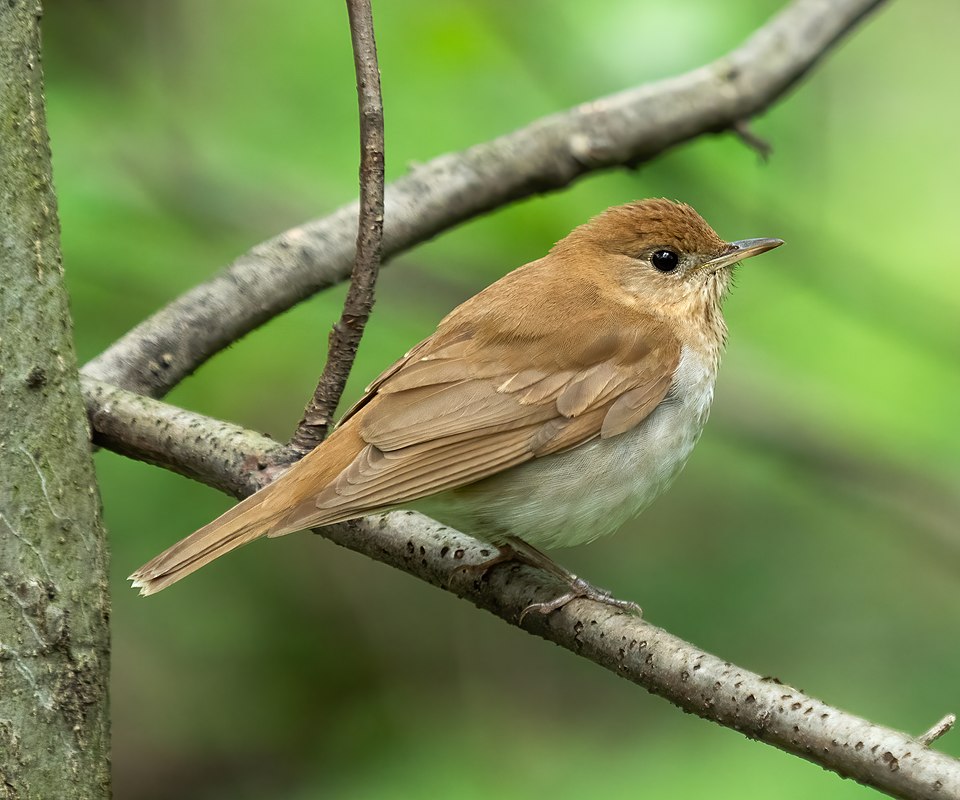
The Veery is the plainest-looking member of North America's brown forest thrushes, and yet it produces one of the most spellbinding sounds in the eastern woods. Where its relatives the Wood Thrush and Hermit Thrush wear bold, heavy spotting, the Veery is washed in a warm, even cinnamon-brown from crown to tail, with only the faintest smudging across its upper breast. It is a bird you are far more likely to hear than to clearly see, slipping through the shadowy understory of damp deciduous and mixed forests, especially where willows, alders, and ferns crowd a streambank or wet bottomland.
What makes the Veery special is its voice. The song is a breezy, downward-cascading series of flute-like notes that seems to spiral into itself, often described as ethereal or otherworldly because the bird can sing two notes at once using both sides of its syrinx. Veeries are long-distance migrants, breeding across southern Canada and the northern United States and wintering in central and southern Brazil. Recent research even suggests they can fly enormous distances over the open ocean during migration and may adjust their breeding effort based on conditions thousands of miles away.
The Veery is a medium-small, round-bodied thrush with a relatively short tail, an upright posture, and the thin, straight bill typical of Catharus thrushes. Its overall shape mirrors a small American Robin, but everything about its plumage is softer and warmer. The single best clue is the uniform reddish-brown wash over the entire upperparts combined with a notably clean, pale breast that shows only faint, blurry spots.
| Upperparts | Warm, uniform cinnamon- or tawny-brown from crown to tail, with no contrast between back and rump |
| Breast | Pale buffy upper breast with faint, indistinct brownish spots that fade quickly into a clean white belly |
| Face | Plain and open-looking, with a grayish cheek and only a thin, often incomplete pale eye-ring |
| Flanks & belly | Grayish-white sides and a bright white belly, lacking the warm tones of the back |
| Size & shape | Robin-shaped but smaller, with an upright stance, rounded body, and short tail |
| Bill & legs | Thin straight bill with a pale pinkish base to the lower mandible; pinkish legs |
Male vs. female
Male and female Veeries look essentially identical in the field. There is no difference in color, pattern, or size that a birder can reliably use to tell the sexes apart, so the only practical clue to sex is behavior during the breeding season. The singing bird perched and delivering that spiraling flute song is almost always the male, while the female does the bulk of nest-building and all of the incubation.
Juveniles
Recently fledged Veeries look scruffy and distinctly different from adults, with pale buffy or cinnamon spots and streaks scattered across the back, wing coverts, and head, giving them a faintly spangled appearance. Their breast spotting tends to be a bit more obvious than an adult's. By late summer, after the molt into first-winter plumage, young birds become very difficult to separate from adults and show the same warm, plain upperparts and faintly spotted breast.
The song is the Veery's signature and one of the most distinctive bird sounds in eastern North America. It is a breezy, swirling cascade of flute-like notes that tumbles downward in pitch, often written as vee-ur, vee-ur, veer, veer, veer, the source of the bird's name. The notes seem to harmonize and resonate as if echoing inside a metal pipe, an effect produced by the bird singing two notes simultaneously. Veeries sing most persistently at dawn and dusk, and their voices carry hauntingly through dim, humid woodlands.
The most common call is a sharp, low, descending veer or view, often given when a bird is disturbed or moving through the understory. During migration and on the breeding grounds you may also hear softer, lower whistled notes between birds.
Veeries breed across a broad band of southern Canada and the northern United States, from British Columbia eastward to Newfoundland and southward through the Great Lakes, New England, and down the Appalachian Mountains as far as northern Georgia. They favor moist deciduous and mixed forests with a dense, shrubby understory, especially near streams, swamps, and damp bottomlands.
This is a true long-distance migrant. In fall, Veeries funnel south through the eastern and central United States and the Gulf, then on to wintering grounds concentrated in central and southern Brazil, south of the Amazon. They migrate largely at night. Most birds pass through the southern U.S. in spring (roughly April-May) and again in fall (roughly August-September), so for much of the country the Veery is purely a passage migrant seen briefly during these windows.
Veeries are primarily ground and low-foliage foragers with a mixed diet that shifts through the season. In spring and summer they eat large quantities of insects and other invertebrates, including beetles, ants, caterpillars, grasshoppers, spiders, and even small snails, gleaned by hopping along the leaf litter, flicking leaves aside, and snatching prey from low branches.
As summer turns to fall, fruit becomes increasingly important, and Veeries readily switch to wild berries to fuel migration. They take blackberries, wild cherries, elderberries, dogwood fruit, spicebush, and similar soft fruits. This late-season shift to high-energy fruit is typical of the brown thrushes and helps power their marathon journey to South America.
The female builds a bulky open cup nest placed on or very near the ground, often at the base of a shrub or small tree, on a tussock, or in a low tangle of vegetation, and sometimes slightly raised on a stump or fallen branch. The nest is made of dead leaves, weed stems, and bark strips, with an inner cup lined with finer rootlets and decayed leaves.
She typically lays three to four pale greenish-blue eggs, which she alone incubates for roughly 10 to 14 days. The young are altricial and leave the nest only about 10 to 12 days after hatching, often before they can fly well, scrambling into nearby cover where both parents continue to feed them. Veeries usually raise one brood per year, though they will renest if a nest fails. As a ground-nesting forest bird, the Veery is a frequent host to Brown-headed Cowbird parasitism.
The Veery is not a feeder bird and will essentially never come to seed, suet, or a typical backyard setup. It is a shy forest interior species that wants dense, damp woodland with a thick understory. That said, if you live near suitable habitat, you can make your property more inviting, especially during migration.
- Preserve or plant native fruiting shrubs and small trees such as elderberry, dogwood, spicebush, blackberry, and wild cherry to offer the soft fruits Veeries seek in late summer and fall.
- Keep a layered, shrubby understory and leave leaf litter on the ground undisturbed, since Veeries forage by flipping leaves for insects.
- Provide a ground-level water source or a low, gently moving bird bath near cover, which can draw migrants for a drink and a bathe.
- Maintain damp, shaded thickets near streams or low spots rather than tidy, open lawn, as Veeries avoid exposed, manicured areas.
- During spring and fall migration, watch and listen in the early morning at the edges of woodland where understory meets clearing.
- Hermit Thrush: Has a contrasting reddish tail that stands out against a duller grayish-brown back, bolder breast spots, and a habit of slowly raising and lowering its tail. The Veery is uniformly warm-brown with no rusty tail contrast.
- Wood Thrush: Larger and far more boldly marked, with heavy round black spots covering the breast and flanks, a rusty head and nape, and a bold white eye-ring. Its song is a richer ee-oh-lay rather than the Veery's downward spiral.
- Swainson's Thrush: Shows a prominent buffy eye-ring and buffy 'spectacles' across the face, with grayer-brown (not warm cinnamon) upperparts and more distinct breast spots. Its song spirals upward rather than down.
- Gray-cheeked Thrush: Coldest and grayest of the group, with a plain grayish face, grayish-brown back, and crisper breast spots. It lacks the Veery's overall warm reddish tone.
Why is it called a Veery?
The name imitates its call and song. The bird often gives a sharp, descending 'veer' note, and its tumbling song ends in a repeated 'veer-veer-veer.' Birders coined the name directly from that downward-slurring sound.
What does a Veery's song sound like?
It is a breezy, flute-like series of notes that spirals downward in pitch with an echoing, almost metallic resonance, often written as 'vee-ur, vee-ur, veer, veer, veer.' The eerie, harmonizing quality comes from the bird singing two notes at the same time using both sides of its voice box.
How do I tell a Veery apart from other brown thrushes?
Look for warm, uniform cinnamon-brown upperparts with no rusty-tail contrast, and a clean pale breast showing only faint, blurry spots. Hermit Thrushes have a contrasting reddish tail, Wood Thrushes have heavy bold black spots, and Swainson's Thrushes have obvious buffy eye-rings and spectacles.
Will a Veery come to my backyard feeder?
No. Veeries are shy forest birds that forage on insects and fruit in dense, damp woodland and do not visit seed or suet feeders. The best way to attract them is native fruiting shrubs, a shrubby understory with leaf litter, and a ground-level water source near cover.
Where do Veeries go in winter?
They are long-distance migrants that leave North America entirely, wintering mainly in central and southern Brazil, south of the Amazon. They travel at night and pass through much of the eastern and central U.S. as brief migrants in spring and fall.