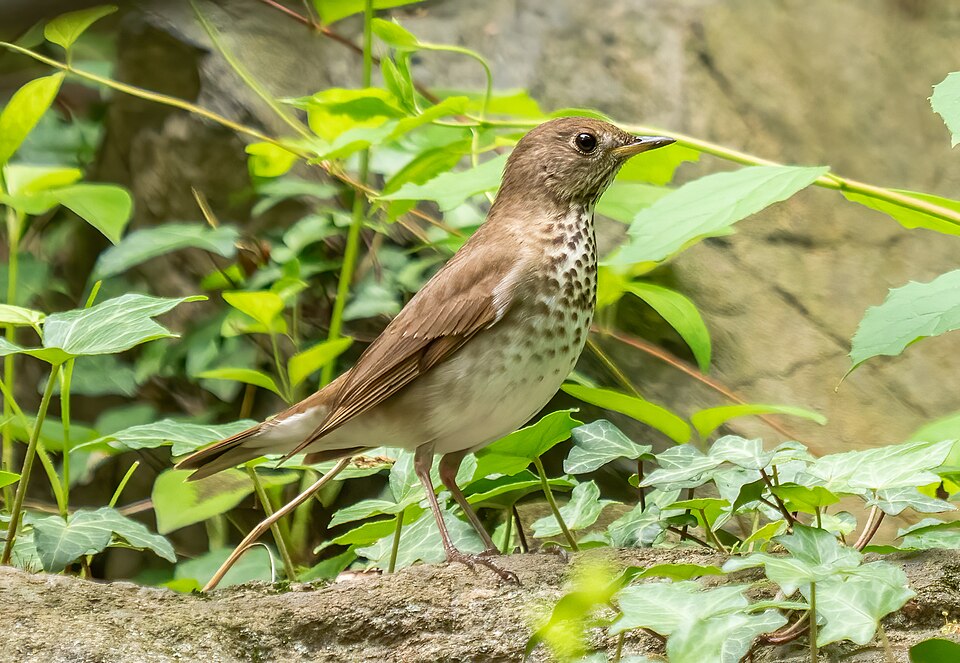
The Gray-cheeked Thrush is one of North America's most overlooked songbirds, and that is partly by design. It nests farther north than almost any other thrush on the continent, in the stunted spruce and dense willow thickets that mark the transition from boreal forest to open tundra, from Newfoundland across northern Canada and Alaska and into the Russian Far East. For most birders south of the taiga, it is known only as a brief, secretive passage migrant in spring and fall, a plain brown thrush skulking in shadowy understory or calling unseen from the night sky overhead.
What it lacks in flashy plumage it makes up for in voice and in a kind of austere, no-nonsense beauty. The cool gray wash on its face, the faint eyering, and the reserved demeanor all set it apart from its warmer, more confiding relatives. Because it is so easily confused with the Swainson's Thrush and the closely related Bicknell's Thrush, learning to identify a Gray-cheeked Thrush with confidence is one of the satisfying challenges of intermediate birding.
This is a medium-small, slender thrush with the typical upright, alert posture of the genus Catharus. It is cold-toned overall, lacking the warm buff or rufous highlights of its cousins, and its face is the key: gray cheeks, a grayish wash around a faint, often incomplete eyering, and a generally plain, expressionless look.
| Upperparts | Uniform cold olive-brown to grayish-brown from crown to tail, with no rufous or contrast in the wings or rump. |
| Face | Grayish cheeks (auriculars) and a faint, often broken or grayish eyering; lacks the bold buffy 'spectacles' of Swainson's Thrush. |
| Underparts | Whitish breast with bold blackish spots, a grayish-buff wash across the upper chest, and clean white belly and flanks. |
| Bill | Dark with a pinkish to yellowish base on the lower mandible. |
| Legs | Pinkish to flesh-colored, typical of Catharus thrushes. |
| Size and shape | Slim and medium-small, slightly larger and longer-winged than a Swainson's, with a fairly long primary projection suited to long-distance migration. |
Male vs. female
Males and females look alike in the field. The sexes share the same cold gray-brown plumage, spotted breast, and gray face, and there is no reliable visual way to tell them apart in the wild. On the breeding grounds, behavior offers the only clues: the singing bird perched in the open is usually the male, while the female does the building and incubating. In the hand, breeding females can be identified by a brood patch, but for ordinary field birding, treat any Gray-cheeked Thrush as sex-unknown.
Juveniles
Recently fledged juveniles are heavily marked with pale buff spotting and streaking on the upperparts, especially on the back and wing coverts, giving them a scaled or spangled look that fades as they molt. By the time young birds appear on fall migration they closely resemble adults, though fresh-plumaged immatures may show slightly more buff in the wing covert tips. The cold gray face and spotted breast are present from early on.
The song is a thin, reedy, slightly nasal phrase that spirals downward at the end, often written as wee-o, wee-o, wee-o, tee-de-leee-u or chee-chee-wee-oo, tideoo. It has the haunting, flute-like ventriloquial quality shared by all the Catharus thrushes, but it is more buzzy and nasal than the rising, ethereal song of the Swainson's Thrush, and it tends to drop in pitch rather than climb. Heard at dusk in the boreal twilight, it is unmistakably wild.
The common call is a distinctive, slurred, slightly down-slurred quee-a or veer, nasal and reedy and quite different from the liquid whit of a Swainson's. During nocturnal migration, listeners with patience can pick out the species' flight call, a high, descending, somewhat buzzy note given by birds passing overhead in the dark, one of the classic challenges of nocturnal flight-call birding.
Gray-cheeked Thrushes breed across the far north, from the spruce-and-willow scrub of Newfoundland and northern Quebec west through the Canadian taiga to Alaska, and across the Bering Strait into northeastern Siberia, the only Catharus thrush that nests in the Old World. They favor stunted, dense vegetation near the treeline rather than tall closed forest.
They are long-distance migrants that winter mainly in northern South America, especially the Amazon Basin of Colombia, Venezuela, Brazil, and neighboring countries. In between, most birds funnel through the eastern and central United States, where they are uncommon to fairly common but easily missed passage migrants, typically peaking in mid-to-late May in spring and from September into early October in fall. A great deal of their migration happens at night.
Like other forest thrushes, the Gray-cheeked Thrush eats a mix of invertebrates and fruit, shifting with the season. During the breeding period and on migration it forages heavily on insects and other small animals: beetles, ants, caterpillars, flies, spiders, and the like. It hunts mostly on or near the ground, hopping through leaf litter and low cover, flicking aside debris and pausing to peer for movement in the classic stop-and-stare style of its genus.
In late summer, fall, and on the wintering grounds, berries and small fruits become much more important, fueling the enormous energy demands of migration. Birds will glean fruit from shrubs and low trees as well as continue to take insects when available.
The female builds a bulky, cup-shaped nest of grasses, twigs, weed stems, moss, and mud, often lined with finer material, and usually places it low, within a few feet of the ground in a dense conifer, willow, or alder thicket. The well-hidden placement in tangled subarctic scrub makes nests genuinely difficult to find.
A typical clutch is three to four pale greenish-blue eggs, lightly speckled with brown. The female does the incubating, and after hatching both parents feed the nestlings a steady diet of insects. With such a short northern summer, pairs generally raise a single brood per season before beginning the long journey south.
Honestly, this is not a backyard or feeder bird, and you should not expect one to show up at a seed tray. Gray-cheeked Thrushes are shy migrants and far-north breeders that spend their lives in dense cover, so the goal is to make your yard a welcoming migration stopover rather than a feeding station.
- Plant native fruiting shrubs such as dogwood, viburnum, serviceberry, and elderberry; fall berries are exactly what migrating thrushes are looking for.
- Provide dense, shrubby cover and a brushy understory where a skulking thrush can forage and rest out of sight.
- Offer water at ground level with a shallow dish or a dripper near cover; migrant thrushes are drawn to the sound of moving water.
- Keep leaf litter under shrubs instead of raking it bare, since these birds feed on insects in the litter.
- Keep cats indoors and reduce window collisions during May and September migration peaks, when exhausted migrants are most vulnerable.
- Watch and listen at dawn during migration, especially after a night of southerly (spring) or northerly (fall) winds, when grounded migrants pause to refuel.
- Swainson's Thrush: The most-confused species. Swainson's shows bold buffy 'spectacles' (warm buff eyering and lores) and a buff-washed face and breast; its song rises in pitch while Gray-cheeked's falls.
- Bicknell's Thrush: Nearly identical and only recently split from Gray-cheeked. Bicknell's is slightly smaller, warmer-toned with more rufous in the tail, and breeds in mountaintop forest of the Northeast; best separated by range and voice.
- Veery: Much warmer, bright reddish-brown above with only faint, blurry spotting on a pale breast, lacking the cold gray face and crisp spots of a Gray-cheeked.
- Hermit Thrush: Shows a contrasting rufous tail that it slowly raises and lowers, and a complete buffy eyering; Gray-cheeked has a uniform tail and a fainter, grayer eyering.
How do you tell a Gray-cheeked Thrush from a Swainson's Thrush?
Look at the face. A Swainson's Thrush has obvious buffy 'spectacles' (a warm buff eyering and buff lores) and a buff-washed breast, giving it a friendly, big-eyed expression. A Gray-cheeked Thrush looks plainer and colder, with gray cheeks and only a faint, grayish eyering. Voice clinches it: the Swainson's song spirals upward while the Gray-cheeked's drops in pitch and sounds more nasal.
Where does the Gray-cheeked Thrush live?
It breeds in stunted spruce and willow thickets near the treeline across the far north, from Newfoundland and northern Canada to Alaska and into northeastern Siberia. It winters in northern South America, mainly the Amazon Basin, and passes through the central and eastern United States as a migrant in spring and fall.
Is the Gray-cheeked Thrush rare?
It is not globally rare and is listed as Least Concern, but it is hard to see. It nests in remote subarctic country and migrates secretively, often at night, so most birders encounter it only briefly during migration. 'Uncommon but easily overlooked' describes it better than 'rare.'
What does the Gray-cheeked Thrush sound like?
The song is a thin, reedy, slightly nasal phrase that falls in pitch at the end, often rendered as wee-o, wee-o, tee-de-leee-u. The common call is a slurred, nasal quee-a. During nocturnal migration it gives a high, buzzy, descending flight call that experienced listeners use to detect birds passing overhead in the dark.
Will a Gray-cheeked Thrush come to my feeder?
Not to seed feeders. It is an insect- and fruit-eating ground forager that stays in dense cover. The best way to attract one is to make your yard a migration stopover with native fruiting shrubs, dense cover, leaf litter, and a ground-level water source during the May and September migration peaks.
What is the difference between a Gray-cheeked Thrush and a Bicknell's Thrush?
They were considered one species until the 1990s and are extremely similar. Bicknell's is slightly smaller and warmer-toned, often with more rufous in the tail, sings a higher, more rising song, and breeds in dense mountaintop forest in the northeastern U.S. and adjacent Canada. Outside that breeding range and song, the two are very difficult to separate in the field.