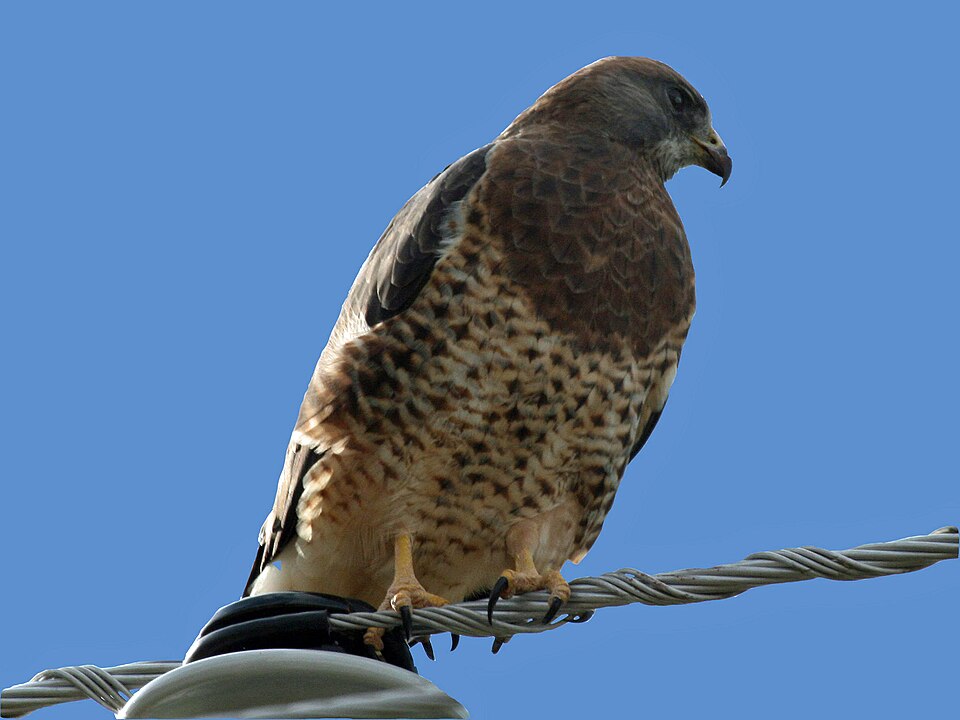
Swainson's Hawk is the classic buteo of the open West, a lean, long-winged raptor that perches on fence posts and power poles across the grasslands and farm country of the Great Plains and Intermountain basins. In summer it is one of the most visible hawks of the prairie, often hunting on foot through stubble fields or kiting low over hayland. Slimmer and more elegant in flight than the bulky Red-tailed Hawk it shares the landscape with, it holds its wings in a shallow V and shows a striking two-toned underwing that, once learned, makes it identifiable at a great distance.
What truly sets this hawk apart is its astonishing migration. Nearly the entire population funnels down through Mexico and Central America each fall to winter on the pampas of Argentina, traveling in flocks that can number in the tens of thousands. These swirling rivers of hawks, called "kettles," are one of the great spectacles of the Americas. Named for the English naturalist William Swainson, the species is a true long-distance champion, completing a round trip of roughly 12,000 miles each year.
This is a medium-to-large buteo with a notably slim build, long pointed wings, and a longer tail than most of its relatives. In flight the wings taper toward the tips, giving a more falcon-like or graceful silhouette than the broad, paddle-shaped wings of a Red-tailed Hawk. Swainson's Hawks come in light, intermediate, and dark morphs, so plumage varies, but the wing shape and flight style are consistent giveaways.
| Underwing pattern | Light-morph birds show clean white wing linings contrasting sharply with dark gray flight feathers (the reverse of most hawks), a key distant mark. |
| Breast band | A reddish-brown or rufous bib across the chest on light morphs, set off against a white belly and white throat. |
| Wing shape | Long, relatively narrow, pointed wings held in a shallow dihedral (slight V) while soaring. |
| Face | White throat patch and often a small white patch at the base of the bill, with a dark hood-like head. |
| Tail | Grayish-brown with numerous fine dark bars and a slightly wider dark band near the tip; longer and slimmer than a Red-tail's. |
| Color morphs | Light, rufous-intermediate, and dark morphs occur; dark birds are chocolate to nearly black but still show pale undertail coverts. |
Male vs. female
Males and females look essentially alike in plumage, and both show the same morphs and the diagnostic two-toned underwing. As with most hawks, females average noticeably larger and heavier than males, but size is hard to judge on a lone bird. On light morphs, males tend to have a grayer head and a cleaner, more sharply defined rufous breast band, while females may show a slightly browner head and a somewhat more diffuse band, but these differences overlap and are not reliable for confidently sexing a single bird in the field.
Juveniles
Juveniles are heavily streaked and buffy below, lacking the clean rufous breast band of adults, and their faces often show a pale supercilium and dark malar streak that can briefly suggest a falcon or a young Red-tail. They do not yet have the crisp two-toned underwing; instead the flight feathers are more uniformly pale with fine barring. The buffy, mottled look gradually gives way to adult plumage over the first couple of years, and young birds often appear scruffier and more variable than adults.
Swainson's Hawk is not especially vocal, but its main call is a drawn-out, plaintive scream, a thin, high kreeeeer or peeeeeee that slurs downward and lacks the rough, gravelly quality of the Red-tailed Hawk's famous rasp. The call is cleaner and more whistled, often given near the nest or when an intruder approaches.
Around the nest birds also give shorter, sharper alarm notes and softer contact calls between mates. On the wintering grounds and in migration the species is largely silent, letting the spectacle of the flocks speak for itself.
Swainson's Hawk breeds across much of western North America, from the Canadian prairie provinces and the northern Great Plains south through the Intermountain West, the Central Valley of California, Texas, and into northern Mexico. It favors open country, shortgrass and mixed prairie, sagebrush flats, agricultural land, and the edges of riparian groves where it can find scattered trees for nesting.
It is a complete long-distance migrant. Almost the entire population leaves North America in fall, streaming south through Mexico and the narrow land bridge of Central America in enormous kettles, then continuing to the grasslands of southern South America, especially Argentina, for the northern winter. Spring and fall passage through places like Veracruz, Mexico, and Panama can involve hundreds of thousands of birds. A few individuals winter in southern Florida and southern Texas rather than completing the full journey.
This hawk has one of the most seasonally split diets of any North American raptor. During the breeding season, when feeding nestlings, it hunts vertebrate prey, ground squirrels, gophers, mice, voles, young rabbits, snakes, lizards, and small birds, typically by perching and dropping onto prey or by quartering low over open ground.
Once the young have fledged and through migration and winter, Swainson's Hawks shift dramatically toward insects, especially grasshoppers, crickets, and dragonflies. They will follow grasshopper outbreaks and gather where farm machinery, fires, or grazing flush insects into the open, sometimes hunting on foot and snatching prey from the ground. On the Argentine wintering grounds they are famous for swarming over fields after insects, a habit that, tragically, exposed them to mass pesticide poisonings in the 1990s before international conservation efforts curbed the practice.
Swainson's Hawks nest in isolated trees, riparian groves, shelterbelts, and increasingly on artificial structures and utility poles in treeless country. The pair builds a fairly flimsy stick nest, often lined with fresh green leaves, grasses, and weed stems, usually placed at moderate height. Pairs frequently return to the same general nesting area year after year and may reuse or rebuild old nests.
The female lays a small clutch, incubated mostly by her while the male delivers food. Both parents help feed the young, which hatch in roughly a month and remain dependent for several more weeks after fledging. Because the species nests in farm country, individual trees and shelterbelts can be locally important, and nesting birds are sensitive to disturbance and to loss of the scattered trees they depend on.
Swainson's Hawk is a wide-ranging predator of open country, not a backyard or feeder bird, so you won't draw one in with seed or suet. Instead, the goal is to recognize and appreciate it in the landscapes it favors and to support the open habitats it needs.
- Scan fence posts and power poles along rural roads through prairie and farm country in summer, this hawk loves to perch in the open on exposed lookouts.
- Watch hayfields and stubble during and after mowing or harvest, when hawks gather to grab grasshoppers and rodents flushed by machinery.
- Look up in late summer and fall for kettles of soaring hawks riding thermals; migration hotspots like Veracruz, Mexico, can produce staggering numbers.
- Learn the flight silhouette, long pointed wings in a shallow V and a white-and-dark underwing, to pick it out from Red-tailed Hawks at a distance.
- Support grassland conservation and reduced pesticide use, since insect prey and open nesting habitat are what this species truly depends on.
- Red-tailed Hawk: Bulkier with broad, rounded wings held flatter; adults show a brick-red tail and a dark belly band. Wing linings are darker than the flight feathers, the opposite of Swainson's two-toned pattern.
- Ferruginous Hawk: Larger and paler with very long broad wings, a big head, and rusty leg feathers forming a dark V on light-morph birds; lacks Swainson's dark flight-feather contrast and rufous chest band.
- Rough-legged Hawk: A winter visitor from the Arctic with feathered legs, dark belly and dark 'wrist' patches, and a habit of hovering; present when Swainson's is far away in South America.
- Broad-winged Hawk: Much smaller and chunkier, an eastern-forest bird with a boldly black-and-white banded tail; also migrates in huge kettles but with very different shape and habitat.
How do I tell a Swainson's Hawk from a Red-tailed Hawk?
Look at the underwing in flight. A light-morph Swainson's shows clean white wing linings contrasting with dark gray flight feathers, the reverse of a Red-tailed Hawk, which has darker linings and pale flight feathers. Swainson's is also slimmer with longer, more pointed wings held in a shallow V, and lacks the brick-red tail. A rufous breast band on a white belly is another good clue.
Why do Swainson's Hawks migrate so far?
Almost the entire population winters on the grasslands of Argentina, a round trip of roughly 12,000 miles. They follow abundant insect food, especially grasshoppers, on the South American pampas during the northern winter. Because they soar on thermals rather than flap, they funnel through Mexico and Central America in massive flocks called kettles.
What do Swainson's Hawks eat?
Their diet shifts with the season. While raising young they hunt rodents like ground squirrels and gophers, plus snakes, lizards, and small birds. The rest of the year, including migration and winter, they switch heavily to insects, especially grasshoppers, crickets, and dragonflies, often hunting on foot or following farm machinery that flushes prey.
Where can I see a Swainson's Hawk?
Look in open country across the western United States and the Canadian prairies in summer: shortgrass prairie, sagebrush flats, and farmland. Scan fence posts, power poles, and freshly mowed fields. During fall migration, hawk-watch sites in the Southwest and especially Veracruz, Mexico, can see enormous numbers passing through.
Are Swainson's Hawks dangerous to pets or chickens?
They pose little threat to dogs and cats and are not a chicken-yard menace the way some larger raptors can be. Their prey is dominated by rodents and insects, and during much of the year they feed mainly on grasshoppers. They are far more beneficial than harmful, helping control rodent and insect populations on farmland.