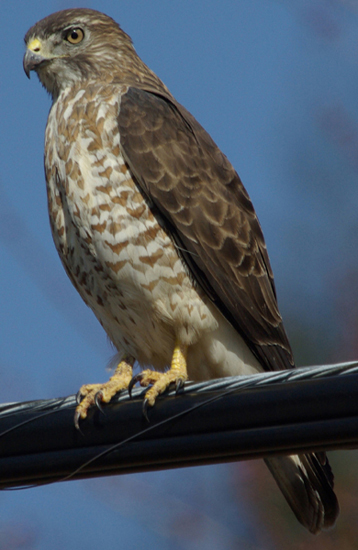
The Broad-winged Hawk is one of eastern North America's most abundant forest raptors, yet for much of the year it is also one of the easiest to overlook. A stocky, crow-sized member of the Buteo genus, it spends the breeding season tucked inside deciduous and mixed woodlands, perching quietly along the edges of clearings and waiting to drop on small prey. Its thin, high-pitched whistle drifting through the summer canopy is often the first and only clue that one is nearby.
What makes this otherwise modest hawk famous is its migration. Each September, Broad-wings funnel southward by the thousands, riding columns of rising warm air called thermals. They spiral upward in swirling flocks known as "kettles" that can number in the tens of thousands, then peel off and glide toward the next thermal. Hawkwatch sites from the Appalachians to the Texas coast and on to Panama tally these rivers of raptors as the birds stream toward wintering grounds in Central and South America. Few birds turn a quiet woodland life into such a dramatic seasonal display.
The Broad-winged Hawk is a small, compact buteo with a chunky body, a relatively short, banded tail, and broad wings that taper to a noticeably pointed tip in flight. At rest it looks stocky and short-tailed; in the air it shows a distinctive silhouette with wings held flat and a pale underwing rimmed by a clean dark border.
| Size | Small buteo, roughly crow-sized, clearly smaller and more compact than a Red-tailed Hawk. |
| Tail | Short tail with bold black-and-white bands; adults show one broad white band that is obvious from below. |
| Underparts | Adults have warm reddish-brown barring across a whitish breast and belly, densest on the upper chest. |
| Wings in flight | Broad, pointed wings with pale undersides and a crisp dark trailing edge framing the whole wing. |
| Head & eye | Compact head with a dark eye and yellow cere; relatively plain face compared to other hawks. |
| Dark morph | A scarce dark (chocolate-brown) morph occurs mainly in the western part of the breeding range. |
Male vs. female
Male and female Broad-winged Hawks look essentially identical in plumage, both share the reddish barred underparts, banded tail, and dark-bordered wings, so you cannot reliably sex them by sight in the field. As with most raptors, females average larger and heavier than males, but the size difference is modest and only apparent when a pair is seen together. During courtship and nesting, behavior is a better clue than appearance: the smaller, more agile bird is usually the male.
Juveniles
Juveniles look quite different from adults and cause a lot of identification confusion. Young birds are brown above and creamy-white below with dark vertical streaking on the breast and belly rather than the neat reddish barring of adults. Their tail is grayish-brown with several narrow dark bands instead of the bold single white band, and the dark trailing edge to the wing is fainter. This streaky, finely banded look persists through the first year, and many fall-migrant Broad-wings are these brown juveniles.
The Broad-winged Hawk's signature sound is a thin, plaintive, two-parted whistle, a short note followed by a long, descending one, often written as pa-teeeee or kee-eeeee. It is surprisingly high and reedy for a hawk, almost insect-like or like the whistle of a Eastern Wood-Pewee stretched thin, and it carries well through dense summer woods.
Birds call most persistently during the breeding season, especially around the nest and in territorial flight, and the whistle is frequently given by birds circling overhead. Because the call is so distinctive, many birders detect this hawk by ear long before they spot it in the canopy. Blue Jays are notorious for imitating it, so a "Broad-wing" whistle near a feeder is worth a second look.
Broad-winged Hawks breed across the eastern half of North America, from the Maritime provinces and southern Canada south through the eastern United States to the Gulf states, and west into the forested edges of the Great Plains. They favor large blocks of deciduous and mixed forest and are absent as breeders from the open and arid West (a few isolated populations occur on Caribbean islands).
They are among the most migratory of North American hawks. Nearly the entire population leaves for the winter, traveling to Central America and northern South America, with most birds wintering from southern Mexico to Peru and Brazil. Because they rely on thermals and avoid long water crossings, migrants concentrate along ridgelines and around the Gulf of Mexico, pouring through bottlenecks like Veracruz, Mexico, and Panama in staggering numbers each fall. Peak passage in the eastern U.S. is mid-September; spring return is in April and May.
The Broad-winged Hawk is a versatile sit-and-wait predator. It hunts mostly by perching on a limb at the edge of a forest opening, scanning the ground, and then dropping or making a short flight to seize prey. Its diet is dominated by small mammals such as voles, mice, chipmunks, and young squirrels, but it is highly opportunistic and takes a wide range of prey through the season.
Amphibians and reptiles, frogs, toads, snakes, and lizards, make up a substantial part of the menu, especially in damp woodlands, and the hawk also eats large insects, earthworms, crayfish, nestling birds, and occasionally small birds. This flexibility lets it thrive in the patchy mix of woods, wetlands, and clearings that characterizes much of the eastern forest.
Broad-winged Hawks nest in the interior of forests, usually in the first main crotch of a deciduous tree well below the canopy. Both members of the pair help build a fairly small, somewhat flimsy stick nest, often lining it with bark, lichens, and sprigs of green foliage that they continue to add through the nesting period. Pairs sometimes refurbish an old nest of their own or of another bird.
The female lays a small clutch and does most of the incubation while the male delivers food, a process that takes about a month. Chicks hatch covered in white down and remain in the nest for several weeks before fledging, after which the adults continue to feed them for a time. The species raises a single brood per year, and pairs are quiet and secretive around the nest, making active nests easy to walk past unnoticed.
The Broad-winged Hawk is not a feeder bird and cannot be attracted with food the way songbirds can, it is a forest predator that hunts live prey and avoids human activity, especially while nesting. That said, you can encounter and even host them with the right habitat and timing.
- Protect mature forest. Broad-wings need sizable blocks of deciduous or mixed woodland to breed, so keeping wooded acreage intact is the single best way to host them.
- Watch the fall skies. In September, visit a local hawkwatch on a ridge or near the coast on a day with northwest winds to witness migrating kettles, this is the best way most people ever see the species.
- Maintain forest edges and clearings. Small openings, wet meadows, and woodland edges give the hawks the perches and open ground they need to hunt.
- Welcome the frogs and chipmunks. A healthy population of amphibians and small mammals on wooded property supports the prey base these hawks depend on.
- Learn the whistle. Knowing the thin, descending pa-teeeee call will help you detect breeding birds in summer woods long before you see them.
- Skip the rodenticides. Poisons aimed at mice and voles move up the food chain and can harm the hawks that eat them.
- Red-shouldered Hawk: Larger and longer-tailed with bold reddish shoulders and translucent pale crescents ('windows') near the wingtips in flight; its tail shows more numerous, narrower bands.
- Cooper's Hawk: An accipiter, not a buteo, slimmer with a long tail and short rounded wings, and it flaps with quick beats rather than soaring on broad wings.
- Red-tailed Hawk: Noticeably larger and bulkier with longer, broader wings; adults show a rusty unbanded tail and a dark belly band rather than the Broad-wing's banded tail.
- Sharp-shinned Hawk: Much smaller accipiter with a long square-tipped tail and short rounded wings; flap-and-glide flight and forest-dashing style differ from the soaring Broad-wing.
Why do Broad-winged Hawks gather in such huge flocks during migration?
They migrate by riding thermals, rising columns of warm air, to gain altitude with very little effort, then glide to the next thermal. Many birds use the same thermals at once, creating swirling 'kettles' that can hold thousands of hawks. Because they avoid crossing large bodies of water, they also funnel through narrow land routes, concentrating into spectacular streams over hawkwatch sites.
When and where can I see a Broad-winged Hawk migration?
Peak fall migration in the eastern U.S. is mid-September. Watch from ridgelines, mountain lookouts, or coastal hawkwatch sites, especially on days with northwest winds after a cold front. World-famous concentration points include the eastern Appalachians, the Texas coast, Veracruz in Mexico, and Panama, where hundreds of thousands can pass in a single season.
How do I tell a Broad-winged Hawk from a Red-shouldered Hawk?
Broad-wings are smaller and shorter-tailed, with a bold single white tail band and clean dark borders around pale wings in flight. Red-shouldered Hawks are larger, longer-tailed, show reddish shoulder patches, and have pale translucent crescents ('windows') near the wingtips and many narrow tail bands. Voice helps too, the Broad-wing's whistle is thinner and two-parted.
Will a Broad-winged Hawk come to my backyard or feeder?
Not in the usual sense. They are forest hunters that eat live prey like rodents, frogs, and snakes, and they avoid human activity while nesting. You're most likely to see one soaring overhead during migration. The hawks that occasionally raid backyard feeders for songbirds are usually Cooper's or Sharp-shinned Hawks, not Broad-wings.
What does a Broad-winged Hawk sound like?
Its call is a thin, high, two-parted whistle, a short note followed by a long, descending one, often written 'pa-teeeee.' It is reedy and almost insect-like for a hawk and carries well through summer woods. Be aware that Blue Jays frequently imitate it, so a whistle near your yard is worth confirming with a look.