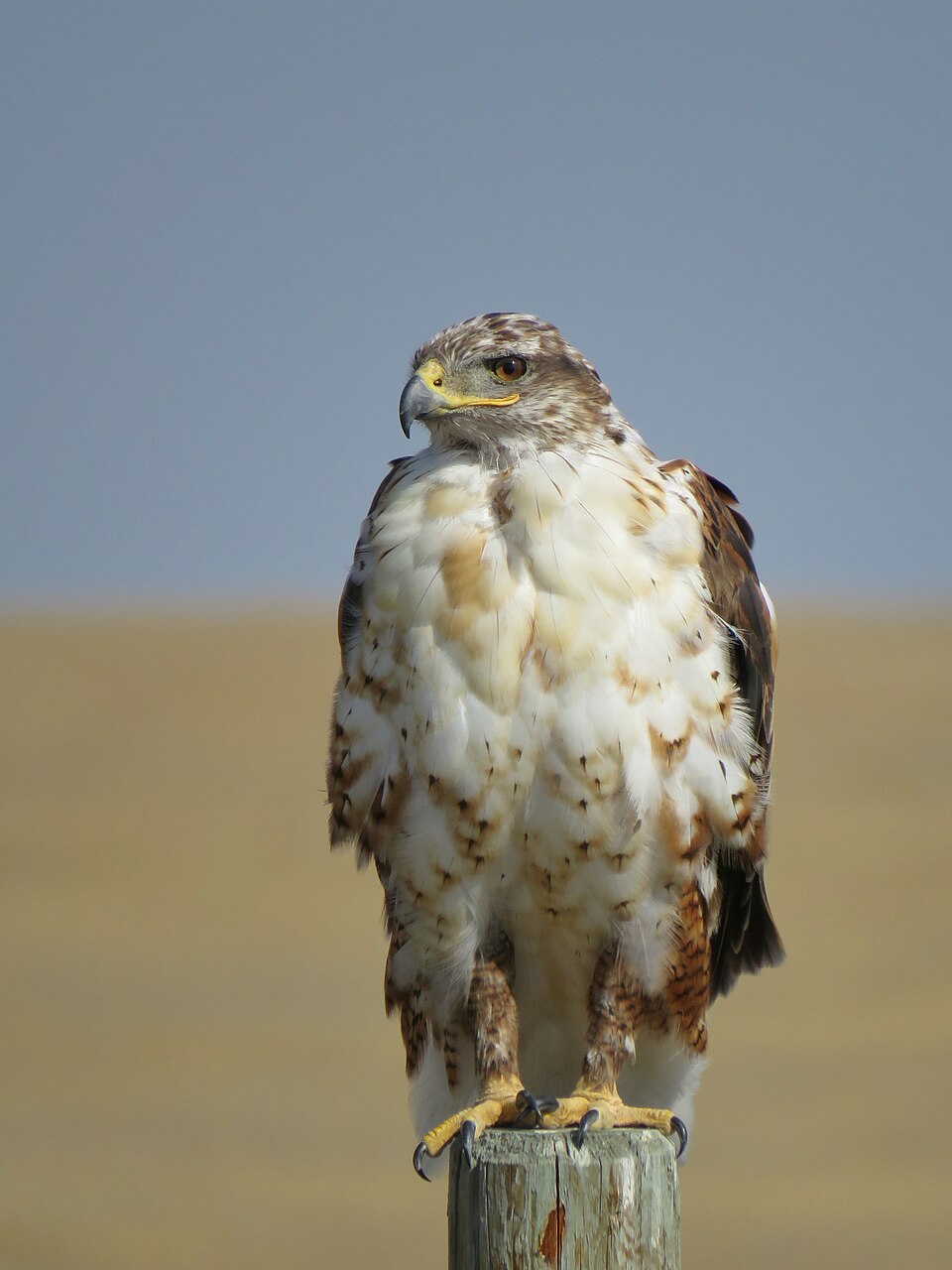
The Ferruginous Hawk is the heavyweight of North American buteos, a broad-winged, eagle-like raptor of wide-open western grasslands, sagebrush flats, and shortgrass prairie. Its name comes from "ferrugo," the Latin word for rust, a nod to the rich reddish-brown that washes its shoulders, back, and legs on classic light-morph adults. Big, pale-bodied, and long-winged, it can look almost like a small eagle as it hangs in the wind over a prairie-dog town, scanning for movement below.
This is a bird of space and sky. Unlike the ubiquitous Red-tailed Hawk that thrives along highways and city edges, the Ferruginous Hawk needs intact open country with healthy rodent and ground-squirrel populations. Where prairie has been plowed under or prairie-dog colonies poisoned out, this hawk disappears. That tie to the disappearing grassland makes it a favorite of western birders and a useful barometer for the health of the open range itself.
Start with size and shape. This is a big, bulky hawk with long, broad, slightly tapered wings and a large head, often appearing nearly the size of an eagle when it soars. In flight it holds its wings in a shallow dipping V (a faint dihedral), and the long gape that reaches back below the eye gives it a notably large-mouthed, fierce expression up close.
| Size | The largest North American buteo, roughly Red-tailed Hawk size or bigger, with a heavy chest and broad wings |
| Light morph (most common) | Clean whitish underparts and pale head; rusty back and shoulders; rust-colored legs that form a dark V against the white belly when seen from below in flight |
| Underwing | Strikingly pale, almost white flight feathers with little dark patterning, contrasting with the rusty leg feathering; lacks the bold dark wrist comma of many buteos |
| Dark morph | Uncommon; rich chocolate to rufous-brown body with contrasting pale, silvery flight feathers below |
| Tail | Pale and unbanded, washed with rust, gray, or white above; never the solid brick-red of a Red-tailed Hawk |
| Gape | Very large yellow gape extending back under the eye, giving a wide-mouthed look at close range |
Male vs. female
Males and females look alike in plumage, so you can't reliably sex one by color or pattern in the field. As with most raptors, the difference is size: females are noticeably larger and heavier than males, a difference most obvious when a pair is perched or flying together. A lone bird, though, is essentially impossible to sex with confidence.
Juveniles
Juveniles lack the warm rusty tones of adults. They are browner above and largely white below, with dark spotting or barring concentrated on the flanks and legs rather than the clean rufous leggings of an adult. The rusty back and the bold dark-legged V develop over the first couple of years, so a young bird can look surprisingly plain and pale, sometimes causing confusion with other light-bellied hawks until you note the size and structure.
Ferruginous Hawks are generally quiet birds, and you can watch one for a long stretch without hearing a sound. The main call is a harsh, descending alarm given near the nest or in disputes, often written as a drawn-out kree-a or kaah, gull-like and gruff rather than the clear, ringing scream of a Red-tailed Hawk.
Around the nest they also give softer chattering and chuckling notes between mates and toward begging young. Away from breeding territory, expect mostly silence, this is a hawk you identify by eye far more often than by ear.
The Ferruginous Hawk is a bird of the interior West. It breeds across the shortgrass and mixed-grass prairies, sagebrush, and high desert of the Great Plains and Intermountain West, from the Canadian prairie provinces south through Montana, the Dakotas, Wyoming, Colorado, the Great Basin, and into the Southwest. It favors flat to rolling open country and avoids forest and densely settled landscapes.
It is a short- to medium-distance migrant. Northern breeders pull south and downslope in fall, and in winter the species concentrates across the southern Great Plains, the desert Southwest, and into northern and central Mexico, often gathering where ground squirrels, prairie dogs, or jackrabbits are abundant. Some birds wander to grasslands and agricultural valleys outside the core range during the colder months.
This hawk is a specialist on small to medium mammals of the open country. Its diet leans heavily on ground squirrels, prairie dogs, pocket gophers, rabbits, and jackrabbits, supplemented by mice, voles, and occasionally snakes, lizards, large insects, and birds. In many regions its breeding success rises and falls with the local prairie-dog and ground-squirrel populations.
It hunts in several styles. It will soar and kite into the wind, drop from a perch such as a fence post, utility pole, or low rise, or hunt from the ground itself, standing at a burrow entrance and waiting for a rodent to emerge. It also coursing low and fast over the prairie, using terrain to surprise prey, more like a giant harrier than a typical sit-and-wait buteo.
Ferruginous Hawks build bulky stick nests that they often reuse and add to year after year, sometimes growing them into enormous mounds. Nest sites reflect the treeless country they live in: low trees and shrubs where available, but also cliff ledges, rock outcrops, low knolls, haystacks, old buildings, utility structures, and artificial nest platforms. Historically, nests were sometimes built almost on the bare ground or lined with bison bones and dung.
The female lays a typical clutch of about two to four eggs, occasionally more in good rodent years, and incubation lasts roughly a month. Both parents tend the young, with the male doing most of the hunting early on while the female broods and feeds the chicks. Nestlings fledge after several weeks but remain dependent on the adults for a while afterward. This species is notoriously sensitive to disturbance near the nest and may abandon a site if people approach too closely during egg-laying or early incubation.
The Ferruginous Hawk is not a backyard or feeder bird, and there is no birdseed, suet, or feeder setup that will draw one in. It is a wide-ranging predator of open prairie that needs large tracts of grassland and a healthy supply of ground squirrels, prairie dogs, and rabbits. You find this hawk by going to its habitat rather than luring it to yours.
- Go where the prairie is intact: shortgrass prairie, sagebrush flats, and high desert in the interior West are your best bet, especially areas with active prairie-dog towns or ground-squirrel colonies.
- Scan fence posts, utility poles, low knolls, and the ground itself, this hawk frequently hunts and rests low rather than always soaring.
- Watch for a big, pale buteo soaring with a shallow V and very white underwings, then look for the rusty shoulders and the dark leg-V against a white belly to clinch it.
- Winter is often the easiest season in the southern Plains and Southwest, where birds concentrate around abundant prey and may even gather loosely.
- If you own or manage open land, the best thing you can do is keep grassland intact, avoid poisoning rodent colonies, and leave nest structures undisturbed; artificial nest platforms have helped the species in some areas.
- Keep a respectful distance from any nest, as these hawks abandon nests readily if disturbed during the breeding season.
- Red-tailed Hawk: Far more common and widespread; adults show a solid brick-red tail and usually a dark belly band and dark wing patagial mark. Ferruginous is larger, paler-winged, with a pale unbanded tail and rusty leg-V.
- Rough-legged Hawk: Another open-country, feather-legged buteo, but a winter visitor from the Arctic with a bold dark belly, dark wrist patches, and a white tail with a dark terminal band. Ferruginous is bigger and cleaner-bellied with rusty (not dark) leggings.
- Golden Eagle: Shares open western habitat and can be confused at a distance, but is much larger and darker with fully feathered legs and a broad dark trailing wing edge. Ferruginous is paler overall with bright white underwings.
- Swainson's Hawk: A slimmer prairie buteo with longer, pointed wings held in a stronger V; light morphs show a dark chest bib and dark flight feathers contrasting with pale wing linings, the reverse of Ferruginous's pale flight feathers.
How do I tell a Ferruginous Hawk from a Red-tailed Hawk?
Look at size, color, and the tail. The Ferruginous Hawk is bigger and bulkier with very pale, nearly white underwings and a pale, unbanded tail. Light-morph adults have rusty shoulders and rust-colored legs that form a dark V against a clean white belly. A Red-tailed Hawk typically shows a solid brick-red tail above, a dark belly band, and a dark mark along the leading edge of the underwing.
Where can I see a Ferruginous Hawk?
Head to open country in the interior West: shortgrass prairie, sagebrush, and high desert across the Great Plains and Intermountain West in breeding season, and the southern Plains, Southwest, and northern Mexico in winter. Areas with active prairie-dog towns or ground-squirrel colonies are especially good.
Is the Ferruginous Hawk endangered?
It is listed as Least Concern globally and is not federally endangered in the United States, but it is uncommon, has a limited range, and is sensitive to habitat loss. Some states and provinces consider it a species of concern because plowing of prairie and the loss of prairie-dog and ground-squirrel colonies reduce both its food and its nesting habitat.
What does a Ferruginous Hawk eat?
Mostly small and medium mammals of open country, especially ground squirrels, prairie dogs, pocket gophers, rabbits, and jackrabbits, plus mice and voles. It will also take snakes, lizards, large insects, and the occasional bird. Its breeding success often tracks local rodent abundance.
Why is it called 'Ferruginous'?
The word comes from the Latin 'ferrugo,' meaning rust or iron-rust. It refers to the rich reddish-brown color on the back, shoulders, and legs of typical light-morph adults, the field mark that, together with its great size and pale underwings, sets it apart from other hawks.