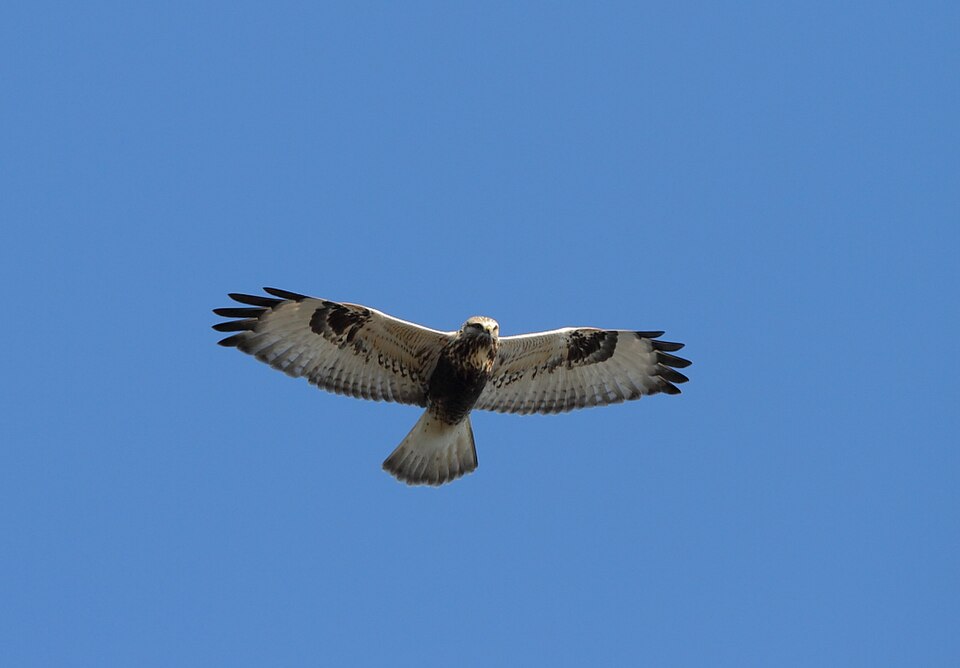
The Rough-legged Hawk is a large, long-winged buteo that breeds across the tundra of the far North and drops down into the United States and southern Canada only in winter. For many birders south of the boreal forest, its arrival is one of the quiet markers of the cold season: a big, pale-headed hawk perched at the very tip of a slender roadside sapling, or hanging motionless on the wind above a snowy field. Its name comes from the feathering that runs all the way down its legs to the toes, an insulation adaptation it shares with only a couple of other North American raptors and one that fits its Arctic life perfectly.
What makes this hawk such a satisfying winter find is its habit of hovering and "kiting" over open ground while hunting, something most of our broad-winged hawks rarely do. Combined with its boldly patterned underwings and dark belly, that behavior makes it identifiable at a remarkable distance. Rough-legs are birds of open country in winter, favoring marshes, prairies, airports, agricultural fields, and the wide shoulders of rural highways, where they hunt the small rodents that drive both their feeding and their famously boom-and-bust population cycles.
Rough-legged Hawks are large buteos with notably long, somewhat narrow wings and a longish tail compared with the chunkier Red-tailed Hawk. In flight they look big-winged and slightly loose, and they appear lightly built for their size, which suits all that hovering. Plumage is variable, with a light morph and a dark morph, but a few marks hold true across nearly all birds.
| Black wrist patches | Bold dark commas (carpal patches) at the bend of each wing underneath, one of the most reliable marks in flight |
| Dark belly band | Light-morph birds show a heavy dark belly, often a solid dark band, contrasting with a paler chest |
| Tail pattern | White-based tail with a broad dark band near the tip; from above the tail base flashes white |
| Feathered legs | Legs feathered to the toes (hard to see at distance, but diagnostic up close) |
| Small bill, small feet | Relatively small bill and feet for the body size, it preys mainly on small rodents |
| Hovering flight | Frequently hovers and kites into the wind over open fields, unlike most other buteos |
Male vs. female
Sexes are similar in overall pattern, and many birds cannot be safely sexed in the field. On light-morph adults there is a tendency for females to show a single broad, solid dark belly band while adult males show a more mottled or multi-banded belly and often more extensive black at the wingtips and a multi-banded tail. These differences overlap and are best used as supporting clues rather than firm calls. As with most raptors, females average larger than males.
Juveniles
Juveniles (first-winter birds) are common in the wintering range and worth learning. Light-morph juveniles show a clean, contrasting pattern: a pale head, a single solid dark belly patch, and bold black carpal patches on a whitish underwing. Their tail has a broad, soft dusky tip with a wide white base, the dark band being less crisp than on adults. Juvenile eyes are paler, and the upperwing often shows a pale window in the outer primaries. Dark-morph juveniles are chocolate brown overall with paler, silvery flight feathers below.
Rough-legged Hawks are mostly silent away from the breeding grounds, so wintering birds are seen far more often than heard. On the tundra, the main call is a downslurred, slightly mewing whistle, often written as a plaintive kee-eer or kee-uk, thinner and softer than the harsh scream of a Red-tailed Hawk.
Around the nest, adults give a variety of alarm and contact notes, including a hoarse, cat-like wail and short cackling or clucking sounds when a predator or rival approaches. These vocalizations are something most North American birders never hear, since the breeding range lies far beyond the reach of most birding.
The Rough-legged Hawk has a circumpolar breeding range, nesting on Arctic and subarctic tundra across northern North America (Alaska and northern Canada) as well as northern Europe and Asia. It is a true long-distance migrant: in fall it moves south out of the Arctic to winter across much of southern Canada and the northern and central United States, reaching roughly the latitude of the central states and occasionally farther south in big flight years.
Winter numbers and how far south birds push vary a great deal from year to year, driven largely by the abundance of tundra rodents (lemmings and voles) during the breeding season and by the severity of northern winters. In some winters Rough-legs are scarce; in others, an irruption brings them to fields and marshes where they are otherwise uncommon. Look for them from late fall through early spring in open landscapes, then they vanish north again by April and May.
This is a small-mammal specialist. On the breeding grounds, lemmings and voles make up the bulk of the diet, and Rough-legged Hawk nesting success rises and falls with the multi-year cycles of those rodents. In winter, voles, mice, and other small rodents remain the staple, supplemented by shrews, the occasional small bird, and carrion when prey is scarce. Their relatively small feet and bill reflect this focus on small, soft prey rather than larger quarry.
Their hunting style is distinctive. Rough-legs hunt from exposed perches, fence posts, utility poles, and the flimsy tops of small trees that would barely hold a Red-tailed Hawk, and also by flying low and slow into the wind, hovering on rapidly beating wings or kiting motionless to scan the ground below before dropping onto prey. This energetic hovering, more typical of a kestrel or harrier, is one of the best long-distance clues to the species in winter.
Rough-legged Hawks nest on the open tundra, typically on cliff ledges, rocky outcrops, riverbanks, or steep bluffs that offer a commanding view, occasionally on artificial structures. The nest is a bulky platform of sticks lined with finer material, and pairs often reuse and add to nests in successive years, building large mounds over time. Because the treeless Arctic offers few options, nest sites are chosen for their inaccessibility to ground predators.
The female lays a clutch that commonly ranges from about 2 to 5 eggs, with larger clutches in years of abundant rodents and smaller clutches, or no breeding at all, in poor lemming years. The female does most of the incubation while the male provisions her, and incubation lasts roughly a month. Young remain in or near the nest for several weeks before fledging, timed to the brief, intense Arctic summer. Typically a single brood is raised per year.
The Rough-legged Hawk is not a backyard or feeder bird, and there is no way to draw one to a yard the way you might attract a chickadee or finch. It is a wintering raptor of wide-open country, so the goal is to find it rather than feed it.
- Search open country in winter, marshes, prairies, large agricultural fields, airports, and reclaimed land where rodents are abundant.
- Scan the tops of small trees and roadside poles; Rough-legs perch on flimsy treetops that won't hold heavier hawks.
- Watch for a hawk that hovers and kites into the wind over fields, that behavior alone flags this species at a distance.
- Look underneath for the black wrist (carpal) patches and dark belly to confirm a light-morph bird.
- Time your search from late fall through early spring; they are absent in summer, having returned to the Arctic.
- Drive rural roads at dawn and dusk in winter, when the hawks hunt actively from low perches along open margins.
- Red-tailed Hawk: Bulkier with broader wings and a shorter tail; rarely hovers, lacks bold black wrist patches, and adults show a brick-red tail rather than a white-based, dark-tipped one.
- Northern Harrier: Slimmer with a long tail and an obvious white rump patch; flies low with wings held in a V (dihedral) rather than hovering on flat, beating wings.
- Ferruginous Hawk: Larger and longer-winged with a pale, unbanded tail and rusty leg-feathering; lacks the dark belly band and bold black carpal patches of a light-morph Rough-leg.
- Red-shouldered Hawk: Smaller and more woodland-loving, with rufous shoulders, barred reddish underparts, and pale crescent 'windows' in the wingtips rather than dark wrist commas.
Why is it called a Rough-legged Hawk?
The name refers to its legs, which are feathered all the way down to the toes, giving them a rough, fuzzy look. This feathering is an insulation adaptation for life on the cold Arctic tundra, and only a few North American raptors (such as the Ferruginous Hawk and Golden Eagle) share it.
When and where can I see a Rough-legged Hawk?
In the Lower 48 and southern Canada, look for them in winter, roughly from late fall through early spring. They favor open country, marshes, prairies, farm fields, and airports, and are often seen perched on roadside poles or hovering over fields. They are absent in summer, when they breed on Arctic tundra.
How do I tell a Rough-legged Hawk from a Red-tailed Hawk?
Rough-legs have longer, narrower wings, a longer tail, and bold black 'wrist' patches under the wings, plus a dark belly band on light-morph birds and a white-based tail with a dark tip. They also hover and kite into the wind, which Red-tails rarely do. Red-tails are chunkier and adults show a rusty-red tail.
Do Rough-legged Hawks really hover?
Yes. Hovering and kiting into the wind over open fields is one of their signature hunting behaviors and a great identification clue. Most of our other large buteos hunt from perches or soar high, so a big hawk holding position on beating wings over a winter field is very likely a Rough-leg.
What is the difference between the light morph and dark morph?
Light-morph birds, the more common type, are pale below with a dark belly band and bold black wrist patches. Dark-morph birds are chocolate brown to nearly black on the body, but in flight they still show silvery, pale flight feathers below and the same white-based, dark-tipped tail, which helps confirm the species.