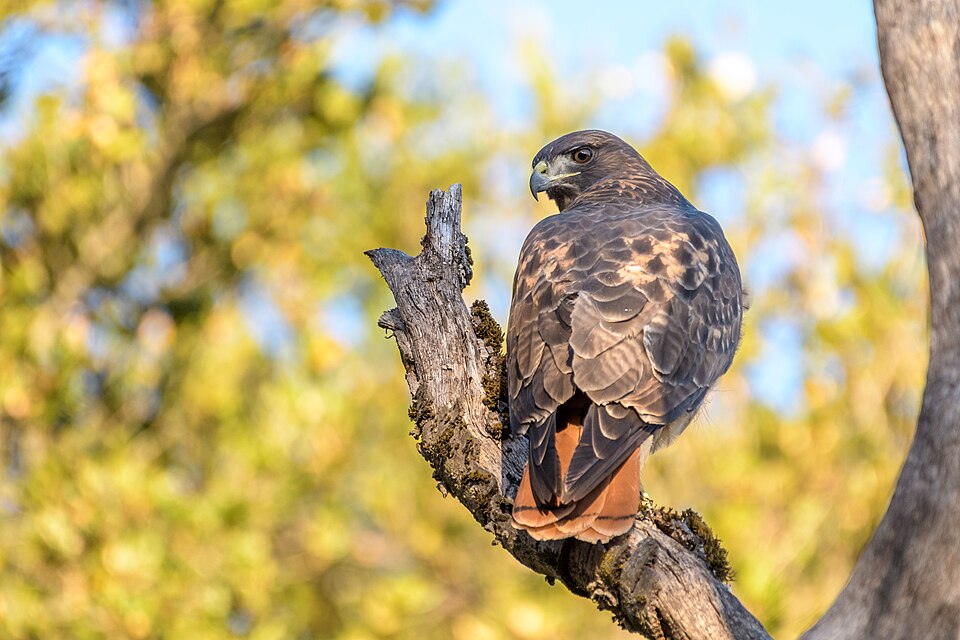
If you have ever spotted a big, broad-winged hawk perched on a highway light pole or wheeling slowly over an open field, odds are very good it was a Red-tailed Hawk. This is the default large hawk across most of North America, a stocky, powerful Buteo built for soaring and for dropping onto prey from a perch. It is so widespread and adaptable that it turns up everywhere from desert canyons and prairie to suburban parks and the edges of big cities, and it is comfortable hunting the grassy margins of interstate highways where rodents are easy to find.
The Red-tailed Hawk also happens to be the voice of nearly every hawk and eagle in movies and television. That harsh, rasping scream you associate with a soaring eagle? It is almost always a Red-tail dubbed in. For backyard birders, this hawk matters because it is a reliable, learnable benchmark: once you know the Red-tail well, every other large hawk becomes easier to identify by comparison. It is variable in plumage, especially across its many regional forms, which makes it a wonderful bird to study closely.
Look for a large, bulky hawk with broad, rounded wings and a short, wide tail, the classic Buteo shape. Perched birds look heavy-shouldered and upright; in flight they soar on wings held in a very slight dihedral, often hanging almost motionless into the wind. Plumage is famously variable, but a few marks hold up across most birds.
| Tail | Adults show the namesake brick-red tail, usually with a thin dark band near the tip; it is rusty above and pale pinkish from below |
| Belly band | Most birds have a band of dark streaks across the lower belly, contrasting with a pale chest |
| Patagial bars | Dark leading-edge marks on the underwing (the patagial bars) are the single most reliable in-flight field mark |
| Upperparts | Brown back and wings, often with a paler V or mottled scapular patches across the shoulders |
| Wingtips | In flight the outer flight feathers (primaries) are dark, giving dark wingtips and a pale window in the wing |
| Size and shape | Large and stocky with broad rounded wings and a short, fanned tail; bigger and bulkier than a crow |
Male vs. female
Males and females look essentially identical in plumage, so you cannot reliably sex a Red-tailed Hawk by color or markings in the field. As with most raptors, females are noticeably larger and heavier than males, sometimes by up to a third in weight, but this is only obvious when a pair perches side by side. At a nest, the larger bird doing most of the incubating and brooding is usually the female, while the smaller male does more of the hunting and food delivery.
Juveniles
Young birds are the most common source of confusion. Juveniles do not have a red tail; instead the tail is brown with many narrow dark bands, similar to several other hawks. They tend to be more streaky and have paler, yellowish eyes that darken to brown as they mature. Juveniles also show a more obvious pale window in the outer wing and often a heavier belly band. The patagial bars on the underwing are still present, so even on a brown-tailed youngster, those dark leading-edge marks plus the bulky Buteo shape will point you to a Red-tail.
The signature sound is a harsh, descending scream, usually written as kee-eeeee-arr, drawn out over two to three seconds and trailing off raspy at the end. It is a thin, raw, slightly menacing sound, and it is the call Hollywood reuses for eagles, falcons, and just about any bird of prey on screen. Red-tails give it while soaring, when defending territory, and when disturbed at the nest.
They also use shorter, sharper notes and chirps around the nest, and begging young make a persistent, wheezy whistle. If you hear that classic raptor scream drifting down from a soaring bird, look up and you will very likely find a Red-tailed Hawk.
The Red-tailed Hawk is a year-round resident across most of the United States, Mexico, and southern Canada, and it ranges from Alaska and the Canadian boreal forest south through Central America and into the Caribbean. It is one of the most widespread raptors in North America and occupies an enormous range of habitats, favoring open and semi-open country with scattered perches and woodland edges.
Northern breeders, especially those nesting in Canada and the far north, are migratory and move south for winter, and large numbers stream past hawk-watch sites in fall. Across the middle and southern parts of the range, many birds are resident and hold territories year-round. In winter the open country of the central and southern states fills with both local residents and migrants from the north.
Red-tailed Hawks are generalist predators, and small mammals are the core of the diet, especially voles, mice, rats, ground squirrels, gophers, and rabbits. They also take snakes, lizards, birds up to the size of pheasants, and occasionally large insects or carrion. This flexibility is a big reason the species thrives in so many landscapes, from prairie to suburb.
The classic hunting style is the still-hunt: the hawk perches on a pole, snag, or tree at the edge of open ground, watches patiently, then drops or makes a short powerful stoop onto prey, pinning it with strong feet and talons. They also hunt on the wing, soaring or hanging into the wind and dropping when they spot movement. Roadsides are prime habitat precisely because mowed verges concentrate rodents and offer abundant perches.
Pairs are long-term and often hold the same territory for years. They build a large, bulky stick nest, typically high in a tall tree, but also on cliff ledges, on artificial structures, and even on city buildings and towers. Both members of the pair contribute to building, and they often line the nest cup with fresh greenery and reuse and add to the structure across seasons.
The female lays a small clutch, usually two to three eggs, which are whitish and sometimes lightly marked. Incubation lasts about a month and is done mostly by the female while the male hunts and delivers food. Chicks stay in the nest for several weeks before fledging and then depend on the parents for weeks more as they learn to hunt. Red-tails raise a single brood per year.
The Red-tailed Hawk is not a feeder bird, and you should not try to feed it. In fact, its presence usually clears your songbirds and squirrels off the feeders for a while, because to a Red-tail your busy backyard looks like a hunting opportunity. That said, you can absolutely make your property hawk-friendly and improve your chances of regular sightings.
- Provide tall perches with open views, such as snags, dead-limbed trees, or even a sturdy post at the edge of a field, which hawks use as hunting lookouts.
- Keep some open, grassy areas nearby; rodent-rich field edges and meadows are what draw Red-tails far more than any feeder.
- Avoid rodenticides. Poisoned rats and mice carry the toxin into hawks that eat them, and secondary poisoning is a serious, widespread threat to these birds.
- Tolerate the natural drama. A hawk hunting at your feeders is a healthy sign, not a problem to fix; the songbirds will return.
- Watch open country and highway edges from a distance with binoculars, where perched Red-tails are easy to study without disturbing them.
- Leave large trees standing where possible, since mature trees provide the nesting and roosting sites hawks need in suburban areas.
- Red-shouldered Hawk: Slimmer with bold black-and-white tail bands, rusty barred underparts, and translucent crescent windows near the wingtips; lacks the Red-tail's belly band and red tail
- Rough-legged Hawk: A winter visitor of open country with a dark belly patch, dark wrist commas, feathered legs, and a white tail base with a dark terminal band rather than a red tail
- Swainson's Hawk: Slimmer with longer, more pointed wings held in a stronger V, a dark flight-feather pattern that reverses the Red-tail's, and a dark chest bib in light-morph adults
- Ferruginous Hawk: Larger and paler with rusty leggings forming a V, a pale gleaming underwing, and a pale unbanded tail; lacks dark patagial bars and the belly band
What does a Red-tailed Hawk sound like?
It gives a harsh, raspy, descending scream, often written kee-eeeee-arr, lasting two to three seconds. This is the same call Hollywood dubs over eagles and other raptors in nearly every film and TV show, so most people already know the sound.
Why don't I see the red tail on the hawk I'm looking at?
Only adults have the brick-red tail, and it can be hard to see from below or in poor light. Juvenile Red-tailed Hawks have brown tails with many narrow dark bands and do not get red tails until they mature. Look instead for the dark belly band and the dark patagial bars on the leading edge of the underwing.
Will a Red-tailed Hawk attack my pets or my feeder birds?
Red-tails primarily hunt rodents and rabbits, but they will take small birds and occasionally very small pets if the opportunity is easy. A hawk hunting at your feeders is normal behavior. Keep small pets supervised, but attacks on cats and dogs are rare and usually involve only the smallest animals.
Are Red-tailed Hawks dangerous to people?
No. They have no interest in people and will not attack humans except in the rare case of defending a nest if you climb to it. From the ground you pose no threat to them and they pose none to you. They are best enjoyed at a respectful distance with binoculars.
What's the difference between a Red-tailed Hawk and a hawk on a highway pole?
Very often they are the same thing. The large hawk you see perched on highway light poles, fence posts, and roadside trees across North America is almost always a Red-tailed Hawk, which favors mowed roadsides because they concentrate rodents and provide abundant hunting perches.