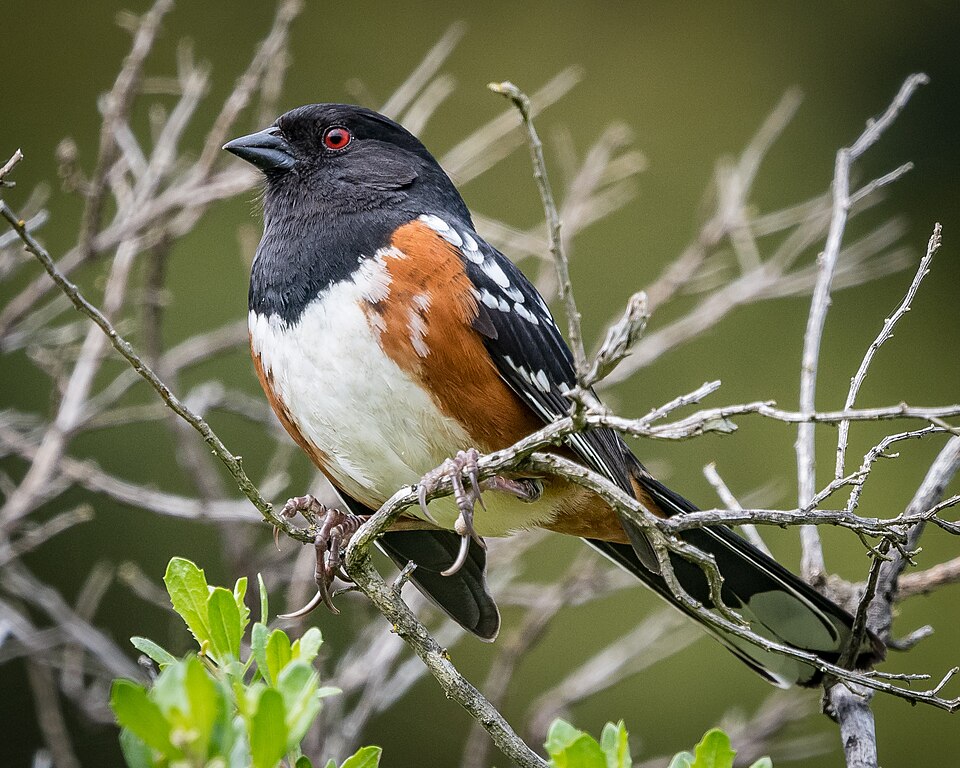
The Spotted Towhee is one of the West's most handsome large sparrows, a bird more often heard scratching beneath a thicket than seen out in the open. With its jet-black hood, brick-red flanks, and a back peppered with crisp white spots, it looks like an Eastern Towhee that wandered through a snowstorm. For most western birders it is the quintessential brush bird, a flash of rufous and white vanishing into the chaparral, oak scrub, or the tangled edge of a suburban garden.
Once lumped with the Eastern Towhee under the single name "Rufous-sided Towhee," the Spotted Towhee was split into its own species in the late 1990s based on differences in plumage, voice, and genetics. It thrives anywhere there is dense low cover and bare ground to forage on, which makes it a familiar resident across much of western North America and an easy bird to coax to a backyard with the right habitat.
Spotted Towhees are chunky, long-tailed sparrows with a rounded head, a thick conical bill, and a habit of holding that long tail slightly cocked. They are noticeably larger and bulkier than a junco or a song sparrow, and their bold tricolor pattern of black, white, and rufous makes a clear look unmistakable.
| Head & breast | Solid black hood and upper breast (males); dark slate-gray in females |
| Spotting | Rows of bright white spots and bars across black wings and back, the key separator from Eastern Towhee |
| Flanks | Warm rufous-cinnamon sides, sharply set off from a clean white belly |
| Eye | Staring red iris (pale to yellowish in a few Pacific-coastal populations) |
| Tail | Long and dark with white corners that flash conspicuously in flight |
| Bill & legs | Stout dark conical bill; pinkish legs built for scratching |
Male vs. female
Males and females share the same pattern but differ in the darkness of the hood. The male's head, throat, and upper breast are a deep glossy black, contrasting hard against the rufous flanks. The female wears the same arrangement in dark grayish-brown or smoky slate instead of black, so she looks a touch softer and less crisp. Both sexes show the white spotting, red eye, and rufous sides, so a quick glance at hood color is usually all you need to sex one in the field.
Juveniles
Juveniles look strikingly different from adults and often puzzle birders. For their first summer they are heavily streaked brown overall, on the head, breast, and back, with no black hood and only a hint of the rufous flanks coming in. The best clue is the long dark tail with white corners and the species' typical chunky towhee shape and double-scratch foraging. By fall they molt into adult-like plumage and the red eye begins to develop.
The song is a buzzy trill, often written as a few introductory notes followed by a fast insect-like buzz: "chip-chip-chip-zzzzzzz" or simply a dry, mechanical "zheeeeee." Western populations vary a lot, and many birds skip the introductory notes entirely, delivering just the raspy trill from a low perch or the top of a shrub.
The call is even more useful for finding the bird. Spotted Towhees give a rising, whiny, catlike "mewww" or "chweee?" that sounds almost like a question, quite different from the clear "chewink" of the Eastern Towhee. They also make a sharp metallic "tink" when alarmed. Learning that rising mew is the fastest way to know a towhee is lurking in the brush near you.
The Spotted Towhee is a bird of western North America, found from southern British Columbia and the interior Northwest south through California, the Great Basin, the Rockies, and the Southwest into the mountains of central Mexico and Guatemala. It ranges east across the Great Plains as far as the Dakotas and central Texas, where it meets and occasionally hybridizes with the Eastern Towhee.
Across milder parts of its range, coastal California, the desert Southwest, and lower elevations, it is a year-round resident. Birds breeding in the northern interior, the high mountains, and the Great Plains are migratory or move downslope in winter, when individuals can turn up well east of the usual range and become a prized find for eastern birders scanning their feeders.
Spotted Towhees are omnivores that shift with the seasons. In spring and summer they take a wide range of insects and other invertebrates, beetles, caterpillars, true bugs, ants, spiders, and millipedes, gleaned from the leaf litter and low vegetation. In fall and winter the diet swings heavily toward seeds, berries, and acorns, including the seeds of many weeds and grasses.
Their signature feeding move is the "double-scratch": a quick backward hop with both feet at once that flings leaf litter aside to expose food underneath. This noisy, two-footed kicking is so distinctive that you can often identify a hidden towhee by the rustling alone before you ever see the bird.
Nesting happens low and well hidden. The female builds a bulky open cup of leaves, bark strips, twigs, and grasses, lining it with finer grasses and hair. Many nests are placed directly on or just under the ground in a scrape sheltered by dense vegetation; later in the season birds may build a few feet up in a shrub or low tree.
She lays a clutch of typically three to four eggs (sometimes up to five), grayish or creamy white with brownish speckling, and incubates them alone for about 12 to 13 days. Both parents feed the nestlings, which leave the nest after roughly 10 to 12 days. Pairs often raise two and sometimes three broods in a season. Like many low-nesting songbirds, Spotted Towhees are frequent hosts to Brown-headed Cowbird parasitism.
Yes, Spotted Towhees readily visit yards that offer the dense cover and ground-feeding opportunities they crave. They are not classic tube-feeder birds, but if you can mimic a brushy edge they will become regular, and entertaining, backyard residents.
- Scatter millet, sunflower, and cracked corn on the ground or on a low platform feeder rather than relying on hanging tube feeders.
- Keep a brush pile, hedgerow, or dense native shrubs nearby, towhees want thick low cover to dart into and forage beneath.
- Leave a layer of leaf litter under shrubs instead of raking it bare; the double-scratch foraging happens right in that litter.
- Plant berry-producing native shrubs (such as elderberry, blackberry, or manzanita) for natural fall and winter food.
- Provide a ground-level or low birdbath, since they prefer to drink and bathe near cover rather than in the open.
- Reduce open lawn and avoid pesticides so the insects and seeds they depend on stay available.
- Eastern Towhee: Nearly identical shape but lacks the white spotting on the back and wings; gives a clear 'drink-your-tea' song and 'chewink' call. The two overlap only on the Great Plains.
- California Towhee: Same chunky towhee build and double-scratch habit, but plain warm brown all over with no black hood, white spots, or rufous flanks.
- Black-headed Grosbeak: Shares a black head and rusty tones but is a stocky finch with a massive pale bill and orange-cinnamon underparts, not a slim long-tailed sparrow.
- American Robin: Far larger with a yellow bill and uniform rusty-red breast; can be confused at a glance for the towhee's rufous-and-dark scheme but is a thrush, not a sparrow.
What is the difference between a Spotted Towhee and an Eastern Towhee?
They look almost identical except that the Spotted Towhee has rows of bright white spots and bars across its black back and wings, while the Eastern Towhee's upperparts are solid black. Their voices also differ: the Eastern gives a clear 'chewink' and 'drink-your-tea,' while the Spotted gives a rising, whiny mew and a buzzy trill. Range helps too, Spotted is the western bird, Eastern the eastern one, and they overlap only on the Great Plains.
Why do towhees scratch so loudly in the leaves?
They forage with a 'double-scratch,' hopping backward and kicking with both feet at once to fling leaf litter aside and expose insects and seeds underneath. It is surprisingly noisy for a sparrow-sized bird, and the rustling often gives away a towhee hidden deep in the brush.
What does a Spotted Towhee sound like?
The most distinctive sound is its call: a rising, catlike, questioning 'mewww' or 'chweee?' The song is a buzzy, insect-like trill, sometimes with a few introductory chips, sometimes just the raspy buzz on its own.
Will Spotted Towhees come to bird feeders?
Yes, though they prefer feeding on the ground beneath or near feeders rather than perching on hanging tubes. Scatter millet, sunflower, or cracked corn on the ground or a low platform near dense shrubs and you will often see them double-scratching for fallen seed.
Why does the Spotted Towhee have red eyes?
Adults of most populations have a striking deep-red iris, a natural feature of their plumage rather than a sign of anything wrong. A few coastal Pacific populations have paler, more yellowish eyes, and juveniles start with dark eyes that redden as they mature.