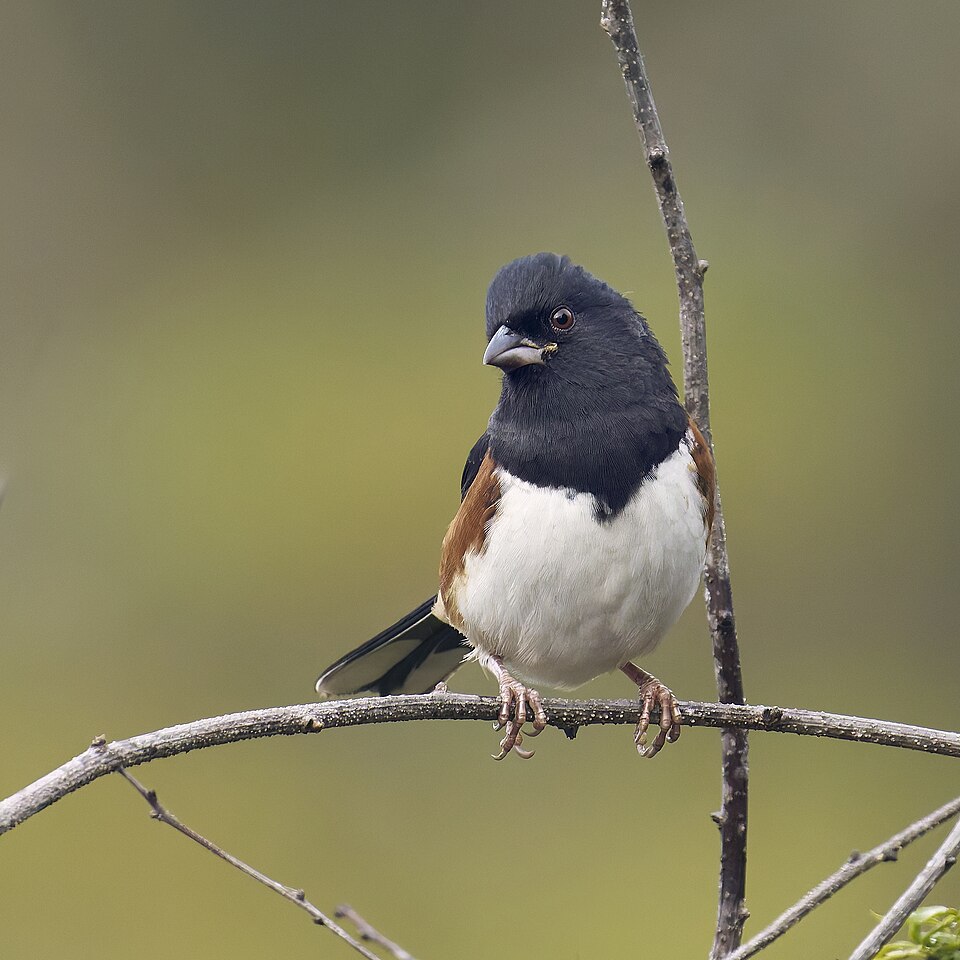
The Eastern Towhee is one of those birds you usually hear before you see. A loud rustling in the dead leaves under a tangle of brush, then a flash of black, white, and warm rufous, and there it is: a chunky, long-tailed sparrow scratching backward with both feet like a tiny chicken. Despite its size and bold colors, it spends much of its life in the shadowy understory of woodland edges, thickets, and overgrown fields, which is exactly where it likes things.
For many backyard birders in the eastern United States, the towhee is a familiar voice of spring and summer, famous for the male's cheerful "drink-your-tea!" song delivered from an exposed perch. Once lumped with its western cousin as the "Rufous-sided Towhee," it was split into its own species in the 1990s. It is a bird of edges and transitions, thriving wherever forest gives way to shrubby, weedy cover, and that preference shapes everything about how and where you will find it.
Think of the Eastern Towhee as an oversized, long-tailed sparrow with a stout, conical seed-cracking bill. It is roughly robin-length but bulkier in the body, with a habit of carrying its long, rounded tail cocked slightly as it hops on the ground. The strong contrast between dark upperparts, bright rufous sides, and a clean white belly makes a well-seen bird unmistakable.
| Head & upperparts | Male jet-black, female warm brown, both with a hooded look extending onto the chest |
| Sides (flanks) | Bright rufous-orange, like the color of a robin's breast, a key field mark |
| Belly | Clean white, sharply set off from the rufous flanks |
| Tail | Long and rounded with bold white corners that flash conspicuously in flight |
| Eye | Usually red in most of the range; pale straw-yellow to white in southeastern (Florida) birds |
| Wing | Small white patch at the base of the primaries, most visible at the wing fold |
Male vs. female
The sexes share the same bold pattern but differ in the dark color. The male's head, throat, back, and tail are a glossy jet black, contrasting dramatically with the rufous sides and white belly. The female wears the identical pattern but with warm chocolate or cinnamon-brown replacing all the black. Once you have seen both, telling them apart is easy and reliable in the field; the brown female is sometimes mistaken for a different species entirely by newer birders.
Juveniles
Fresh juveniles look surprisingly unlike their parents. For their first few weeks out of the nest they are heavily streaked brown above and below, lacking the clean rufous-and-white pattern, which often puzzles people who report a "streaky brown mystery bird" scratching in the leaves. Look for the same chunky shape, long dark tail with white corners, and the leaf-scratching behavior to confirm the ID. They molt into a more adult-like plumage by late summer or fall of their first year.
The male's song is one of the easiest to learn by phrase: a ringing drink-your-TEA!, with the final note a buzzy, sustained trill. Some birds shorten it to just drink-tea or even a simple two-part chip-tEEEE, and there is real regional and individual variation in how many notes come before the trill. It is delivered from a song perch atop a shrub or low tree, often the only time a towhee sits out in the open.
The call most people hear is an emphatic, rising che-WINK or tow-hee, which gives the bird its name. Florida birds tend to give a flatter, more nasal note. Whether singing or calling, the towhee's voice carries well and is often the first clue that one is working the brush nearby.
The Eastern Towhee breeds across the eastern United States and into extreme southern Canada, from the Great Lakes and New England south to the Gulf Coast and Florida, and west to roughly the edge of the Great Plains. Across the southern part of this range, particularly the Southeast and Florida, towhees are year-round residents.
Northern populations are migratory, withdrawing from areas with hard winters and heavy snow that buries their leaf-litter foraging. In winter the bulk of the population concentrates across the Southeast. This means a towhee that nests in Pennsylvania or Michigan may winter in Georgia or the Carolinas, while a Florida bird may never leave its home thicket.
Eastern Towhees are omnivores that do most of their feeding on the ground. Their signature move is the double-scratch: a quick backward hop with both feet at once that kicks aside leaf litter to expose food underneath. The diet shifts with the seasons, leaning heavily on insects, spiders, and other invertebrates in spring and summer, and on seeds, berries, and other plant matter in fall and winter.
Favored foods include beetles, caterpillars, ants, and grasshoppers, plus the seeds of ragweed, smartweed, and grasses, and small fruits such as blackberries, blueberries, and sumac. They will also take acorns and other mast. This ground-and-cover foraging style is why dense, weedy edges with a deep layer of fallen leaves are so important to them.
The female builds the nest, usually on or very near the ground, tucked into leaf litter, the base of a shrub, or a low tangle of vegetation. Later in the season some nests are placed a few feet up in a shrub or vine. The nest is a sturdy open cup of leaves, bark strips, grasses, and rootlets, lined with finer material, and is often well hidden, which makes it vulnerable to predators and to Brown-headed Cowbird parasitism.
A typical clutch is three to four eggs, creamy or grayish-white with fine brown speckling. The female does the incubating for around 12 to 13 days, and both parents feed the nestlings, which leave the nest in about 10 to 12 days. In the warmer parts of the range, pairs commonly raise two or even three broods in a single season.
The Eastern Towhee is a backyard bird, but on its own terms. It is more a yard-and-edge bird than a feeder regular: it prefers to feed on the ground beneath cover rather than perch on a hanging feeder. If you have brushy edges, a leaf-littered hedgerow, or a wild corner, your odds go way up.
- Scatter white millet or mixed seed on the ground beneath shrubs or near a brush pile, rather than relying on hanging feeders.
- Leave a layer of fallen leaves intact in part of the yard so they have something to scratch through.
- Build or keep a brush pile and let an edge of the yard grow shrubby and tangled for cover.
- Plant native berry-producing shrubs such as blackberry, sumac, blueberry, and viburnum.
- Provide a ground-level or shallow birdbath; towhees drink and bathe but rarely use elevated water.
- Avoid pesticides so the insects and spiders they feed on, and feed their young, remain plentiful.
- Spotted Towhee: The western counterpart; nearly identical shape but shows bold white spots and bars across the black back and wings. Ranges barely overlap on the Great Plains.
- American Robin: Shares rufous on the underparts, but the robin's red covers the whole breast, it lacks white sides and tail corners, and it has a thin bill, not a thick seed-cracker.
- Dark-eyed Junco: Another ground-scratcher with white outer tail feathers, but much smaller, gray-and-white, and lacks any rufous on the sides.
- Eastern Bluebird: Has a rusty breast but is blue above with no white belly contrast or tail corners, and perches in the open rather than scratching in brush.
What does an Eastern Towhee sound like?
The male's song is a ringing 'drink-your-tea!' that ends in a buzzy trill, and the most common call is a sharp, rising 'che-wink' or 'tow-hee' that gives the bird its name. You'll often hear the loud rustling of one scratching in leaves before you ever see it.
Is the Eastern Towhee a sparrow?
Yes. Despite its bold black, rufous, and white plumage and robin-like size, it belongs to the New World sparrow family. It's essentially a large, long-tailed, colorful sparrow with a stout seed-cracking bill.
What's the difference between an Eastern Towhee and a Spotted Towhee?
They were once considered one species, the Rufous-sided Towhee. The key difference is the back and wings: the Eastern Towhee has solid black (male) or brown (female) upperparts, while the Spotted Towhee, found in the West, is covered in bold white spots and wing bars.
Why do towhees scratch backward in the leaves?
It's a feeding technique called the double-scratch. The bird hops backward with both feet at once to rake aside leaf litter and expose insects, spiders, and seeds hidden underneath. The noise is loud enough that people often mistake a single towhee for a much larger animal.
Will Eastern Towhees come to a bird feeder?
Sometimes, but they prefer feeding on the ground. Rather than a hanging feeder, scatter white millet or mixed seed on the ground beneath shrubs or near a brush pile. A leaf-littered, brushy yard edge will attract them far more reliably than any feeder.