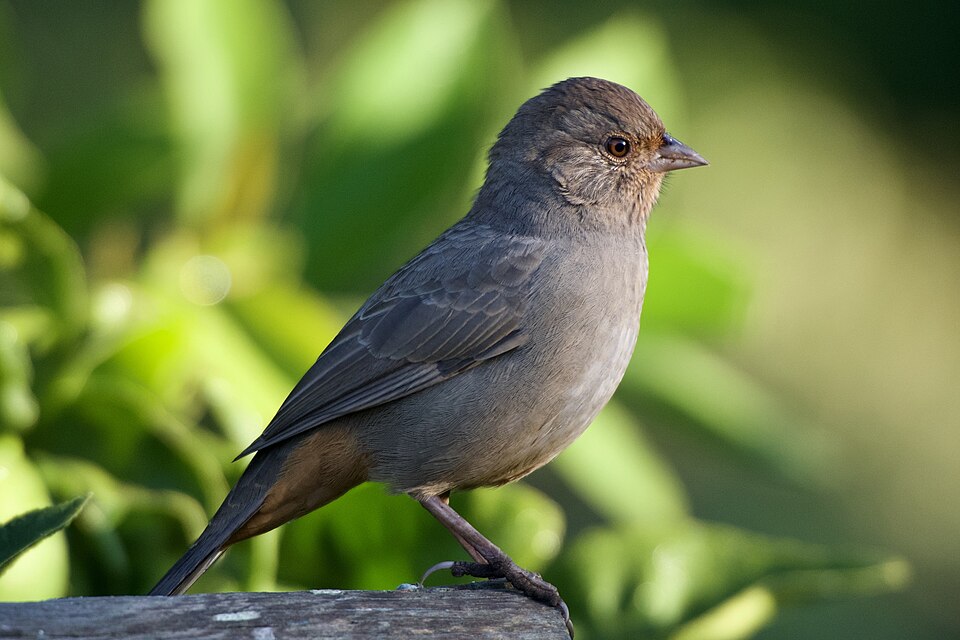
The California Towhee is one of those birds that rewards patience over flash. At first glance it is simply a large, plain, grayish-brown bird shuffling along the ground beneath a hedge, and many people never give it a second look. Spend a little time with one, though, and its quiet personality comes through: the warm cinnamon under the tail, the rusty wash around the face, and the steady, businesslike way it scratches through leaf litter for seeds. For backyard birders from the San Francisco Bay Area down through coastal and interior California, it is one of the most reliable year-round companions.
This is a true California specialty. Its range hugs the West Coast and a slice of Baja California, and within that range it favors chaparral, oak scrub, streamside thickets, and the shrubby edges of suburban gardens. Once known as part of the "Brown Towhee," it was split into the California Towhee and the very similar Canyon Towhee of the desert Southwest. Sedentary, vocal, and strongly tied to its territory, a California Towhee pair will often live out their lives in the same tangle of brush, defending it year after year.
Think of a chunky, long-tailed sparrow the size of a small thrush. The California Towhee is overall a warm, dusty grayish-brown with little contrast, so its shape and behavior do as much of the identifying work as its colors. Look for a heavy, conical seed-eating bill, a fairly long tail it often pumps or flicks, and a habit of hopping and scratching on the ground rather than perching out in the open.
| Overall color | Uniform grayish-brown above and below, with little pattern, a famously plain bird |
| Face | Warm rusty-cinnamon wash around the bill, lores, and throat, often framing fine dark streaks on the throat |
| Undertail | Bright rusty-cinnamon (rufous) patch under the tail, the best confirming mark |
| Bill | Stout, pale conical bill built for cracking seeds |
| Tail | Long and rounded, frequently flicked or pumped, slightly warmer brown than the back |
| Size & shape | Larger and longer-tailed than most sparrows; a heavy-bodied ground bird |
Male vs. female
Males and females look essentially identical, same plain brown plumage, same rusty undertail, same buffy throat. There is no reliable way to tell the sexes apart in the field by sight. Behavior offers the only hints: the male does most of the singing and is the one more likely to be seen and heard defending the territory, while a closely bonded pair foraging together on the ground is usually a male and female. In the hand, males average very slightly larger, but the overlap is too great to use in the field.
Juveniles
Juvenile California Towhees look much like adults in overall plain brown tone but are softer and warmer, with diffuse buffy or cinnamon streaking or spotting across the breast and sometimes faint wing bars, markings the adults lack. They keep the rusty undertail of their parents. This streaky juvenile plumage fades over the first summer and fall as the bird molts into the clean, unmarked adult look, so heavily streaked towhees seen from late spring through summer are this year's young.
The signature sound of a California Towhee is a sharp, metallic chink! or tseep call note, given persistently as the bird forages or when it is mildly alarmed. It is one of the most characteristic background sounds of a California backyard once you learn it. Listen also for the "squeal duet", when a pair reunites, they break into a rapid, excited series of squealing, tinkling notes together, a charming bit of pair communication.
The song itself is simple and easy to overlook: an accelerating series of those same chink notes that speeds up into a dry, rattling trill at the end, often rendered as chip-chip-chip-chip-chichichichi. It is not musical or varied like a sparrow's song, but it carries well from a low perch and is delivered most often in the breeding season from early spring into summer.
The California Towhee is largely a coastal and near-coastal western bird. Its range runs from extreme southwestern Oregon south through the length of California, the coast ranges, the western foothills of the Sierra Nevada, interior valleys, and the chaparral country, and continues down into the Baja California peninsula of Mexico. A distinct, isolated population also lives in the Inyo Mountains area.
This is a non-migratory, resident species. Individual birds and pairs are strongly sedentary, often spending their entire lives within a small home range and defending the same territory year after year. There is no meaningful seasonal movement, so a towhee in your yard in January is very likely the same bird you will see there in July.
California Towhees are primarily seed-eaters, and they do most of their feeding on the ground. Watch for the classic towhee "double-scratch," a quick backward hop-kick with both feet that flips aside leaf litter to expose seeds and small invertebrates beneath. They favor seeds of grasses, weeds, and shrubs, and readily take fallen seed under feeders.
The diet shifts seasonally: insects and other small invertebrates become more important in spring and summer, especially for feeding nestlings, while seeds dominate the rest of the year. They will also eat berries and small fruits when available. Their habit of foraging at the base of dense cover means you will more often hear the rustle of one working through the leaves than see it out in the open.
California Towhees nest in dense shrubs, low trees, or thick vines, usually placing the nest a few feet off the ground inside good cover. The female builds a bulky open cup of twigs, grass, and bark strips, lined with finer plant fibers and hair. Clutches are typically three to four pale bluish eggs marked with dark spots and scrawls, and the female does the incubating.
Pairs are strongly monogamous and stay together year-round on their territory, and they will often raise two or even three broods in a season across the long western breeding period. Both parents feed the young. Like many open-cup nesters in this range, they are vulnerable to Brown-headed Cowbird parasitism, so dense, protective cover is important to their nesting success.
Yes, within its range the California Towhee is a dependable and easy backyard bird, though it feeds differently from the finches and chickadees crowding your hanging feeders. It is a ground bird at heart, so the trick is to feed it the way it likes to eat.
- Scatter seed on the ground or use a low platform/tray feeder, towhees are reluctant to use hanging tube feeders
- Offer millet, cracked corn, and black-oil sunflower seed, the seeds they take most readily
- Leave a brushy corner, hedge, or shrub thicket nearby, they will not venture far from dense cover
- Let leaf litter accumulate under shrubs so they can do their double-scratch foraging
- Provide a ground-level birdbath or shallow water dish; they bathe and drink readily
- Avoid over-tidying the yard, a manicured lawn with no understory offers them nothing
- Canyon Towhee: Nearly identical but lives in the desert Southwest, not coastal California; paler and grayer with a small dark central breast spot and a more contrasting rusty crown. Ranges essentially do not overlap.
- Abert's Towhee: A desert-river bird of the Southwest with a distinctly black face around the bill and warmer cinnamon tones; range does not overlap with California Towhee.
- Spotted Towhee: Shares the same yards and scratch-foraging habits but is boldly patterned, black hood, rufous sides, white belly, and white wing spots, never plain brown like the California Towhee.
- California Thrasher: Another plain brown chaparral ground bird, but much longer, with a long sickle-shaped down-curved bill and longer tail; lacks the towhee's stout conical seed bill.
Why does a California Towhee keep attacking my car mirror or window?
During the breeding season a territorial towhee sees its own reflection as a rival and will repeatedly fly at car mirrors, hubcaps, and windows trying to drive the 'intruder' off. It is harmless to you and the bird, and it usually stops after nesting season. Covering the mirror or hanging something over reflective glass ends the behavior.
Is the California Towhee a sparrow?
It belongs to the New World sparrow family (Passerellidae), so it is a close relative of sparrows even though it is larger and plainer. Towhees are essentially big, long-tailed, ground-foraging members of that group.
What's the difference between a California Towhee and a Canyon Towhee?
They look almost the same and were once lumped as one 'Brown Towhee,' but they are separated by range: California Towhee lives along the West Coast and Baja, while Canyon Towhee lives in the inland desert Southwest. The Canyon Towhee is grayer with a small dark breast spot and a rustier crown.
What is that sharp 'chink' sound coming from my bushes?
That metallic chink or tseep is the California Towhee's main call note. They give it constantly while foraging and when mildly alarmed, so it's one of the most common background sounds in California yards and chaparral.
How do I get California Towhees to come to my feeder?
Feed them on the ground or on a low tray rather than a hanging feeder, offer millet, cracked corn, or sunflower seed, and keep dense shrubs or a brush pile nearby. They feed by scratching through leaf litter, so a brushy, less-manicured yard is far more attractive to them.