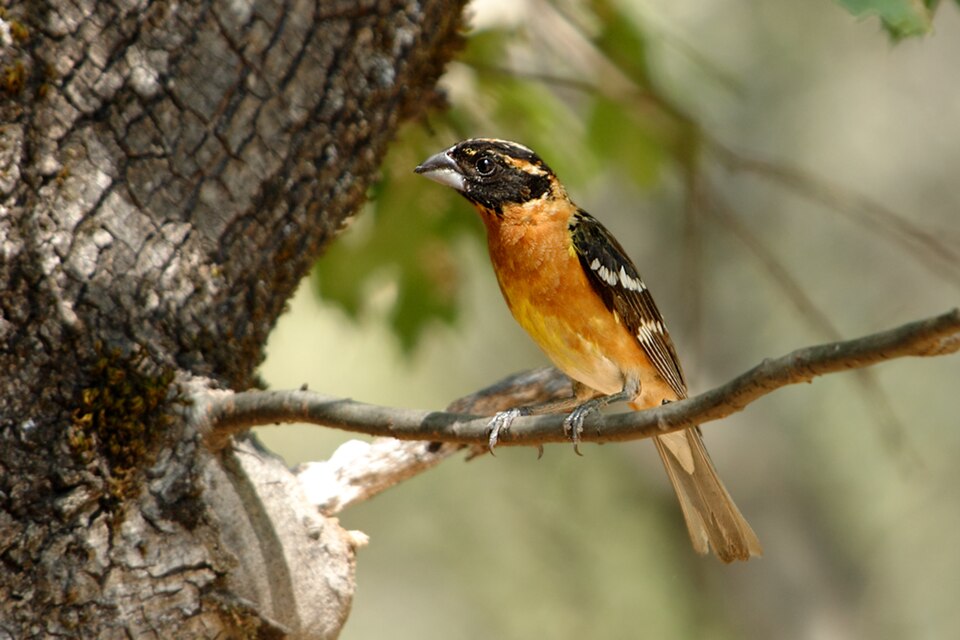
The Black-headed Grosbeak is the West's answer to the Rose-breasted Grosbeak, a stocky, big-billed songbird that floods canyon woodlands, riparian thickets, and backyard feeders with rich, warbling song from spring into summer. Males are unmistakable in good light: a cinnamon-orange body, a black head, and bold black-and-white wings. Females and young birds are a warmer, streakier brown that can puzzle newer birders, but the oversized pale bill always gives the family away. Where the species occurs, it is one of the more conspicuous and beloved breeding birds, equally at home in oak foothills, pine-oak slopes, mountain streamsides, and shady neighborhoods with mature trees.
Beyond its good looks and easy song, the Black-headed Grosbeak is ecologically notable as one of the few birds that readily eats toxic monarch butterflies on their Mexican wintering grounds, tolerating the cardenolide compounds that sicken most predators. In the breeding season it is a gardener's friend, working over leaves and bark for caterpillars, beetles, and other insects, then switching to seeds and fruit as the season turns. For backyard birders across the western United States, its arrival each spring is a reliable and welcome marker of the warm months ahead.
This is a chunky, large-headed songbird about the size of a slim American Robin, with a short tail and a conical, two-toned bill so thick it looks almost comical. The heavy bill, upright posture, and stout body separate it instantly from sparrows, finches, and warblers even before color comes into play.
| Bill | Very thick and conical, pale grayish or bicolored (darker upper, paler lower mandible), a classic grosbeak tool for cracking seeds |
| Adult male body | Rich cinnamon-orange below and on the collar/nape, with a solid black head and black-and-white wings |
| Wings | Black with two bold white wing bars and white flashes at the base of the primaries, obvious in flight |
| Female/immature | Warm brown above, buffy-orange wash on the breast, bold whitish eyebrow and crown stripes, fine streaking mostly on the sides |
| Underwing | Bright lemon-yellow wing linings, visible in flight or when the bird stretches |
| Size & shape | Robin-sized but stockier, with a big head, short tail, and heavy front-loaded look |
Male vs. female
Males and females look quite different. The adult male is striking: a black head and back, cinnamon-orange breast, sides, collar, and rump, and black wings marked with bright white. The female (and first-year male) is a streaky warm brown with a strongly patterned head, broad pale eyebrow, dark crown sides, and a pale median crown stripe, plus a buffy-orange breast that is much fainter and less saturated than the male's. Females show only light streaking, mostly along the sides and flanks, whereas they look cleaner-breasted than a female Rose-breasted Grosbeak. Both sexes flash yellow underwing linings.
Juveniles
Juveniles and first-year birds resemble the adult female: warm buffy-brown overall with a boldly striped head, a peachy wash across the breast, and fine streaking on the sides. Young males gradually acquire orange and black through their first year, and by their first spring many show a patchy, mottled mix of female-like brown and adult-male orange and black, sometimes singing and even breeding in this immature plumage. Full adult-male brilliance comes with later molts.
The song is a long, rich, rolling warble of sweet whistled phrases that rise and fall, often compared to an American Robin's caroling but faster, smoother, and more operatic, as if a robin had taken voice lessons. Both males and females sing, which is unusual and can lead to surprises when a female delivers a full song from the nest area.
The most distinctive call is a sharp, squeaky eek or pik, often likened to the squeak of a sneaker on a gym floor. This single penetrating note is frequently the first clue to the bird's presence in dense canopy. Pairs and family groups keep in touch with these spiky calls as they move through the foliage.
The Black-headed Grosbeak is a bird of western North America, breeding from southwestern Canada south through the western United States and into the mountains of Mexico. It favors deciduous and mixed woodlands, especially oak and pine-oak foothills, riparian corridors lined with cottonwoods and willows, aspen groves, and shady suburban neighborhoods with mature trees, generally from lowlands up into the mountains.
It is a long-distance migrant. Birds arrive on the breeding grounds in spring (often April into May) and depart by late summer to early fall, wintering primarily in Mexico. Its breeding range meets that of the eastern Rose-breasted Grosbeak across the Great Plains, where the two species sometimes interbreed and produce hybrids.
Black-headed Grosbeaks are omnivorous and shift their diet with the season. In the breeding months they hunt insects and other invertebrates, caterpillars, beetles, bugs, and spiders, gleaned methodically from leaves, twigs, and bark in the canopy and midstory. They also take a great deal of fruit and berries, along with seeds, buds, and flowers, and the heavy bill lets them handle hard items that smaller birds cannot.
On their Mexican wintering grounds they are famous for feeding on overwintering monarch butterflies, eating the bodies despite the butterflies' toxic defenses and feeding in cycles that let them process the chemicals. At feeders and in gardens they readily take sunflower seeds, which they crack with ease.
Pairs nest in the outer branches of a deciduous tree or tall shrub, often near water, building a fairly bulky but loosely woven open cup of twigs, stems, rootlets, and plant fibers, placed where surrounding foliage offers shade and cover. The nest can look so flimsy that eggs are sometimes visible from below.
The female typically lays 3 to 4 pale greenish-blue eggs spotted with reddish-brown. In a notable departure from many songbirds, both sexes incubate and both feed the young, and males commonly sing right from the nest while sitting. After the chicks fledge, the parents continue to tend them, and the species generally raises one brood per season, occasionally attempting a second.
Yes, within its western range, the Black-headed Grosbeak is a genuine and rewarding feeder and garden bird, most reliably during spring and summer. It is not present in the East, where the Rose-breasted Grosbeak takes its place.
- Offer black-oil and striped sunflower seeds on a sturdy platform or hopper feeder, the heavy bill handles striped sunflower easily, and grosbeaks prefer a stable perch over a swinging tube.
- Put out feeders in spring as migrants return (April-May in much of the range); a clean, full feeder when they first arrive helps establish them in your yard.
- Provide fresh water, especially a shallow birdbath or a gentle dripper, grosbeaks come readily to water in dry western summers.
- Plant or protect native trees and shrubs that fruit, such as elderberry, serviceberry, and other berry producers, to supply natural food and nest sites.
- Keep mature deciduous trees and streamside vegetation intact; shady, leafy yards near water are exactly the habitat these birds seek.
- Avoid pesticides so the caterpillars and insects they feed to their young remain available.
- Rose-breasted Grosbeak: The eastern counterpart. Males have a white breast with a rose-red triangle (not orange); females are very similar to female Black-headed but typically show heavier, more extensive breast streaking and white wing linings rather than yellow. The two replace each other geographically and hybridize on the Great Plains.
- Spotted Towhee: Shares rufous flanks and a dark head in the West, but is slimmer with a long tail, a thin pointed bill (not a thick grosbeak bill), red eyes, and white-spotted black upperparts.
- American Robin: Similar size and warm orange underparts, but the robin is slimmer with a thin yellow bill, a gray back, and a steady gait on lawns, it lacks the bold black-and-white wings and heavy conical bill.
- Bullock's Oriole: Another orange-and-black western bird, but slender with a slim pointed bill; the male has an orange face with a black cap and eyeline rather than a fully black head, and a different bold white wing patch.
What does a Black-headed Grosbeak look like?
Adult males are striking: a black head, cinnamon-orange breast and collar, and black wings with bold white markings, all anchored by a very thick pale bill. Females and young birds are warm streaky brown with a strongly striped head and a buffy-orange breast. Both sexes flash bright yellow wing linings in flight.
What is the difference between a Black-headed Grosbeak and a Rose-breasted Grosbeak?
They are western and eastern counterparts. The male Black-headed has an orange breast, while the male Rose-breasted has a white breast with a rose-red patch. Female Black-headeds tend to be cleaner below with finer streaking and yellow wing linings, whereas female Rose-breasteds are more heavily streaked with white wing linings. Their ranges overlap on the Great Plains, where hybrids occur.
What do Black-headed Grosbeaks eat?
They are omnivores. In summer they eat insects, caterpillars, beetles, and spiders along with fruit, berries, and seeds. At feeders they love sunflower seeds, which their heavy bills crack with ease. On their Mexican wintering grounds they famously feed on toxic monarch butterflies.
How do I attract Black-headed Grosbeaks to my yard?
Offer black-oil or striped sunflower seeds on a sturdy platform or hopper feeder, provide fresh water, and keep mature trees and berry-producing native shrubs in the yard. They are most likely to visit in spring and summer within their western range, so having feeders ready when migrants return in April and May helps.
Where do Black-headed Grosbeaks live and when do they migrate?
They breed across western North America in oak and pine-oak woodlands, riparian thickets, and leafy neighborhoods, from southwestern Canada down into Mexico's mountains. They are long-distance migrants that arrive in spring and head to Mexico for the winter, typically leaving by early fall.