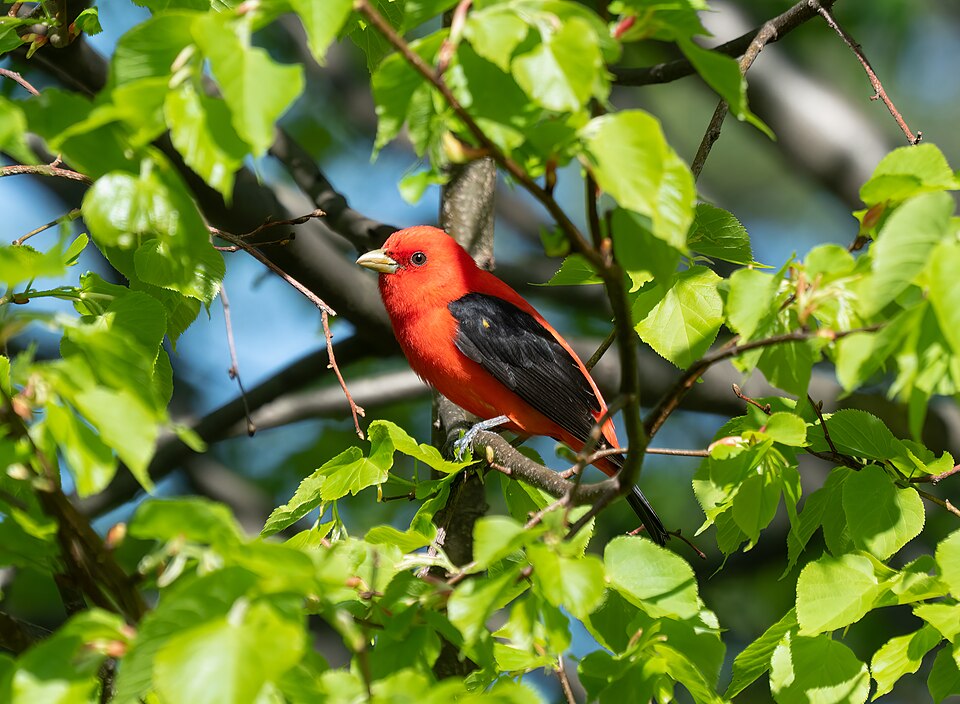
Few North American birds reward a patient watcher like the Scarlet Tanager. In breeding plumage the male is a shock of pure, glowing red set against jet-black wings and tail, a color so saturated it almost looks painted. Yet for all that brilliance, this is a bird most people never see. Scarlet Tanagers spend the summer high in the leafy canopy of mature deciduous forest, moving slowly and deliberately among the branches, and their habit of staying up top and out of sight means they are far more often heard than seen. Birders sometimes describe the thrill of finally catching that red flame against the green as one of the great moments of the eastern woods.
Despite the tropical name, the Scarlet Tanager is a long-distance migrant that breeds across eastern North America and winters in the forests of northwestern South America. Recent genetic work places it alongside the cardinals rather than the true tanagers, but the common name has stuck. It is a bird of large, unbroken woodlands, which makes it a useful indicator of forest health: where mature oak and hickory stands remain intact, tanagers tend to thrive, and where forests are carved into small fragments, they decline.
The Scarlet Tanager is a medium-sized, stocky songbird, a bit chunkier than a warbler and rounder-headed than an oriole, with a short tail and a notably thick, pale, slightly blunt bill built for both insects and fruit. Shape alone is a good clue when the bird is backlit in the canopy: look for that heavy bill and compact, big-shouldered profile.
| Breeding male | Brilliant, even scarlet-red body with sharply contrasting solid black wings and tail. No crest, no red in the wings. |
| Female & nonbreeding male | Soft yellow-green below, olive-green above, with darker (grayish to brownish) wings. Plain-faced with no wing bars or eye stripe. |
| Bill | Thick, pale horn-colored, and slightly rounded at the tip, paler than the bill of an oriole or grosbeak. |
| Wings | Male's coal-black flight feathers and coverts are the single best mark; females show plain, unmarked dusky wings. |
| Size & shape | Compact and short-tailed, roughly sparrow-to-bluebird sized, with a rounded head and no crest. |
| Molting male | In late summer, males can be a patchy mosaic of red and green as they molt out of breeding plumage. |
Male vs. female
In breeding season the sexes could hardly look more different. The male is unmistakable: vivid scarlet over the entire body with crisp black wings and tail. The female is a completely different bird to the eye, dressed in muted yellow-olive, brightest yellow on the underparts and greener on the back, with plain dusky wings. The key is that females and nonbreeding males never show wing bars, a bold eye line, or any streaking, which separates them from many look-alikes. After breeding, males molt into a female-like green plumage but keep their black wings and tail year-round, so a green-bodied tanager with dark wings is almost always a male.
Juveniles
Juvenile Scarlet Tanagers resemble adult females, with olive-green upperparts and yellowish underparts, but they are often faintly streaked or mottled below and look softer and fluffier overall. Young males begin to show their black flight feathers in their first fall, and by their first spring they typically arrive on the breeding grounds in adult-like scarlet, though some first-year birds show a slightly duller or more orange-tinged red.
The song is the most reliable way to find this bird, and it is famously described as sounding like an American Robin with a sore throat, a hurried, burry series of rich whistled phrases that rise and fall: querit, queer, query, querit, queer. The burry, slightly hoarse quality sets it apart from the cleaner, sweeter caroling of a robin and the clearer phrases of a Rose-breasted Grosbeak. Males sing persistently from high in the canopy through late spring and early summer.
Far more diagnostic, and easier to learn, is the distinctive call note: a sharp, dry chip-burr (often written chick-burr). Once you know this two-part call, you will pick out Scarlet Tanagers in the treetops you would otherwise walk right past. Both sexes give it.
Scarlet Tanagers breed across eastern North America, from the southern edges of Canada through the eastern and central United States, favoring large tracts of mature deciduous and mixed forest, especially oak-dominated woodland. They are most numerous in the Appalachians and the forests of the Northeast and upper Midwest, thinning out toward the western and southern margins of the range.
They are true long-distance migrants. In fall they head to the foothill and montane forests of northwestern South America, including parts of Colombia, Ecuador, Peru, and Bolivia. Spring migration brings them back north relatively late, with most arriving on breeding territories from late April into May. During migration they can turn up in parks, woodlots, and yards well outside breeding habitat, which is often the best chance backyard birders get to see one.
Through the breeding season the Scarlet Tanager is primarily an insect eater, gleaning caterpillars, beetles, moths, aphids, and other arthropods from leaves and branches high in the canopy. It is a notably deliberate forager, hopping along limbs and peering at the undersides of leaves, and it will also sally out to snatch flying insects in mid-air. Caterpillars, including hairy ones that many birds avoid, are a favorite, making tanagers valuable allies against forest pest outbreaks.
In late summer and on migration the diet shifts to include a great deal of fruit, and the birds readily take wild berries such as serviceberry, mulberry, blackberry, and elderberry. This fruit-eating habit is the main reason a tanager might pause in a yard.
The female builds the nest, a rather flimsy, shallow open cup of twigs, grass stems, and rootlets, placed well out on a horizontal limb of a deciduous tree, often quite high and frequently in an oak. The loose construction can be thin enough that eggs are sometimes visible from below.
She lays a clutch of typically three to four pale blue-green eggs spotted with brown, and incubates them herself for roughly two weeks. Both parents feed the nestlings, which leave the nest after about nine to fifteen days. Scarlet Tanagers usually raise a single brood per year. Because the nest sits exposed in the open canopy, it is vulnerable to Brown-headed Cowbird parasitism, particularly along forest edges, which is one reason large unbroken forest blocks matter so much for this species.
The Scarlet Tanager is not a typical feeder bird, and you will not lure one with a tube of sunflower seed the way you would a finch. It is a canopy-dwelling forest specialist, so the best way to attract one is to offer the kind of habitat and food it actually uses, especially during spring and fall migration when wandering birds are most likely to drop in.
- Plant native fruiting trees and shrubs such as serviceberry, mulberry, blackberry, and elderberry, late-summer and migrating tanagers seek out berries.
- Keep mature shade trees, especially oaks, which host the caterpillars tanagers depend on and provide the tall canopy they prefer.
- Offer fresh water, ideally a dripping or moving water feature, which can pull canopy birds down to drink and bathe.
- Try orange halves, grape jelly, or mealworms in spring, tanagers occasionally visit oriole-style feeders during migration.
- Avoid pesticides so caterpillars and other insects remain available as food.
- Your best odds are during spring and fall migration; in summer they stay high in large forests rather than in open yards.
- Summer Tanager: Male is an even rosy-red all over with NO black wings, and the bill is larger and paler; a southern, more open-woodland species.
- Northern Cardinal: Red male has a prominent crest, black face mask, and a thick orange-red conical bill, never the tanager's solid black wings.
- Western Tanager: Western counterpart; male has a yellow body, black wings with wing bars, and a red-tinged head, not an all-red body.
- Baltimore Oriole: Orange (not scarlet) with black, but has a slender pointed bill, white wing bars, and orange in the tail; slimmer build.
What is the difference between a Scarlet Tanager and a Summer Tanager?
The easiest mark is the wings. A breeding male Scarlet Tanager has solid black wings and tail contrasting with its red body, while a male Summer Tanager is rosy-red all over with no black at all. Summer Tanagers also have a larger, paler bill and favor more open southern woodlands.
Is a Scarlet Tanager the same as a cardinal?
No. They are different birds that happen to be red. A Northern Cardinal has a pointed crest, a black face mask, and a heavy orange-red bill, and its wings are red, not black. A male Scarlet Tanager has no crest and shows distinctive solid black wings and tail.
Why are Scarlet Tanagers so hard to see?
They spend most of their time high in the forest canopy, moving slowly among dense leaves, and they often stay well above eye level. Their brilliant red is surprisingly easy to lose against sun-dappled foliage. Learning their burry song and dry chip-burr call is usually the best way to locate them.
Do Scarlet Tanagers come to bird feeders?
Rarely. They are forest insect- and fruit-eaters rather than seed-feeder birds. During spring and fall migration they occasionally visit yards for fruit, orange halves, grape jelly, mealworms, or a water feature, but they are not regular feeder visitors.
Why does the male Scarlet Tanager turn green?
After the breeding season the male molts out of his scarlet plumage into a yellow-green coloring much like the female's. He keeps his black wings and tail year-round, so a green-bodied tanager with black wings in late summer or fall is a molting or nonbreeding male.