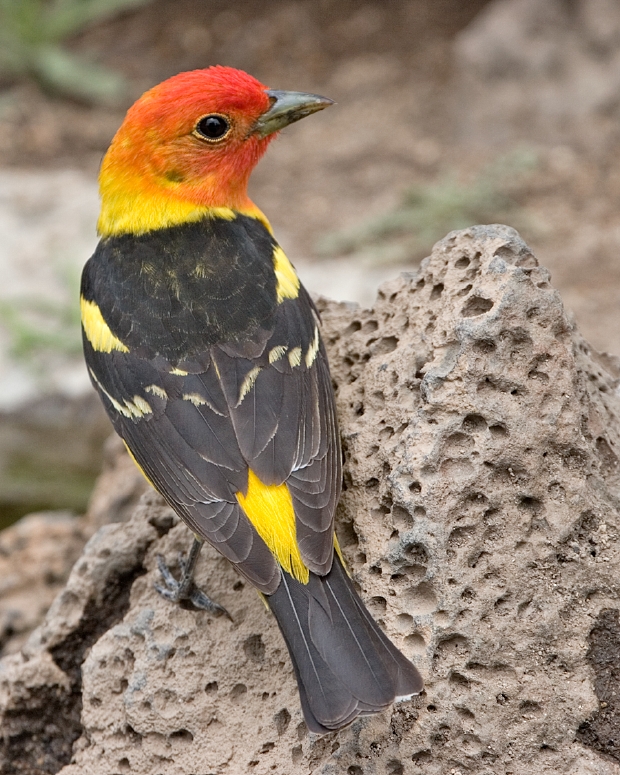
Few birds make a spring birder gasp quite like a male Western Tanager. Picture a robin-sized songbird the color of a ripe lemon, its black wings crossed by two bold bars, and a head flushed a startling orange-red as if it had been dipped in flame. Against the dark green of a ponderosa pine or a Douglas-fir, that combination of yellow, black, and fire-orange looks almost tropical, which is fitting because the tanagers as a group are a largely tropical family. The Western Tanager simply pushes farther north than any of its relatives, breeding all the way up into the boreal forests of the Northwest Territories.
For all that color, the Western Tanager is more often heard than seen. It tends to forage high in the canopy, moving deliberately through the foliage rather than flitting about in the open, and its plumage can melt into a sun-dappled treetop with surprising ease. It is a bird of coniferous and mixed-evergreen forests across the American West, a long-distance migrant that winters from Mexico to Costa Rica, and a genuine treat to find during spring and fall when it sometimes drops into backyards and city parks well outside its usual mountain haunts.
The Western Tanager is a stocky, medium-sized songbird, a touch smaller than a robin, with a fairly large pale bill, a short tail, and a rounded head. Shape alone rarely clinches an ID, but the heavy, slightly hooked bill and upright, unhurried posture in the canopy are good starting points. Plumage does the rest, and the breeding male is essentially unmistakable.
| Breeding male | Bright yellow body, jet-black back, wings, and tail, with a vivid orange-red face and head |
| Wing bars | Two bars on the black wing: the upper one yellow, the lower one whitish, a key mark in all plumages |
| Female | Yellow-green overall, grayer on the back, with dull yellowish wing bars and no red on the head |
| Bill | Pale, stout, and somewhat hooked, often looking pinkish or horn-colored |
| Rump | Yellowish, contrasting with darker back and tail |
| Size & shape | Robin-shaped but smaller, with a short tail and a relatively large head |
Male vs. female
Males and females look quite different. The breeding male is the showstopper: brilliant yellow with crisp black wings, back, and tail and that signature orange-red head. The female is far more subdued, a soft yellow-green that grades to gray on the back and crown, with dusky wings marked by two pale, yellowish wing bars and no red whatsoever. Females can look washed-out and confusing, but the wing bars and pale bill give them away. Non-breeding and first-year males are intermediate, often showing greenish backs with only a blush of orange on the face, so a tanager that looks "in between" is usually a young or molting male.
Juveniles
Juvenile Western Tanagers resemble females but are duller and more streaky, with blurry dark streaking on a grayish-yellow breast and faintly marked wing bars. By their first fall, young birds molt into a plumage much like the adult female, and young males may show traces of yellow brightening and a hint of orange around the face. The red head color in males builds with age and is thought to come from a pigment the bird obtains from its insect diet, which is why head color can vary from pale orange to deep red even among adult males.
The song is a series of short, burry, robin-like phrases, rising and falling with a hoarse, slightly raspy quality, often described as a robin with a sore throat. The phrases come in unhurried couplets and triplets, something like pri-tic, pri-tic-tic, pree-dit, lower and rougher than the clear caroling of an American Robin. Because the singer usually stays high in the conifers, the song is frequently the first clue that a tanager is present.
The call is even more distinctive and useful: a dry, rattling pit-er-ick or prit-ic, a rolling, almost laughing two- or three-note chatter. Once you learn that pit-er-ick call note, you will pick out Western Tanagers from a long way off, often before you ever spot the bird.
Western Tanagers breed across much of western North America, from the deserts' mountain forests of the Southwest north through the Rockies, the Sierra Nevada, the Cascades, the interior ranges, and the Pacific Coast, reaching as far north as southern Alaska, the Yukon, and the Northwest Territories. This is the northernmost breeding range of any tanager. They favor open coniferous and mixed forests, especially mature stands of pine, fir, and Douglas-fir, generally at middle to higher elevations.
They are complete, long-distance migrants. Birds leave the breeding grounds in late summer and fall and winter from central Mexico south through Central America to Costa Rica and western Panama, often in pine-oak woodlands. Spring migration brings them north again from April into June. During migration they turn up in a much wider variety of habitats, including lowland riparian areas, gardens, and city parks, which is when many people away from the mountains get their best looks. Vagrants stray east every year and are a prized find at feeders across the eastern United States.
In the breeding season Western Tanagers are mostly insectivorous, gleaning the canopy for beetles, wasps, ants, grasshoppers, cicadas, caterpillars, dragonflies, and other invertebrates. They forage deliberately, hopping among branches and sometimes sallying out to snatch flying insects on the wing in short flycatching flights. The pigment that gives males their orange-red head is thought to be derived from compounds in the insects they eat, which the birds cannot manufacture on their own.
Outside the breeding season their diet shifts to include a great deal of fruit. They readily eat wild berries and small fruits and will visit fruiting trees and shrubs, especially during migration and on the wintering grounds. This fondness for fruit is the key to drawing them to a yard.
Western Tanagers nest in trees, almost always conifers, placing the nest out on a horizontal limb well away from the trunk and typically fairly high off the ground. The female builds a somewhat flimsy, shallow cup of twigs, rootlets, grasses, and pine needles, lined with finer materials such as hair and rootlets. Nests are often surprisingly loosely constructed and can be hard to spot among the needles.
The female lays a clutch of pale blue-green eggs lightly speckled with brown, and she does the incubating, which lasts roughly two weeks. Both parents feed the nestlings, bringing a steady supply of insects. The young fledge in around two weeks. Pairs generally raise a single brood each season given the short summers in much of their high-elevation, northern breeding range.
Western Tanagers are not classic seed-feeder birds, so you usually will not lure one with sunflower or millet. But they do have a sweet tooth and a taste for fruit, and during spring and fall migration they can be tempted into yards within or near their range. Patience and the right offerings make all the difference.
- Offer fresh fruit, especially orange halves and sliced apples skewered on a feeder or fence post, which tanagers find irresistible during migration
- Put out grape jelly in a small dish, the same setup used for orioles, as tanagers will often share it
- Plant native fruiting trees and shrubs such as elderberry, serviceberry, and wild cherry to provide natural food
- Provide a clean, moving water source; a dripper or shallow bird bath is one of the best ways to attract them, since they will come to bathe and drink
- Skip the pesticides and let insects thrive in your yard, since canopy insects are their main breeding-season food
- Time your efforts for April through early June and again in late summer, when migrants are most likely to pass through
- Summer Tanager: Adult males are entirely rosy-red with no black wings or wing bars; females are uniform mustard-yellow without the Western's bold wing bars
- Scarlet Tanager: An eastern species; breeding males are brilliant red with black wings but lack wing bars and have no orange on the head
- Bullock's Oriole: Overlaps in range and is orange-and-black, but is slimmer with a longer, sharply pointed bill and a large white wing patch rather than tanager-style wing bars
- Flame-colored Tanager: A rare Mexican visitor to the Southwest; males are more orange overall with dark streaks on the back and a streaked face pattern the Western lacks
What does a Western Tanager look like?
The breeding male is bright yellow with black wings, back, and tail, two wing bars (one yellow, one whitish), and a striking orange-red head. Females and young birds are yellow-green and grayer, with no red, but still show the pale wing bars and stout pale bill.
Where do Western Tanagers live?
They breed in open coniferous and mixed forests across the American West, from the Southwest mountains north into Canada and southern Alaska. They migrate south to winter from Mexico to Costa Rica and western Panama.
Why is the Western Tanager's head red?
The orange-red head pigment is believed to be derived from compounds the bird gets from eating insects, rather than produced by the bird itself. Head color can range from pale orange to deep red depending on age and diet.
Will Western Tanagers come to a bird feeder?
They rarely take seed, but they love fruit. Offering orange halves, sliced apples, or grape jelly, along with a water feature, can draw them in, especially during spring and fall migration.
What is the difference between a Western Tanager and an oriole?
Orioles, like the Bullock's Oriole, are slimmer with a long, sharply pointed bill and a large white wing patch. Western Tanagers are chunkier with a stout pale bill and two distinct wing bars, and the male has a yellow body with an orange-red head rather than an oriole's clean orange underparts.