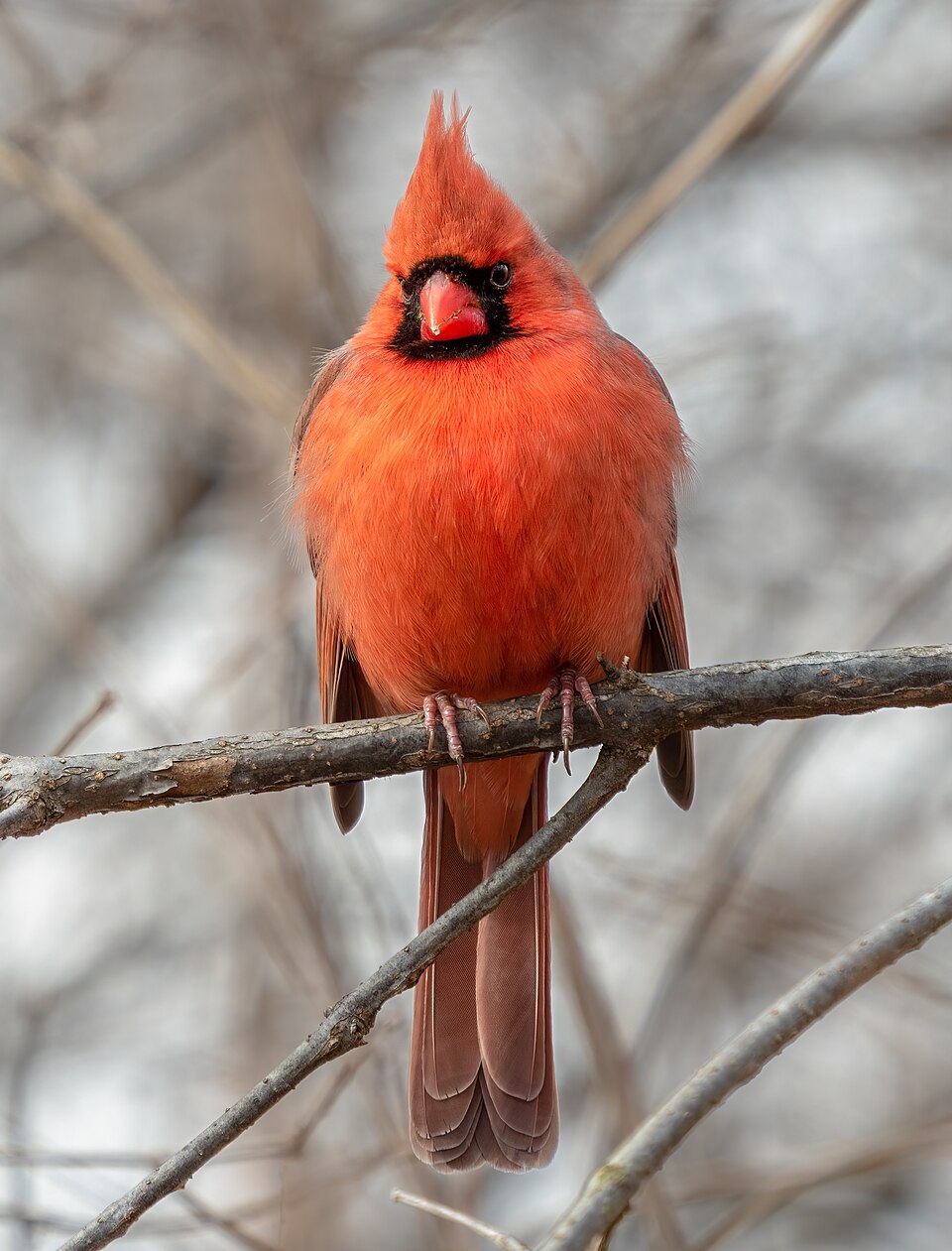
Few birds are as instantly recognizable as the Northern Cardinal. The blazing red male, with his pointed crest and black mask, is the bird most people picture when they think of a cardinal, and he is a fixture at winter feeders, perched against the snow like a living ornament. It is no accident that this bird is the official state bird of seven states, more than any other species in the United States.
Cardinals are medium-sized songbirds with a heavy, cone-shaped bill built for cracking seeds, a long tail, and a distinctive peaked crest they can raise or lower with their mood. They are year-round residents that do not migrate, so a pair often becomes a familiar presence in a single yard for years. Their adaptability to suburbs, woodland edges, and gardens has helped them steadily expand their range northward over the past century.
The cardinal's silhouette is a giveaway even before you see color: a chunky, full-bodied songbird with a prominent pointed crest, a long tail, and an unusually thick, conical reddish bill. At roughly the size of a large sparrow or a small robin, it sits upright and alert, often flicking its tail.
| Male color | Vivid all-over red, slightly darker on the back and wings, with a sharply contrasting black face mask and throat |
| Female color | Warm buff-brown to gray-brown body with reddish tinges in the crest, wings, and tail |
| Crest | Tall, pointed crest that is raised when alert or agitated and flattened when relaxed |
| Bill | Thick, cone-shaped, and bright coral-red to orange in both sexes (dark in juveniles) |
| Face mask | Black mask around the bill and eyes; bold on males, fainter or grayish on females |
| Tail | Long and reddish, often held cocked or flicked while perched |
Male vs. female
The sexes are easy to tell apart, which is unusual and helpful. The male is the famous brilliant red bird with a stark black mask. The female is more subtly beautiful: a soft warm tan or grayish-brown overall, washed with rosy red on the crest, wings, and tail, and with a duller grayish version of the black face. Both sexes share the same orange-red bill and pointed crest. Notably, female cardinals sing, which is uncommon among North American songbirds, so a singing brown cardinal is almost certainly a female.
Juveniles
Juvenile cardinals resemble adult females, with the same muted brownish plumage and reddish highlights, but they are most easily told apart by their bill: young birds have a dark grayish-black bill rather than the bright orange-red of an adult. Fledglings also look scruffy and short-crested at first. The dark bill gradually brightens to red over the first several months as the bird matures into its adult coloration.
The cardinal has one of the cleanest, most whistled songs of any backyard bird, a series of loud, clear notes that carry well. Common phrases sound like cheer-cheer-cheer, birdy-birdy-birdy, or a sliding whoit-whoit-whoit followed by a trill. The notes often slur or sweep up and down in pitch. Both males and females sing, and mated pairs sometimes countersing back and forth, matching each other's phrases.
Their most familiar call is a sharp, metallic chip or tik, given frequently from cover and especially when a person or predator is near a nest. This crisp chip note is often the first clue that a cardinal is nearby even when the bird stays hidden in dense shrubbery.
Northern Cardinals are found across the eastern and central United States, from the Atlantic coast west to the Great Plains, and south through Texas into much of Mexico, Central America, and the desert Southwest. Over the last hundred years they have steadily pushed their range north into the upper Midwest, New England, and southern Canada, helped along by maturing suburbs and the growing popularity of bird feeders.
They are non-migratory. A cardinal you see in summer is almost certainly the same bird you will see in the depths of winter, often holding the same territory year after year. They were also introduced to Hawaii and Bermuda, where populations are now well established.
Cardinals are primarily seed-eaters, and that heavy conical bill is a precision tool for husking seeds. In the wild they eat a wide variety of seeds, grains, wild fruits, and berries, including those of dogwood, wild grape, sumac, and hackberry. During the breeding season they also take large numbers of insects such as beetles, caterpillars, grasshoppers, and cicadas, and they feed their nestlings an almost entirely insect diet for the protein.
At feeders they forage mostly low to the ground or on sturdy platform and hopper feeders, where their weight is supported. They are often among the first birds to arrive at dawn and the last to leave at dusk, sometimes feeding in the half-dark when other birds have gone to roost.
The female builds the nest, a fairly loose, open cup of twigs, bark strips, grasses, and rootlets, usually tucked into dense shrubs, vine tangles, or low trees a few feet off the ground. The male often accompanies her and may bring nesting material. She lays a clutch of three to four pale, speckled eggs and does most of the incubating, which lasts roughly twelve to thirteen days.
Once the chicks hatch, both parents feed them, and the young leave the nest after about nine to eleven days. The male frequently takes over feeding the recently fledged young while the female begins a second nesting attempt, and a pair commonly raises two or even three broods in a single season. Cardinals are also a frequent host to Brown-headed Cowbird brood parasitism.
Yes, the Northern Cardinal is a classic backyard and feeder bird, and one of the easiest desirable species to attract. A few simple choices in feeders, food, and landscaping will dramatically improve your odds of hosting a resident pair.
- Offer black oil sunflower seeds and safflower seeds, their two clear favorites; safflower has the bonus of being disliked by squirrels and starlings.
- Use platform feeders, hopper feeders, or wide trays rather than small tube perches, since cardinals are heavy and prefer a stable place to sit while they crack seeds.
- Don't skip the ground; cardinals are natural ground-foragers, so scattering some seed on a tray below your feeders mimics their preferred feeding style.
- Plant dense shrubs and evergreens (such as dogwood, sumac, viburnum, or red cedar) to provide the thick cover they need for nesting and roosting.
- Provide a birdbath or shallow water source; cardinals visit water readily and a heated bath can keep them coming through winter.
- Feed at dawn and dusk when cardinals are most active, and keep feeders stocked in winter when natural seed is scarce.
- Pyrrhuloxia: A desert Southwest relative; gray overall with a red wash, a thicker, parrot-like yellowish bill, and a curved profile rather than the cardinal's straight conical bill.
- Summer Tanager: Males are also all-red but lack any crest and any black mask, and have a paler, longer, more pointed bill.
- Scarlet Tanager: Breeding males are brilliant red but have jet-black wings and tail, no crest, and no black face mask.
- Vermilion Flycatcher: A small red-and-brown bird, but slender, crestless, with a thin insect-catching bill and very different upright flycatching behavior.
Are male and female cardinals both red?
No. Only the male is brilliant red. The female is a warm tan or grayish-brown with reddish tinges on her crest, wings, and tail. Both sexes share the same orange-red bill and pointed crest, so the female is still easy to identify once you know what to look for.
Do cardinals migrate in winter?
No, Northern Cardinals do not migrate. They are year-round residents, which is why they are such a beloved winter sight at feeders. A pair often holds the same territory for years, so the cardinal you see in January is likely the same bird you saw the previous summer.
Why does a cardinal keep attacking my window or car mirror?
During the breeding season, a male cardinal sees his own reflection as a rival male invading his territory and repeatedly attacks it. It is harmless territorial behavior. You can stop it by covering the reflective surface with cardboard, soap, or a cling film until the bird gives up, usually after nesting season.
What is the best food to attract cardinals?
Black oil sunflower seeds and safflower seeds are their favorites. Offer them on a platform feeder, hopper feeder, or wide tray rather than a small tube feeder, since cardinals are heavy and need a stable perch. Scattering some seed on the ground also suits their natural foraging style.
What does it mean when you see a cardinal?
Many people attach personal or spiritual meaning to cardinals, often viewing them as a visit or sign from a lost loved one. From a birding standpoint, frequent sightings simply mean you have a resident pair holding territory nearby, especially if you offer the seeds and cover they prefer.