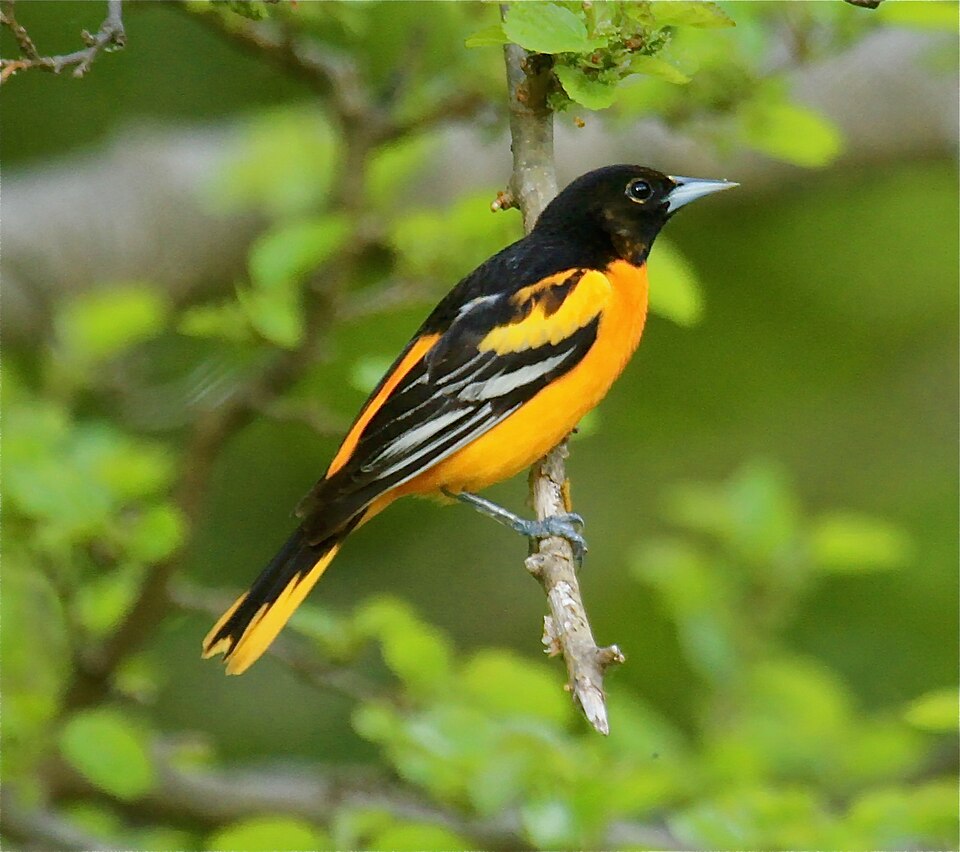
Few backyard birds stop people in their tracks the way a male Baltimore Oriole does. Glowing flame-orange below and on the shoulders, jet black on the head and back, it looks almost too tropical for a maple tree in Ohio or a riverside cottonwood in Kansas. The species takes its name from the orange-and-black colors of the coat of arms of Lord Baltimore, the colonial proprietor of Maryland, and the bird is now Maryland's state bird. For much of the eastern and central United States and southern Canada, the oriole's return in late April and early May is one of the surest signs that spring has truly arrived.
Despite the dazzling looks, Baltimore Orioles can be surprisingly easy to miss. They spend most of their time high in the leafy canopy of deciduous trees, where their whistled song carries far better than their bodies show. Patient birders learn to look for them along forest edges, in open woodlands, parks, orchards, and shade trees in towns and suburbs. A well-placed dish of orange halves or grape jelly in spring can pull these canopy-dwellers down to eye level, which is exactly why they have become such a beloved feeder target.
The Baltimore Oriole is a sleek, medium-sized songbird, larger than a warbler but slimmer and longer-tailed than a robin. It has a sturdy, sharply pointed bluish-gray bill, a fairly long tail, and a clean, upright posture as it moves through foliage. Coloration is the quickest giveaway, but the amount of orange varies a lot by age and sex, so it pays to learn the patterns rather than rely on overall brightness alone.
| Adult male body | Brilliant flame-orange underparts, rump, and shoulder patch |
| Adult male head | Solid black hood covering the entire head and upper back |
| Wings | Black with a bold orange shoulder and a single white wing bar |
| Tail | Black center with bright orange outer corners, obvious in flight |
| Bill | Straight, sharply pointed, blue-gray with a darker tip |
| Female/immature | Yellow-orange below, brownish-olive above, grayer wings with two white wing bars |
Male vs. female
Adult males are unmistakable: a full black hood and back contrast sharply with flaming orange underparts, rump, and shoulders, and the black wings show a single white bar. Females are far more subdued, typically yellow-orange to dull orange below with a brownish-olive back and head, grayish wings, and two white wing bars rather than one. Some older females develop blotches of black on the head and back and can become quite richly colored, so a brightly marked bird is not automatically a male. Males also take a full year to reach adult plumage, which complicates spring identification.
Juveniles
Juveniles and first-year birds resemble females: warm yellowish-orange underparts, a pale olive-brown back, and two whitish wing bars on grayish wings. First-spring males often look like females but may show scattered black feathers around the face, throat, or lores, hinting at the hood to come. These young males can sing and even breed before reaching full adult coloring, so do not assume a dull-looking singing oriole is misidentified.
The song is a rich, flute-like series of clear whistled notes, often described as a leisurely, slightly disjointed phrase like hew-li, hew-li, hew-li-lee. Each male has his own arrangement of notes, so the song sounds musical and somewhat improvised rather than rigidly patterned, and it carries well across open woodland. The pure, mellow tone is a good clue even when the bird stays hidden in the canopy.
The most distinctive call is a dry, rattling chatter, a rapid chuh-chuh-chuh-chuh often given when a bird is agitated or defending territory. You may also hear a sharp two-note whistle, hue-lee, used in contact between mates. Females sing too, frequently answering the male.
Baltimore Orioles breed across eastern and central North America, from the Maritime provinces and Great Plains south to the Gulf states, reaching west to roughly the Rocky Mountain foothills. Across much of the central Great Plains their range overlaps and they sometimes hybridize with the closely related Bullock's Oriole of the West; the two were once lumped together as a single species, the Northern Oriole.
This is a long-distance migrant. Most birds winter in Central America, the Caribbean, and northern South America, with a smaller number lingering along the Gulf Coast and the southeastern United States, especially where feeders are available. Spring arrival is dramatic and concentrated, with waves of birds appearing in late April and May; many depart again surprisingly early, with southbound movement well underway by late summer.
Baltimore Orioles have a notably varied diet that shifts with the seasons. In spring and summer they eat large numbers of insects, including caterpillars (they readily take hairy and spiny species many birds avoid), beetles, grasshoppers, and spiders, gleaning them from leaves and bark high in the canopy. This insect protein is especially important for feeding nestlings.
They also have a famous sweet tooth, feeding heavily on ripe fruit and nectar. Orioles favor dark, ripe fruits and will probe flowers for nectar, sometimes piercing the base of a blossom to reach it. This love of sugar is what makes them such reliable visitors to oranges, grape jelly, and nectar feeders, particularly during spring migration when natural food is scarce.
The nest is one of the marvels of North American birds: a deep, sock-like hanging pouch woven from plant fibers, grasses, bark strips, and increasingly bits of string, fishing line, or yarn. The female does almost all the weaving, suspending the pouch from the drooping outer branches of a tall deciduous tree, often an elm, maple, or cottonwood, where it sways well out of reach of most predators. A single nest can take a week or more to construct.
The female typically lays four to five pale grayish or bluish eggs marked with dark scrawls and blotches, and she incubates them for about two weeks. Both parents feed the young, which leave the nest roughly two weeks after hatching. Most pairs raise a single brood per season, reflecting their relatively short stay on the breeding grounds.
Yes, the Baltimore Oriole is one of the most rewarding feeder birds you can host, but attracting it takes a different approach than seed feeders. Orioles are drawn to color and sweetness, and timing matters enormously: put your offerings out in mid to late April, before the first migrants arrive, because birds that find food on arrival are far more likely to stay and nest nearby.
- Offer orange halves impaled on a spike or nail, cut-side out, and refresh them before they dry out or mold.
- Set out grape jelly in a small dish or dedicated oriole feeder, ideally plain (low or no added sugar) jelly to avoid additives.
- Hang a nectar feeder made for orioles, with larger perches and bigger ports than a hummingbird feeder, filled with a 1-part-sugar to 4-parts-water solution (no dye).
- Put feeders out by mid-to-late April to catch arriving migrants, when natural food is scarcest and birds are most eager.
- Plant fruiting and nectar-rich natives such as serviceberry, mulberry, raspberry, and trumpet vine to provide natural food.
- Provide a moving water source like a dripper or shallow bath, and leave short lengths of natural-fiber string nearby for nest material (avoid long synthetic fibers that can tangle birds).
- Bullock's Oriole: The western counterpart; males have an orange face with a black eyeline and crown, plus a large white wing patch, rather than a full black hood.
- Orchard Oriole: Smaller and slimmer; adult males are deep brick-red (chestnut) rather than orange, and females are greenish-yellow with no orange.
- American Robin: Similar orange underparts but much larger and bulkier, with a gray back, dark gray head, and very different ground-foraging behavior.
- Scarlet Tanager: Breeding males are red, not orange, with solid black wings and a thicker, pale bill; lacks any orange shoulder or tail.
What do Baltimore Orioles eat at feeders?
They are drawn to sweet, fruity foods rather than seed. The classics are orange halves, grape jelly, and sugar-water nectar from an oriole feeder. They also eat insects and natural fruit, so a yard with native fruiting plants helps too.
When do Baltimore Orioles arrive in spring?
In most of the eastern and central United States they arrive in late April and early May, with northern areas a week or two later. Put feeders out by mid-to-late April so arriving migrants find food right away and are more likely to stay.
How do you tell a male and female Baltimore Oriole apart?
Adult males have a full black hood and back with brilliant flame-orange underparts and a single white wing bar. Females and young birds are duller yellow-orange below with a brownish-olive back, grayer wings, and two white wing bars.
Where do Baltimore Orioles build their nests?
The female weaves a deep, hanging pouch-shaped nest, suspending it from the drooping outer branches of a tall deciduous tree such as an elm, maple, or cottonwood, usually well above the ground where it sways out of a predator's reach.
Why did my orioles stop coming to the feeder in summer?
This is normal. Once they are nesting and feeding young, orioles switch to a high-protein insect diet and visit sugary feeders far less. Many also leave the breeding grounds early, so visits often taper off by mid to late summer.