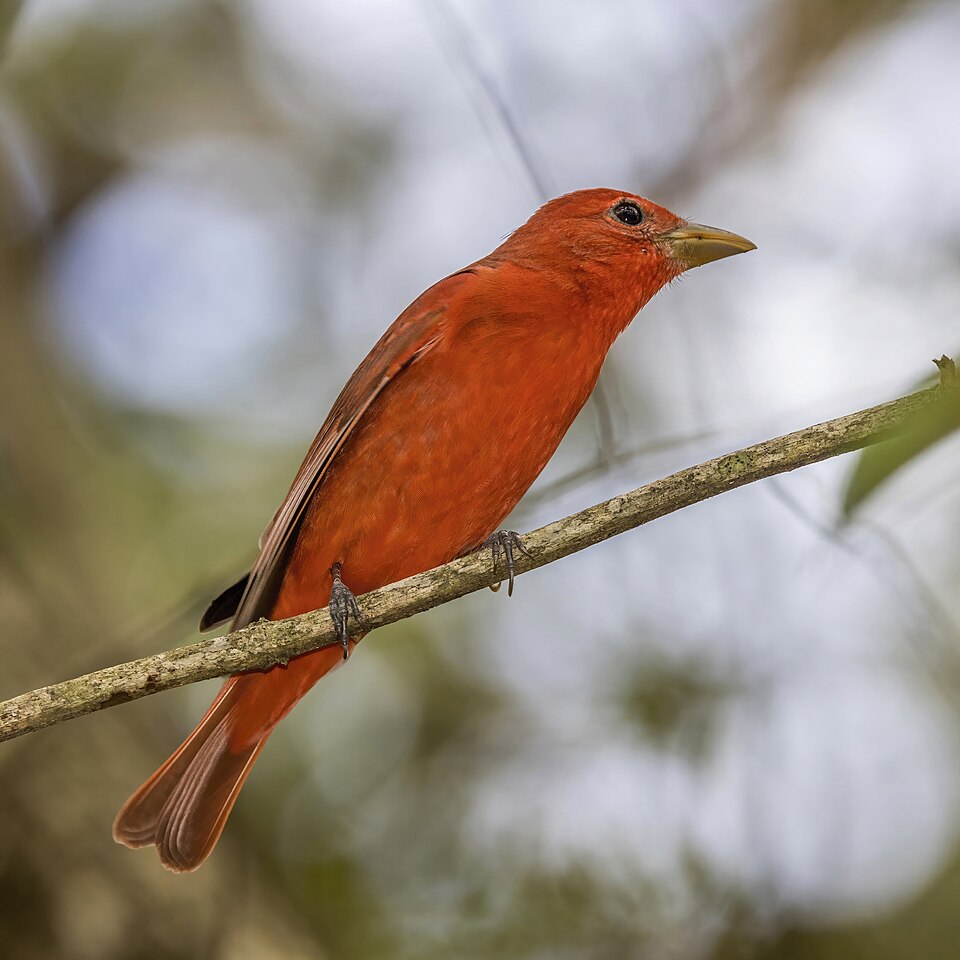
The Summer Tanager is a medium-sized songbird of open woodlands, and the adult male holds a distinction no other bird in North America can claim: he is entirely, uniformly red, with no black wings, no crest, and no mask to break up the color. Where a male Northern Cardinal wears a black face and pointed crest, the male Summer Tanager is a smooth rose-red from bill to tail. Females and young males trade that ruby for soft shades of mustard and olive-yellow, but both sexes share a heavy, pale, slightly hooked bill that gives the bird its blunt-headed, top-heavy look.
This is a bird of summer, as the name promises. It arrives in the United States in mid-to-late spring, raises its young in the leafy canopy of pine-oak and bottomland forests, and departs by early fall for the tropics. Summer Tanagers are famous among naturalists as bee and wasp specialists, they catch stinging insects on the wing, beat them against a branch to remove the stinger, and will even raid wasp nests for the larvae inside. Their unhurried, robin-like song drifting down from the treetops is one of the classic sounds of a southern summer morning.
Look for a chunky, fairly large songbird with a rounded head, a thick neck, and a notably large, pale bill that looks almost too big for the face. Summer Tanagers feed high and quietly, so you will often hear them before you spot the still, upright shape perched in the canopy. Color is the quickest clue, but pay attention to the bill, which separates tanagers from cardinals and orioles at a glance.
| Adult male | Entirely rosy red, top to bottom, with no black anywhere on wings, face, or tail |
| Adult female | Warm mustard-yellow below, olive-yellow above, brightest yellow on the head and underparts |
| Bill | Large, thick, pale horn-to-yellowish, with a faint hook at the tip, a key tanager mark |
| Shape | Stocky and big-headed, about cardinal-sized but without a crest |
| Wings | Unmarked and the same color as the body, no wing bars and no dark wings |
| Tail | Medium length, square-tipped, same color as the back |
Male vs. female
The sexes look strikingly different. The adult male is the unmistakable all-red bird, a deep, even rose-red with no black, which separates him instantly from the orange-red Scarlet Tanager, who wears jet-black wings and tail. The female is a rich mustard-yellow, deepest and brightest on the head and belly and washed olive across the back and wings. She lacks the wing bars and contrast of female orioles. First-spring males can be confusing: they often show a patchy mix of yellow and red, sometimes appearing blotched orange-and-yellow as they molt into adult plumage, and these mottled birds are a normal sight in spring.
Juveniles
Juveniles fresh from the nest resemble the female, yellowish and olive, but are streakier and more diffuse, often showing faint dusky streaking on the breast and a duller, less clean look overall. Young males begin acquiring red feathers during their first fall and winter, so by their first spring they can look like a patchwork of mustard-yellow and rose-red. These intermediate birds are not a separate species or a hybrid; they are simply males that have not finished maturing, and they will be fully red by their second year.
The song is a sweet, lazy series of clear whistled phrases, rising and falling in pitch and often compared to a robin's caroling, but softer, sweeter, and more even, without the burry harshness of a Scarlet Tanager. It rolls along unhurriedly from a high perch, sounding something like churry-churry-cheery-churry, repeated for long stretches on warm mornings.
The call note is the most reliable field mark of all: a distinctive, sharp, staccato pi-tuck or pik-i-tuck-i-tuck, a dry rattling chatter that, once learned, gives the bird away even when it stays hidden in the leaves. Birders often track down a Summer Tanager by this nervous clucking call long before they see the bird itself.
Summer Tanagers breed across the southern and central United States, from California and the desert Southwest east through Texas and the Gulf states up into the mid-Atlantic and lower Midwest. Two populations exist: an eastern group that favors open deciduous and pine-oak woodlands, and a western group tied to the cottonwood and willow galleries along desert rivers and streams. They are long-distance migrants, wintering from central Mexico south through Central America into northern and central South America.
Spring migrants reach the Gulf Coast in April and spread north through May; in fall they slip away quietly from August into October. During migration they turn up well outside their breeding range, and they are a regular and welcome surprise at coastal migrant traps. Northern birders occasionally find a wandering individual at a feeder or in a yard during migration.
Summer Tanagers are insect specialists with a famous appetite for bees and wasps, so much so that they are sometimes called the "bee bird." They hunt by sitting still, scanning, then sallying out to snatch flying insects in mid-air or gleaning them from foliage. After catching a stinging insect, the tanager carries it to a perch and wipes or beats it vigorously against the branch to knock off the stinger before swallowing. They will hover at the entrance of a wasp or bee nest, pull it apart, and eat the larvae inside.
Beyond bees and wasps, they take beetles, cicadas, caterpillars, dragonflies, grasshoppers, and a wide variety of other insects. In late summer and on the wintering grounds they supplement their diet with fruit and berries, including blackberries, mulberries, and wild fruits, which can make them more visible as they move through fruiting trees.
The female builds a shallow, somewhat flimsy cup nest of grasses, weed stems, and leaves, usually saddled on a horizontal branch well out from the trunk and often fairly high in the canopy. The nest can be so loosely built that the eggs are sometimes visible from below. She typically lays three to four pale blue-green eggs marked with brown speckling.
The female does the incubating, which lasts roughly two weeks, while the male sings nearby and helps feed the young once they hatch. Nestlings fledge in about a week and a half to two weeks. Summer Tanagers are occasional hosts to Brown-headed Cowbirds, which lay their eggs in the tanager's nest. Most pairs raise a single brood per season, though a second is possible in the southern part of the range.
Summer Tanagers are not classic feeder birds, they are canopy insect-hunters and rarely come to seed. That said, you can make a yard appealing, especially during spring migration when a hungry traveler might drop in.
- Offer fruit. Halved oranges, grape jelly, and mulberry or blackberry plantings can draw migrating or wintering tanagers, much like they draw orioles.
- Provide water. A clean birdbath, and especially a dripper or shallow moving-water feature, is one of the best ways to bring tanagers down from the canopy.
- Skip the insecticides. Since bees, wasps, and beetles are their main food, a pesticide-free yard full of insect life is far more attractive than any feeder.
- Keep mature trees. Open stands of oak, pine, and cottonwood give them the high, leafy hunting perches they prefer.
- Try mealworms. Live or dried mealworms in a tray feeder occasionally tempt a tanager, particularly during cold spring snaps when insects are scarce.
- Scarlet Tanager: Breeding male is brilliant orange-red with jet-black wings and tail, the all-red Summer Tanager never shows black wings. Females are greener with darker wings.
- Northern Cardinal: Male is red but has a pointed crest, a black face mask, and a stout reddish-orange bill. The Summer Tanager has no crest, no mask, and a pale bill.
- Western Tanager: Male has a yellow body, black wings with wing bars, and a red-flushed head, never solid red. Overlaps with Summer Tanager in the Southwest.
- Hepatic Tanager: Southwestern male is a duller brick-red with a gray wash on the cheeks and flanks and a dark gray bill, versus the Summer Tanager's clean rose-red and pale bill.
What is the difference between a Summer Tanager and a Scarlet Tanager?
The easiest clue is the wings. A male Summer Tanager is entirely red, including the wings and tail. A breeding male Scarlet Tanager is more orange-red with sharply contrasting jet-black wings and tail. Summer Tanagers also have a larger, paler bill and a sweeter, less burry song.
Is the Summer Tanager the same as a red cardinal?
No. Although both can look all red at a glance, the Northern Cardinal has a tall pointed crest, a black face mask, and a thick orange-red bill. The Summer Tanager has no crest, no mask, and a large pale bill, and it is a summer-only migrant across most of its range.
Why do Summer Tanagers eat bees and wasps?
They are specialized for it. A Summer Tanager catches a stinging insect, then beats it against a branch to remove the stinger before eating it. They will even tear open wasp and bee nests to eat the larvae, which earns them the nickname 'bee bird.'
Why is my Summer Tanager yellow and red at the same time?
That is a young male, typically in his first spring, molting from female-like yellow plumage into adult red. These patchy orange-and-yellow birds are completely normal and will be fully red by their second year.
Will Summer Tanagers come to a bird feeder?
Not often, they are insect hunters that feed high in the trees. Your best chances are offering fruit like orange halves or grape jelly, providing moving water, and keeping an insect-rich, pesticide-free yard, especially during spring migration.