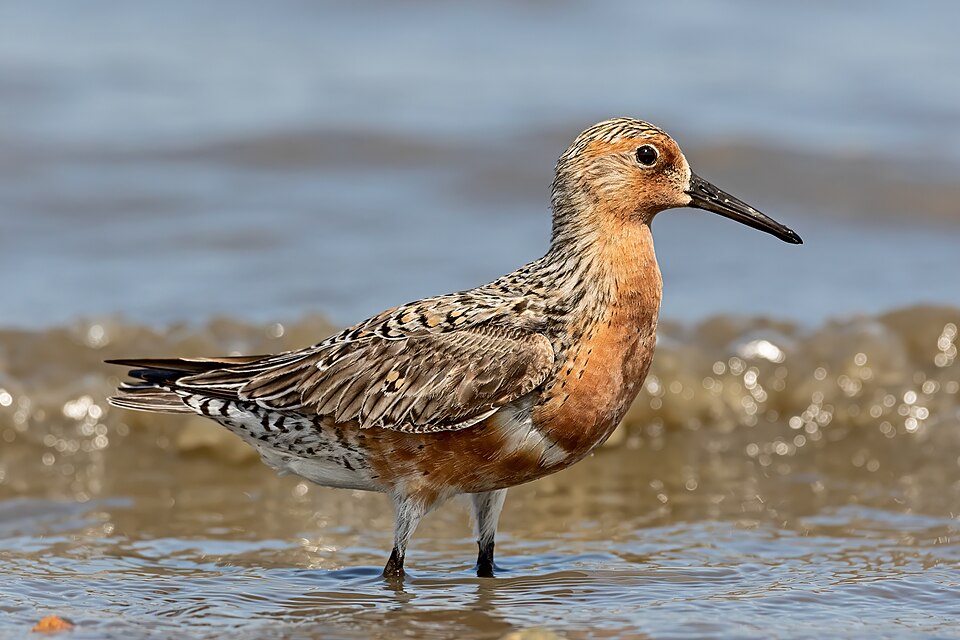
The Red Knot is a chunky, medium-sized sandpiper with a story that dwarfs its size. For much of the year it wears a drab gray, but in spring it transforms into a richly colored bird with a brick-red face, breast, and belly that give it its name. Despite being one of the more nondescript "peeps" of fall, the Red Knot is among the most celebrated shorebirds in the world because of the extraordinary distances it travels. Some individuals fly more than 9,000 miles each way between their High Arctic breeding grounds and wintering areas at the southern tip of South America.
In North America, the Red Knot is best known as a migration spectacle. Each May, huge flocks descend on Delaware Bay to gorge on the eggs of spawning horseshoe crabs, an event so finely timed that the survival of the rufa subspecies depends on it. That dependence has also made the knot a symbol of conservation concern: overharvesting of horseshoe crabs caused steep declines, and the rufa Red Knot is now federally listed as threatened in the United States. For birders, finding a knot among the more familiar dowitchers and dunlin is always a small thrill.
Red Knots are stocky, dovelike sandpipers, noticeably bulkier and more compact than most shorebirds their size. They have a relatively short, straight black bill (roughly as long as the head), a smallish rounded head, and short greenish-gray legs. The overall impression is of a sturdy, large-bodied "peep" that sits low and feeds with a steady, purposeful gait rather than the frantic scurrying of smaller sandpipers.
| Breeding plumage | Brick-red to salmon face, throat, breast, and belly; back mottled black, rufous, and gold |
| Nonbreeding plumage | Plain pale gray above, whitish below with fine streaking; a pale eyebrow stripe |
| Bill | Short, straight, black, about as long as the head |
| Legs | Short, dull greenish to yellowish-gray (not bright) |
| Rump | Pale gray, finely barred; shows a faint whitish rump patch and light wing stripe in flight |
| Build | Stocky and compact, larger and chunkier than dunlin or smaller peeps |
Male vs. female
Males and females look very similar, and in the field they are usually impossible to separate with certainty. In breeding plumage the male tends to be a touch more saturated and uniformly red below, while the female often shows slightly paler, more mottled or whitish-flecked underparts. These differences are subtle and overlap considerably, so most birders simply log "Red Knot" without assigning a sex. In nonbreeding gray plumage the sexes are effectively identical.
Juveniles
Juvenile Red Knots in late summer and fall are gentler and cleaner-looking than worn adults. They are gray above, but each feather of the back and wing coverts is neatly edged with pale buff and a thin dark line, creating a delicate scaly or scalloped pattern. The underparts are washed with a soft buffy peach tone across the breast, and the face is plain with a pale supercilium. This crisp, well-ordered look helps separate young birds from the more ragged, molting adults migrating at the same time.
Red Knots are fairly quiet birds away from the breeding grounds, which is part of why they can be easy to overlook in a mixed flock. The most common call is a soft, low, two-noted knut or kwit-kwit, often given in flight, along with a mellow, rolling quoik or poor-me note. The voice is muffled and unobtrusive compared with the sharper calls of dunlin or yellowlegs.
On the High Arctic breeding tundra, the male performs a song flight, circling high on stiff, fluttering wingbeats while delivering a plaintive, fluty, repeated poor-me, poor-me whistle that carries across the open ground. This haunting display song is rarely heard by birders in the south, since it belongs almost entirely to the brief Arctic summer.
The Red Knot breeds on barren, gravelly tundra across the High Arctic, including the Canadian Arctic islands, Greenland, and parts of Arctic Eurasia. It is a true long-distance migrant. The rufa subspecies that passes through eastern North America winters as far south as Tierra del Fuego in southern Argentina and Chile, with other birds wintering along the southeastern U.S. coast, the Gulf of Mexico, and the Caribbean. A western population (roselaari) moves down the Pacific coast.
During migration, knots funnel through a small number of critical staging sites where they refuel in enormous numbers. Delaware Bay in May is the most famous, timed to coincide with horseshoe crab spawning, but birders also find knots on coastal mudflats, sandy beaches, and bay shores during both spring and fall passage. They are far less common inland, appearing only sporadically at large lakes and reservoirs.
Outside the breeding season, Red Knots feed mainly on small mollusks, especially thin-shelled bivalves like coquina clams and small mussels, which they swallow whole and crush in a powerful muscular gizzard. They also take snails, small crustaceans, and marine worms. Knots feed by walking steadily across mudflats and sandy beaches, probing into the sediment with quick, repeated jabs of the bill and using sensitive pressure receptors at the bill tip to detect buried prey.
The spring stop at Delaware Bay is a striking exception to this shellfish diet. There, knots gorge almost exclusively on the tiny green eggs of horseshoe crabs, an easily digested, fat-rich food that lets them nearly double their body weight in a couple of weeks before the final push to the Arctic. On the tundra, breeding knots and their chicks switch to insects, especially crane flies and other invertebrates abundant in the brief Arctic summer.
Red Knots nest on dry, sparsely vegetated tundra, often on slightly elevated ground with good visibility. The nest is a simple shallow scrape on the ground, frequently lined with bits of lichen, moss, and leaves. The typical clutch is four eggs, pale greenish or olive marked with brown, laid in a single brood for the short Arctic season.
Both parents share incubation, which lasts about three weeks. The chicks are precocial, leaving the nest soon after hatching and feeding themselves under parental guidance. Interestingly, the female often departs first, leaving the male to tend the brood through the final stretch before the young can fly. This early female departure helps explain why adult females may appear on southbound migration ahead of males and juveniles.
The Red Knot is not a backyard or feeder bird, and there is no way to attract one to a typical yard. It is a coastal and Arctic specialist that needs open mudflats, sandy beaches, and rich shellfish beds. The best way to "attract" knots is to go where they are during migration and support the habitats they depend on.
- Visit major coastal staging areas during migration. Delaware Bay in May is the classic spot, but any productive beach or mudflat on either coast can host knots in spring and fall.
- Scan mixed shorebird flocks for a stocky, gray, medium-sized sandpiper with short legs and a short straight bill; in spring look for the unmistakable brick-red underparts.
- Time visits to the tide. Knots feed actively on exposed mudflats and concentrate to roost at high tide, so the hours around a falling or rising tide are best.
- Bring a spotting scope. Knots often feed in large, distant flocks, and a scope helps you pick them out from dowitchers and dunlin.
- Support horseshoe crab conservation and give feeding flocks plenty of space; repeated disturbance forces birds to burn the fat reserves they need for migration.
- Report sightings to eBird, especially of color-banded individuals, which helps track this declining, much-studied species.
- Short-billed Dowitcher: Much longer, snipe-like bill and feeds with a sewing-machine probing motion; knot's bill is short and straight.
- Dunlin: Smaller and slimmer with a longer, drooping bill and a black belly patch in breeding plumage, versus the knot's red underparts and short straight bill.
- Sanderling: Smaller, paler, and more active, chasing waves at the surf line; knot is bulkier, grayer, and feeds more deliberately on mudflats.
- Black-bellied Plover: Plover shape with a short stubby bill, larger head, and run-and-pause feeding; knot is a sandpiper that probes steadily.
Why is it called a Red Knot when most that I see are gray?
The brick-red color only appears in breeding plumage during spring and early summer. Most birders encounter knots during fall migration or winter, when they wear plain gray nonbreeding plumage, so the name can be confusing. The scientific name canutus and the legend tying it to King Canute are colorful but unrelated to the bird's actual coloring.
Where is the best place to see Red Knots?
Delaware Bay in mid-to-late May is the world-famous spot, where thousands gather to eat horseshoe crab eggs. Outside that window, look on coastal beaches and mudflats along both the Atlantic and Pacific during spring and fall migration. They are uncommon inland.
How far do Red Knots migrate?
Some rufa Red Knots travel from the southern tip of South America to the Canadian High Arctic and back, a round trip of more than 18,000 miles. It is one of the longest migrations of any bird, broken up by stops at a few critical refueling sites.
Why are Red Knots endangered or declining?
The rufa subspecies is federally listed as threatened in the U.S., largely because overharvesting of horseshoe crabs reduced the egg supply at Delaware Bay. Without enough eggs to refuel, fewer knots reach the Arctic in good enough condition to breed. Habitat loss, disturbance, and climate change add further pressure.
How do I tell a Red Knot from a dowitcher in fall?
Look at the bill. Dowitchers have very long, straight bills and feed with a rapid sewing-machine motion, while Red Knots have a short, straight bill about the length of the head and a stockier, more compact body. Knots also feed in a steadier, less frantic way.