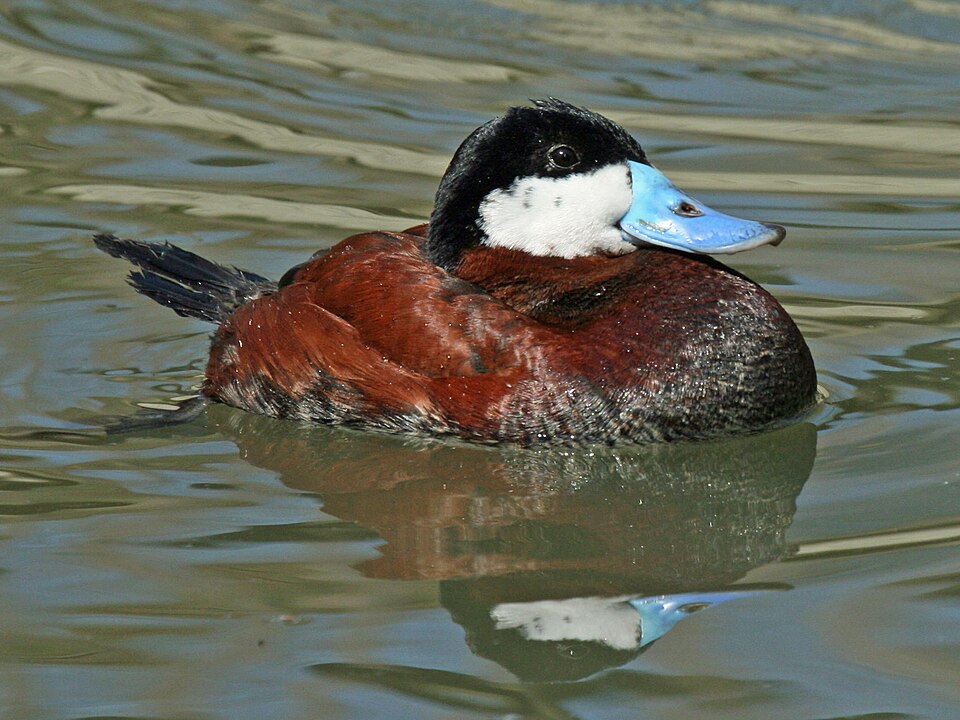
The Ruddy Duck is one of North America's most charismatic little waterfowl, a compact, big-headed diving duck that seems built mostly of personality. Even at a distance you can often pick it out by posture alone: a stocky body riding low in the water with a stiff, spiky tail held cocked straight up like a tiny sail. Come spring, the male trades his drab winter grays for a warm chestnut body, crisp white cheeks, a glossy black cap, and a bill the color of a robin's egg. Few ducks are so unmistakable when they're in full breeding finery.
Ruddy Ducks belong to a small group called the stiff-tailed ducks, and they behave differently from the dabblers most backyard birders know. They dive for nearly everything they eat, rarely come to land, and take off only with a great deal of pattering effort across the surface. They are birds of open marshes, prairie potholes, sewage lagoons, and reservoirs, and in winter they raft up by the hundreds on lakes and coastal bays across much of the continent. Their courtship is one of the great oddball spectacles of the bird world, and once you've seen it you'll never confuse this species with anything else.
Think small, round, and front-heavy. The Ruddy Duck is noticeably smaller than a Mallard, with a thick neck, a large blocky head, a broad flat bill, and a long tail that is frequently held straight up or fanned. That cocked tail and the low, squat profile are the fastest way to name this bird from a distance, even before you can make out any color.
| Size & shape | Small, stocky diving duck with a thick neck, oversized head, and a long stiff tail often held cocked upright. |
| Breeding male | Rich chestnut body, bright white cheeks, black cap, and a vivid sky-blue bill. |
| Bill | Broad, scoop-shaped, and flat; electric blue on breeding males, dull gray otherwise. |
| Female & winter male | Grayish-brown overall with a pale cheek crossed by a single dark horizontal line. |
| Tail | Stiff, spiky rectrices frequently raised straight up, diagnostic among North American ducks. |
| In flight | Small, dark, and fast with rapid wingbeats; uniformly dark wings lacking any bright speculum patch. |
Male vs. female
The sexes are easy to separate in spring and summer. The breeding male is gaudy: deep chestnut body, gleaming white cheeks, a black crown, and that famous baby-blue bill. The female is much plainer, warm grayish-brown overall with a pale buffy cheek crossed by a single dark horizontal stripe, and a dark gray bill. That cheek stripe is the key female mark; no other female duck in the region wears it. In late summer and fall the male molts into a duller, female-like plumage and loses the blue bill color, so winter birds of both sexes look broadly similar, though the male still shows brighter, cleaner white cheeks without the dark line.
Juveniles
Juveniles resemble adult females, grayish-brown with a pale cheek and a dark cheek line, but tend to look even more washed-out and scruffy through their first fall. Young birds and adults alike ride low in the water and frequently cock the tail, so the overall stiff-tailed shape will name the species long before plumage details come into focus. By their first spring, young males begin acquiring the chestnut body and blue bill.
Ruddy Ducks are nearly silent away from the breeding marsh, but the courting male puts on an unforgettable performance. In his "bubbling" display he pulls his head back, jerks his blue bill rapidly down against his puffed chest, and beats it so fast that he forces a ring of bubbles up through the water around his breast. The drumming ends in a strangled, frog-like belch or croak, often written as a sputtering puk-puk-puk-puk-purrr trailing into a low brrrt.
Females and birds outside the breeding season are largely quiet, giving only occasional low, raspy notes. This is not a duck you'll identify by ear at the feeder pond, but on a spring marsh, that bubbling drumroll is one of the most distinctive sounds in all of North American waterfowl.
Ruddy Ducks breed across western and central North America, concentrated in the prairie-pothole region of the northern Great Plains and prairie provinces, with scattered breeding through the intermountain West and into central Canada. They favor permanent freshwater marshes with thick stands of cattail and bulrush bordering open water.
In winter they spread widely across the southern United States, Mexico, and both coasts, gathering in large rafts on lakes, reservoirs, sewage lagoons, and sheltered coastal bays. Migration is mostly nocturnal. A separate population is resident in the Andes and Caribbean, and, notably, birds introduced to Britain in the 20th century spread into Europe, where they hybridized with the endangered White-headed Duck and triggered a major control program.
Ruddy Ducks are diving foragers that feed mostly underwater, paddling to the bottom of marshes and shallow lakes to strain food from the mud. Their diet leans heavily on the larvae and pupae of midges and other aquatic insects, along with small crustaceans, snails, and zooplankton, supplemented by the seeds, roots, and tubers of pondweeds, sedges, and other aquatic plants. The broad, flat bill is built for sieving soft sediment.
They typically dive in shallow water, staying under for many seconds at a time, and rest in tight rafts between bouts of feeding. Unlike dabbling ducks, they almost never tip up or graze on land, when a Ruddy Duck wants food, it goes down after it.
Nesting happens in dense emergent marsh vegetation, usually over shallow water. The female weaves a bulky platform of cattail and bulrush stems, often hidden among standing reeds and frequently with a canopy of bent-over vegetation arching above it; sometimes she will use an abandoned nest of a coot or other marsh bird.
Ruddy Ducks lay surprisingly large eggs for their body size, among the largest relative to the female of any duck, and clutches are often big. Some females also lay eggs in the nests of other Ruddy Ducks and even other waterfowl, a strategy called brood parasitism. The female incubates alone, and the precocial ducklings leave the nest soon after hatching, swimming and diving almost immediately and feeding themselves under her loose supervision.
The Ruddy Duck is not a backyard or feeder bird, so there is no seed or suet that will bring one to your yard. It is a diver of open marshes and lakes, and you'll only host one if you have, or can visit, the right kind of water.
- Look for the right habitat. Ruddy Ducks favor freshwater marshes, prairie potholes, reservoirs, and (famously) sewage and wastewater lagoons, which are often birding hotspots in winter.
- Scan in winter. Check large lakes, reservoirs, and sheltered coastal bays from fall through spring, where they gather in tight rafts, often with other diving ducks.
- Watch the tail. Among a flock of distant ducks, the one holding a stiff tail cocked straight up is almost certainly a Ruddy.
- If you own a pond, protect or restore fringing cattail and bulrush marsh and keep water free of disturbance; healthy emergent marsh is what these ducks need to breed.
- Go in spring for the show. Visit a breeding marsh in late spring to catch the male's bubbling courtship display, well worth the trip.
- Bufflehead: Also small and diving, but the male is boldly black-and-white with a big white head patch and a dark bill, never chestnut or blue-billed, and it does not cock its tail.
- Lesser Scaup: Larger, with a rounded peaked head, blue-gray bill, and pale flanks; lacks the Ruddy's white cheek, chestnut body, and upright stiff tail.
- Pied-billed Grebe: A diving waterbird of similar size and habitat, but it's a grebe with a stubby pale bill and no stiff cocked tail; brown overall and far more secretive.
- Cinnamon Teal: The breeding male is also rich rusty-red, but it's a slim dabbling duck with a long dark bill and bright wing patches, no white cheek, no blue bill, no upright tail.
Why does the Ruddy Duck hold its tail straight up?
The stiff, spiky tail can be raised and fanned, and males do it especially during courtship and territorial displays. It's also simply a resting posture for the species, that cocked tail is one of the quickest field marks for naming a Ruddy Duck at a distance.
Why is the male Ruddy Duck's bill blue?
During the breeding season the male's bill turns a bright sky-blue as part of his courtship signaling. It's a seasonal color tied to hormones; outside of breeding the bill fades to a dull gray. Females keep a gray bill year-round.
What is that bubbling sound a Ruddy Duck makes?
That's the male's bubbling display. He rapidly slaps his bill against his inflated chest, pushing a ring of air bubbles up through the water and ending in a low, belching croak. It's a courtship show performed in spring on the breeding marsh.
Are Ruddy Ducks invasive?
They are native to the Americas, but birds introduced to Britain spread into mainland Europe and began hybridizing with the rare White-headed Duck. To protect that endangered species, European wildlife agencies launched a control program to remove the introduced Ruddy Ducks.
Where can I see a Ruddy Duck?
In summer, look in freshwater marshes and prairie potholes across the western and central parts of the continent. In winter they're widespread on lakes, reservoirs, wastewater lagoons, and coastal bays across much of the southern U.S. and Mexico, often in large rafts.