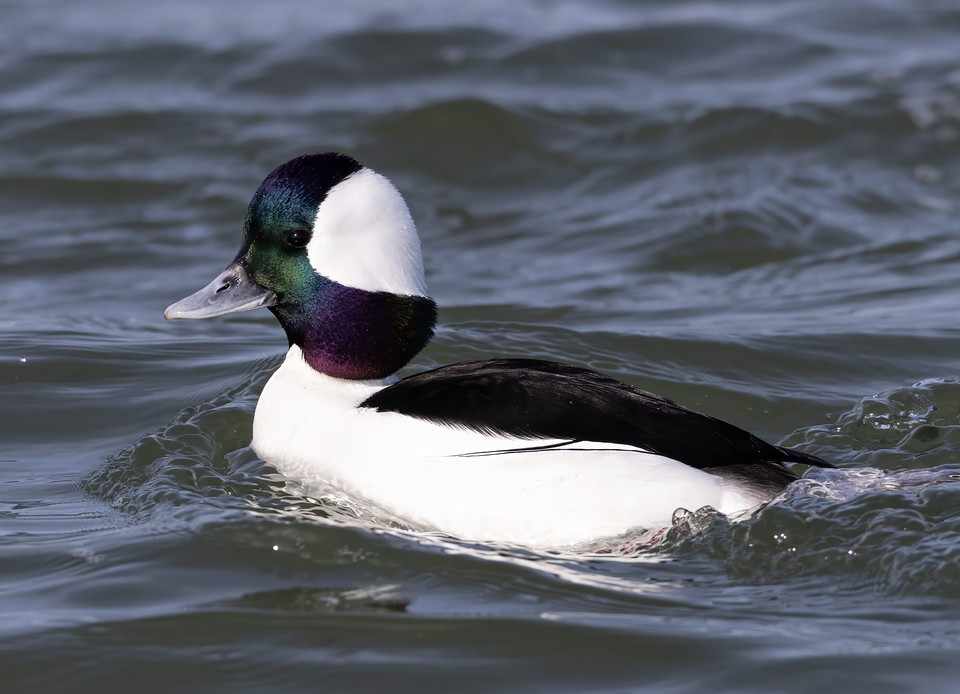
The Bufflehead is the smallest diving duck in North America, a compact, almost toy-like waterfowl that looks like it was carved and painted with extra care. The drake's bold black-and-white plumage and oversized, puffy head make him unmistakable on a winter pond, while his constant diving and bobbing give the whole bird a restless, energetic charm. Despite being barely larger than a teal, the Bufflehead is a true sea duck, a member of the same genus as the goldeneyes, and it carries itself with the same buoyant confidence on open water.
Bufflehead are tied closely to one specific partner in the natural world: the Northern Flicker. Because the birds nest almost exclusively in old flicker cavities, their breeding range maps tightly onto the boreal forests and aspen parklands of Canada and Alaska where flickers excavate. In winter they spread across the United States and into Mexico on bays, lakes, rivers, and sheltered coastlines, where their tidy size and flashing white heads make them a favorite first find for new birders scanning a flock.
Look for a very small, short-necked, large-headed duck that rides high on the water and dives often, vanishing for several seconds and popping back up like a cork. The puffed, almost bulbous head shape is the first thing to register, and on the male the gleaming white head patch can catch your eye from a great distance.
| Size | Tiny for a duck, about 13-16 inches long; noticeably smaller and rounder than most pond ducks. |
| Male head | Glossy greenish-purple iridescent head with a large, wedge-shaped white patch wrapping from eye to eye around the back of the crown. |
| Male body | Brilliant white sides, breast, and belly contrasting with a black back; looks crisply two-toned in flight and at rest. |
| Female | Dark grayish-brown overall with a single small, oval white cheek patch below and behind the eye. |
| Head shape | Distinctly puffy and oversized for the body, giving a bobble-head look. |
| Flight | Fast, low, and buzzy with rapid wingbeats; males flash a large white wing patch (speculum and inner wing). |
Male vs. female
The sexes are easy to separate. The breeding male is dramatically pied: a dark iridescent head set off by a huge white bonnet patch, snow-white flanks and underparts, and a black back. The female and immature are far more understated, a sooty grayish-brown all over with a single neat white spot or short slash on the cheek and paler underparts. In late summer and early fall, eclipse males resemble females but show more extensive white in the wing and a hint of the white head patch, which can confuse a quick glance.
Juveniles
Juveniles look much like adult females, dull brownish-gray with that diagnostic small white cheek patch, though the patch may be smaller and grayer in the youngest birds. Young males begin showing scattered white feathers and the developing head patch through their first winter, gradually acquiring the full crisp adult pattern by their second fall, so first-year drakes can look pleasantly messy and in-between.
Bufflehead are largely silent ducks, and most birders never hear them. Displaying males give a soft, low, rolled growl or chatter, sometimes rendered as a guttural rrr or a squeaky chuckle during courtship chases on the water in late winter and early spring.
Females produce a harsh, hoarse cuk-cuk or low quacking croak, used mainly around the nest and when communicating with ducklings. Because vocalizations are quiet and infrequent, you will identify this bird by sight far more often than by sound.
Bufflehead breed across the boreal forest belt of Alaska and Canada, concentrated in the aspen parklands and lake-dotted woodlands where Northern Flickers carve out the tree cavities the ducks depend on. A few breed south into parts of the western United States. Their breeding distribution is unusually tight for a North American duck precisely because it is locked to flicker habitat.
In winter they migrate to both coasts and across the interior of the United States, reaching the Gulf Coast and northern Mexico. You will find them on protected saltwater bays and estuaries, large lakes and reservoirs, slow rivers, and even small ponds. Spring migration peaks around March and April; fall arrival on wintering grounds runs from October into November.
Bufflehead are active divers that feed almost entirely underwater, plunging from the surface with a quick forward roll and propelling themselves with their feet. On freshwater they take aquatic insects, especially the larvae of midges, dragonflies, and caddisflies, along with small crustaceans, snails, and some seeds and pondweed. On salt and brackish water in winter they shift toward small crustaceans, mollusks, and marine invertebrates.
Dives are short, typically well under half a minute, and birds often surface and immediately dive again, working an area methodically. Unlike many ducks, they usually swallow prey underwater rather than at the surface, and a feeding flock will dive in loose unison, leaving the surface oddly empty for a few seconds at a time.
Bufflehead are obligate cavity nesters and almost always use abandoned Northern Flicker holes in trees near water, a tight relationship that limits their nest sites to the size of a flicker cavity. This small entrance helps exclude larger competitors and predators. They readily take to nest boxes built to the right dimensions where natural cavities are scarce.
The female lines the cavity with down and lays a clutch of pale, ivory to buff eggs, incubating alone for roughly four weeks. Soon after hatching, the ducklings make a bold leap from the cavity to the ground or water below and follow the female to feeding areas, where they can dive almost immediately. Bufflehead show strong site fidelity, with females often returning to the same nesting area, and sometimes the same cavity, year after year.
The Bufflehead is not a feeder bird and will not visit a yard for seed, but if you live on or near a lake, pond, or sheltered coastline within its range, there are real ways to encourage it.
- If you own wooded shoreline within the breeding range, put up a nest box sized for Bufflehead (a small entrance hole around 3 inches), mounted on a tree or post near open water.
- Protect mature trees and dead snags, especially aspens and other trees that Northern Flickers use, since natural Bufflehead cavities are recycled flicker holes.
- Keep nearby water clean and free of heavy boat traffic; Bufflehead favor calm, sheltered water rich in aquatic insect life.
- On wintering ponds and bays, simply give them space and a good vantage point; a spotting scope from shore lets you watch a feeding flock dive without flushing it.
- Avoid stocking or chemically treating small ponds in ways that wipe out the insect larvae and invertebrates they feed on.
- Hooded Merganser: Female and male both show a fan-shaped crest and a thin, spiky bill; the male's white head patch is a vertical fan, not the broad wraparound bonnet of a Bufflehead, and mergansers are larger with longer bodies.
- Common Goldeneye: A close relative but clearly bigger, with a rounder white face spot in front of (not behind) the eye on the male and a peaked greenish head; females have brown heads and golden eyes.
- Barrow's Goldeneye: Similar size confusion with goldeneyes; the male shows a crescent-shaped white face mark and more black on the sides, and like Common Goldeneye is substantially larger than a Bufflehead.
- Ruddy Duck: Also a small, compact diving duck, but it shows a stiff cocked tail, a flat-headed profile, and (in breeding males) a blue bill and rusty body rather than the Bufflehead's puffy head and white head patch.
How big is a Bufflehead compared to other ducks?
It is the smallest diving duck in North America, only about 13 to 16 inches long, noticeably smaller and rounder than a Mallard or even most teal. On the water it looks compact and big-headed, almost like a duck decoy shrunk down a size.
Why is it called a Bufflehead?
The name comes from 'buffalo-head,' a reference to the male's oversized, puffy head, which looks disproportionately large for such a small body, especially when he fluffs out the white-and-iridescent crown feathers in display.
Where do Bufflehead nest?
They are cavity nesters that rely almost entirely on old Northern Flicker holes in trees near water, mostly in the boreal forests and aspen parklands of Canada and Alaska. They will also use properly sized nest boxes.
What do Bufflehead eat?
They dive underwater for aquatic insects, crustaceans, snails, and mollusks, with some seeds and aquatic plants. On freshwater they favor insect larvae; on saltwater bays in winter they take more marine invertebrates.
When and where can I see Bufflehead?
In most of the United States they are winter visitors, present from roughly October through April on lakes, reservoirs, slow rivers, and sheltered coastal bays. Look for small flocks of black-and-white diving ducks that keep disappearing underwater.