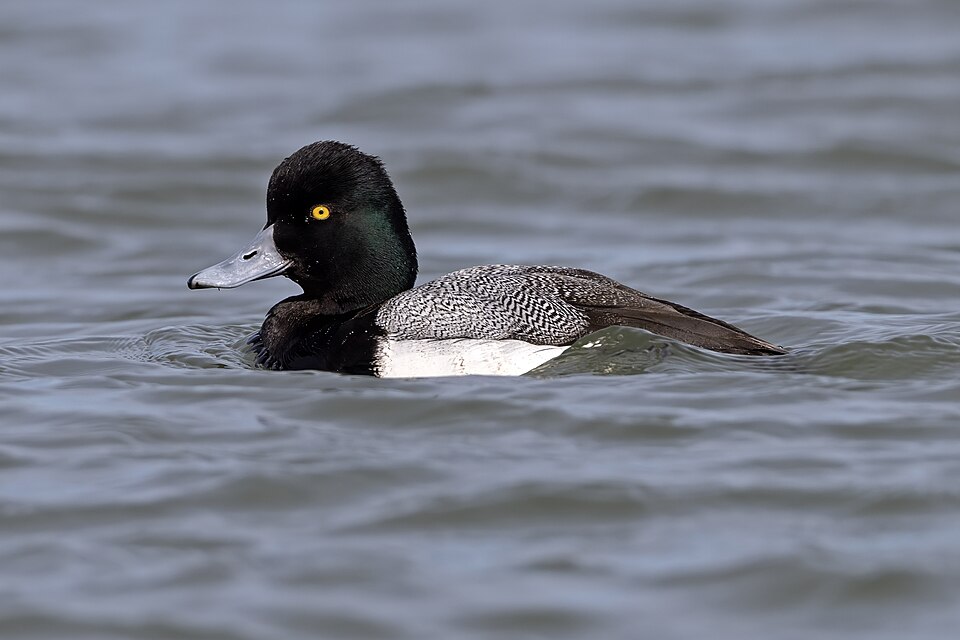
The Lesser Scaup is the workhorse of the North American diving-duck world. On almost any lake, reservoir, or sheltered bay in winter you can find rafts of these compact, dark-headed ducks bobbing offshore, diving in unison and popping back up like corks. They are likely the most numerous diving duck on the continent, and birders often shorten the name simply to "scaup" or, affectionately, "bluebill" for the pale gray-blue bill that both sexes carry.
What makes the Lesser Scaup interesting is that it is almost a twin of the Greater Scaup, and telling the two apart is one of the classic intermediate-level identification challenges in birding. Get to know the Lesser well and you will start to notice the subtle differences in head shape, head color, and body size that separate the pair. Beyond the ID puzzle, scaup are a barometer of wetland health: their long-term population decline across the prairie pothole region has made them a focus of waterfowl conservation.
The Lesser Scaup is a small-to-medium diving duck with a fairly large, peaked head, a short neck, and a rounded body that rides low in the water. The crown often shows a distinct high point toward the back, giving the head a slightly angular, peaked profile rather than a smooth dome.
| Head shape | Tall and peaked toward the rear of the crown, giving a slightly angular profile (the single most useful mark vs. Greater Scaup) |
| Male head | Black with a purplish gloss in good light, though it can flash green at certain angles |
| Bill | Pale blue-gray with a small black tip ("nail"); the dark area is restricted to a small spot, not a wide band |
| Male body | Black chest, pale gray vermiculated back and flanks, black rear end; overall a clean black-white-black pattern |
| Female | Warm brown overall with a sharp white patch wrapping around the base of the bill |
| Eye | Bright yellow in adults of both sexes |
Male vs. female
Males and females look quite different. The breeding male is crisply patterned: a glossy dark head (purplish in most lights), a black breast, finely barred pale-gray back and sides that look whitish at a distance, and a black stern. The female is warm chocolate-brown with paler flanks and, most distinctively, a bold white blaze encircling the base of the bill. Both sexes share the pale blue-gray bill and golden-yellow eye. In late summer, males molt into a drab "eclipse" plumage that resembles the female, becoming brownish overall before regaining their sharp pattern by fall.
Juveniles
Juveniles and first-winter birds resemble adult females but are even plainer and duller, with a browner eye that has not yet brightened to full yellow and only a faint, smudgy whitish area at the base of the bill rather than the crisp white blaze of an adult hen. Young males gradually acquire darker heads and the vermiculated gray flanks through their first winter, often looking patchy and intermediate before reaching full adult plumage.
Scaup are not vocal birds for most of the year, and away from the breeding grounds you may never hear more than the soft whir of wings as a flock takes off. On the water, displaying males give a quiet, almost whispered whistle, while females produce a low, growling brrr or guttural arrr call. Courtship in late winter and spring brings more sound: soft cooing and whistled notes from drakes as they throw their heads back in display.
The most reliable "sound" of a scaup flock is mechanical rather than vocal, the rush of many wings and the splashing of birds diving and resurfacing together. Listen for the female's rough, scolding growl if a flock is flushed.
Lesser Scaup breed across a vast swath of northern North America, from Alaska and the boreal forest of Canada south into the prairie pothole region of the northern Great Plains. The prairie potholes, a landscape of countless small wetlands, are the heart of their breeding range and the reason scaup numbers are so closely tied to prairie water conditions.
In winter they spread widely across the southern United States, Mexico, the Caribbean, and Central America, gathering on lakes, reservoirs, large rivers, coastal bays, and estuaries, often in enormous rafts numbering in the thousands. Migration is staggered, with birds moving south through fall and lingering as far north as open water allows. Lesser Scaup are more likely than Greater Scaup to use freshwater lakes and inland reservoirs, so an inland scaup flock far from the coast is statistically more often Lesser.
Lesser Scaup are diving ducks that feed by plunging underwater and swimming down to forage on the bottom or in the water column. Their diet shifts with the season but leans heavily on aquatic invertebrates, especially small crustaceans like amphipods (scuds), aquatic insect larvae such as midges, snails, and clams. During migration, dense concentrations often build up where invertebrate food is abundant, such as the famous staging areas on the upper Mississippi River.
They also take seeds and parts of aquatic plants, particularly in winter and where invertebrates are scarce. A diving scaup typically stays under for a few seconds to half a minute, and a foraging raft will often dive and surface more or less together, creating a rippling, restless feel to the whole flock.
Lesser Scaup are among the latest-nesting ducks in North America, often not beginning until late spring or early summer once wetlands are reliably full. The female builds the nest on the ground, usually well concealed in dense vegetation near or over water, lining a shallow bowl with grasses and a generous layer of down.
She lays a clutch of roughly 8 to 12 olive-buff eggs and incubates them alone for about three to four weeks; the male departs to molt once incubation is underway and plays no role in raising young. The ducklings are precocial, leaving the nest within a day of hatching and feeding themselves under the hen's watch. Scaup hens will sometimes lay eggs in one another's nests, so unusually large clutches turn up from time to time.
The Lesser Scaup is not a backyard or feeder bird, so there is no seed or suet that will bring one to your garden. It is a deep-diving waterfowl of open lakes, reservoirs, and bays. That said, if you live near water there are real ways to enjoy and "attract" them within view.
- Look on open water, not in yards. Scan lakes, reservoirs, large ponds, and sheltered coastal bays in fall and winter, scaup raft up offshore rather than coming to land.
- Time it for the cold months. In most of the U.S. they are winter visitors; the biggest rafts appear from late fall through early spring.
- Use a spotting scope. Scaup typically sit far out on the water, so a scope is far more useful than feeders for getting good looks and sorting Lesser from Greater.
- Support wetland conservation. Healthy prairie potholes and clean reservoirs are what scaup truly need; backing wetland protection helps the species far more than any backyard effort.
- Check mixed waterfowl flocks. Lesser Scaup often mingle with Ring-necked Ducks, Redheads, and Ruddy Ducks, so scan rafts carefully for the peaked-headed bluebills.
- Greater Scaup: The near-identical twin. Greater is slightly larger with a smoother, rounded head (peak over the eye, not the rear crown), greenish head gloss, a more extensive white wing stripe, and a broader black bill tip. It favors saltwater and large lakes more than Lesser does.
- Ring-necked Duck: Similar size and dark head, but males have a black back (not gray), a peaked angular head, and a bold white ring near the bill tip plus a white spur up the side of the chest. Females show a white eye-ring and pale face rather than a white bill-base blaze.
- Redhead: Larger, with a rounded rufous-red head, gray back, and a blue-gray bill tipped with black and white. The males' rounded red head is unmistakable against a scaup's dark, peaked head.
- Tufted Duck: A Eurasian look-alike that turns up as a rare visitor. Males have a glossy black back (like a Ring-necked) and a drooping head tuft; females may show a small white bill-base patch like a scaup but have a tuft and darker back.
How do I tell a Lesser Scaup from a Greater Scaup?
Focus on head shape first. Lesser Scaup has a taller, peaked head with the high point toward the back of the crown, while Greater Scaup has a smoother, rounded head peaking over the eye. In good light the male Lesser's head glosses purple and the Greater's glosses green. Greater is also a bit larger and bulkier, shows a longer white wing stripe in flight, and has a slightly larger black tip on the bill. Habitat is a clue too: an inland freshwater flock is more likely Lesser.
Why are they called 'bluebills'?
Both sexes have a pale blue-gray bill, and hunters and birders long ago nicknamed scaup 'bluebills' for that feature. The name applies to both Lesser and Greater Scaup, which is why it is not a precise field ID on its own.
Are Lesser Scaup populations declining?
Yes. Although still abundant, the combined scaup population has fallen well below historic levels over recent decades, with much of the decline attributed to changing conditions in the prairie pothole breeding grounds, reduced food quality at migration stopovers, and wetland loss. They remain a focus of waterfowl conservation and monitoring.
What do Lesser Scaup eat?
They are diving ducks that forage underwater, mostly on aquatic invertebrates such as amphipods (scuds), midge larvae, snails, and small clams, along with seeds and aquatic plant material. Their diet shifts toward more plant matter in winter where invertebrates are less available.
Will Lesser Scaup come to a backyard or pond feeder?
No. They are open-water diving ducks and do not visit feeders or yards. To see them, scan lakes, reservoirs, and sheltered bays in fall and winter, ideally with binoculars or a spotting scope, since they usually sit far offshore in rafts.