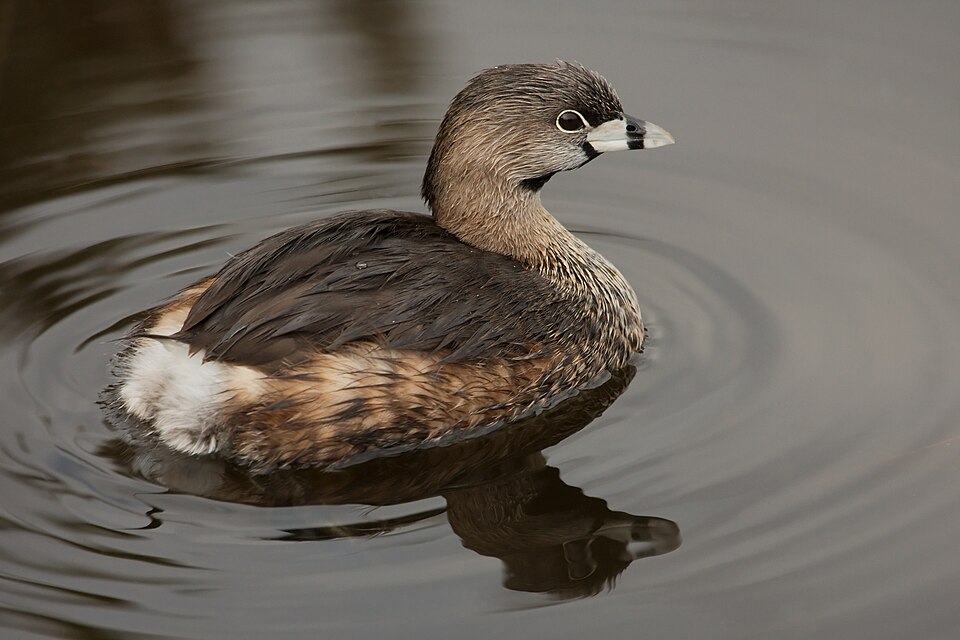
The Pied-billed Grebe is one of North America's most widespread waterbirds, yet it slips past most people unnoticed. It is a small, chunky, brownish diver about the size of a pigeon, usually seen alone on a quiet pond, marsh, or slow-moving stretch of river. What gives it away is not flashy plumage but behavior: it floats low in the water like a half-submerged log, then quietly sinks straight down out of sight, often surfacing many yards away. Birders affectionately call it the "hell-diver" and "dabchick" for exactly this disappearing act.
Despite looking duck-like, grebes are not ducks at all. They belong to an ancient family of foot-propelled divers with lobed (not webbed) toes, a tail so short it is essentially absent, and legs set far back on the body for diving power. The Pied-billed Grebe is the most familiar of the seven North American grebes and the only one that regularly turns up on small farm ponds and city park lakes, which makes it a satisfying bird to learn. Its far-carrying, almost tropical-sounding call is often heard from spring marshes long before the bird itself is spotted.
Look for a small, compact, neckless-looking waterbird that rides low in the water with a blunt, thick bill rather than the flat bill of a duck. The overall impression is brown and rounded, with a fluffy white rear end that often bobs up as the bird dives. Size and the heavy, chicken-like bill separate it instantly from ducks once you know what to watch for.
| Bill | Short, thick, and pale; in breeding season whitish with a bold black vertical band around the middle (the 'pied' bill) |
| Throat | Black chin and throat patch in breeding plumage; whitish and plain in winter |
| Body | Stocky and rounded, plain grayish-brown overall, paler below, with no obvious neck or tail |
| Rear end | Fluffy, pale buff-white undertail that puffs up conspicuously, especially when alarmed |
| Eye | Dark brown with a thin pale eye-ring; gives a gentle, plain-faced look |
| Feet | Lobed toes set far back on the body (rarely seen); legs nearly useless on land |
Male vs. female
Males and females look essentially identical in the field, so you cannot reliably tell them apart by plumage. Males average slightly larger and heavier-billed, but the difference is too subtle to judge on a lone bird. In a mated pair seen side by side, the larger of the two with the chunkier bill is usually the male, but this is a soft clue rather than a sure mark.
Juveniles
Downy chicks are striking and unmistakable: boldly striped in black and white across the head and neck, often with reddish or rusty markings on the face. They frequently ride on a parent's back, tucked into the wing feathers, even diving with the adult. Older juveniles fade to a plainer, washed-out brown like winter adults but keep a faintly striped or smudged face for a while. Young birds lack the black throat and the crisp black bill band of breeding adults.
The voice is far more distinctive than the bird. In the breeding season males give a loud, far-carrying call that starts with several gulping notes and builds into a long, hollow, whooping series that slows toward the end: kuk-kuk-kuk-cow-cow-cow-cowp-cowp-cowp. It has an almost cuckoo-like or tropical quality and carries surprisingly far across a marsh, often at dawn and dusk.
Outside of song, both sexes give a variety of clucks, whinnies, and a sharp cuk when alarmed. The call is one of the classic background sounds of a North American spring wetland, and it is frequently heard from dense vegetation when the bird stays out of sight.
The Pied-billed Grebe breeds across most of North America, from southern Canada through the United States and into Mexico, Central America, and parts of South America, making it one of the most widely distributed grebes in the Western Hemisphere. It is found wherever there is calm, vegetated fresh water with enough open surface to dive.
Birds nesting in the colder northern interior migrate south for winter, often at night, settling on open water in the southern U.S., along both coasts, and farther south where ponds and bays stay ice-free. In milder regions it is a year-round resident. In winter it tolerates brackish estuaries and sheltered coastal waters as well as freshwater lakes, which is why the same modest brown bird can turn up almost anywhere there is water that does not freeze.
The Pied-billed Grebe is a generalist underwater hunter with a powerful, blunt bill built for crushing. It eats a lot of crayfish and other crustaceans, plus small fish, aquatic insects and their larvae, snails, leeches, tadpoles, and even small frogs. The heavy bill lets it handle hard-shelled prey that thinner-billed divers struggle with.
It captures nearly all of its food underwater, propelled by those rear-set lobed feet, and can stay submerged for a surprisingly long time. Like other grebes, it has the curious habit of eating its own feathers and feeding feathers to its chicks; biologists believe the feather mass in the stomach helps protect the gut from sharp fish bones and may aid in forming indigestible pellets.
Pied-billed Grebes build a floating nest, a soggy platform of wet plant material anchored to standing vegetation such as cattails or reeds in shallow water. Both members of the pair help build it. The clutch is typically four to seven bluish-white eggs that quickly become stained brown by the damp nest material.
Both parents incubate, and when an adult leaves the nest it often pulls wet vegetation over the eggs to hide and insulate them. The striped chicks hatch ready to swim and dive, and they spend much of their early life riding on a parent's back, sheltered in the back feathers even while the adult is on the water. Pairs are strongly territorial and aggressive toward intruders during the breeding season.
The Pied-billed Grebe is not a backyard or feeder bird and will not visit a seed feeder, suet, or birdbath. It is a wetland specialist that needs open water to dive in and forage. You attract it by providing or protecting habitat rather than food, so it is mainly a bird for those with a pond, lakeshore, or nearby marsh.
- If you have a pond or large water feature, leave a fringe of native emergent vegetation like cattails, bulrush, and sedges where grebes can hide and anchor a nest.
- Maintain open, fairly calm water at least a few feet deep so the bird has room to dive and forage.
- Keep the water healthy and full of life by supporting populations of small fish, crayfish, and aquatic insects rather than sterilizing the pond.
- Avoid stocking heavy, fast boats or constant disturbance on small waters during spring and summer, when grebes are easily flushed off nests.
- To see them, scan quiet ponds, marshes, and slow rivers at dawn and listen for the whooping call; bring binoculars and watch for the bird that keeps disappearing underwater.
- Reduce shoreline runoff and pesticides so the invertebrate prey base they depend on stays abundant.
- Horned Grebe: Slightly larger and slimmer with a thin, straight bill; winter birds are crisply black-and-white, never the uniform plain brown of a Pied-billed.
- Eared Grebe: Smaller, thinner-billed, with a peaked head and a steeper forehead; winter plumage is dusky and dingy rather than warm brown, and it lacks the thick pale bill.
- Least Grebe: Much smaller and darker with a slender dark bill and a golden-yellow eye; limited to the far southern U.S. and tropics, unlike the widespread Pied-billed.
- American Coot: Slaty-black with a white chicken-like bill and bobbing head; swims and dives on the same ponds but is darker, more social, and not a true grebe.
Is a Pied-billed Grebe a duck?
No. Although it swims and dives like a duck and is often mistaken for one, the Pied-billed Grebe belongs to the grebe family, an unrelated group of foot-propelled divers. The biggest tells are its short, thick, chicken-like bill instead of a flat duck bill, its tailless rounded shape, and its habit of sinking slowly out of sight rather than tipping forward to feed.
Why does the Pied-billed Grebe disappear underwater so suddenly?
It can control its buoyancy by squeezing air out of its feathers and body, letting it sink straight down quietly instead of making a splashy dive. This 'submarining' helps it escape danger and sneak up on prey. The behavior is so characteristic that old-timers nicknamed the bird the 'hell-diver.'
What does a Pied-billed Grebe sound like?
In spring and summer it gives a loud, hollow, whooping series, often written as kuk-kuk-cow-cow-cowp-cowp that slows down at the end and carries far across a marsh. It almost sounds tropical or cuckoo-like. It also makes clucks and a sharp alarm note. You will often hear it from dense reeds before you ever see the bird.
Where can I see a Pied-billed Grebe?
Look on calm, vegetated fresh water: farm ponds, marshes, park lakes, reservoirs, and slow rivers. They are widespread across North America and turn up on small ponds far more often than other grebes. In winter many move south and may also use sheltered bays and estuaries. Scan for a small lone brown bird that keeps diving.
What do Pied-billed Grebes eat?
They are underwater hunters that favor crayfish and other crustaceans, along with small fish, aquatic insects, snails, leeches, tadpoles, and small frogs. Their stout bill is strong enough to crush hard-shelled prey. Oddly, they also eat their own feathers, which is thought to protect the stomach from sharp fish bones.
Why do baby Pied-billed Grebes ride on their parents' backs?
The boldly striped chicks climb onto a parent's back and tuck into the wing and back feathers for warmth and protection from predators and cold water. The adult can swim and even dive with the chicks aboard. This back-riding is common to grebes and lets the vulnerable young stay safe during their first weeks of life.