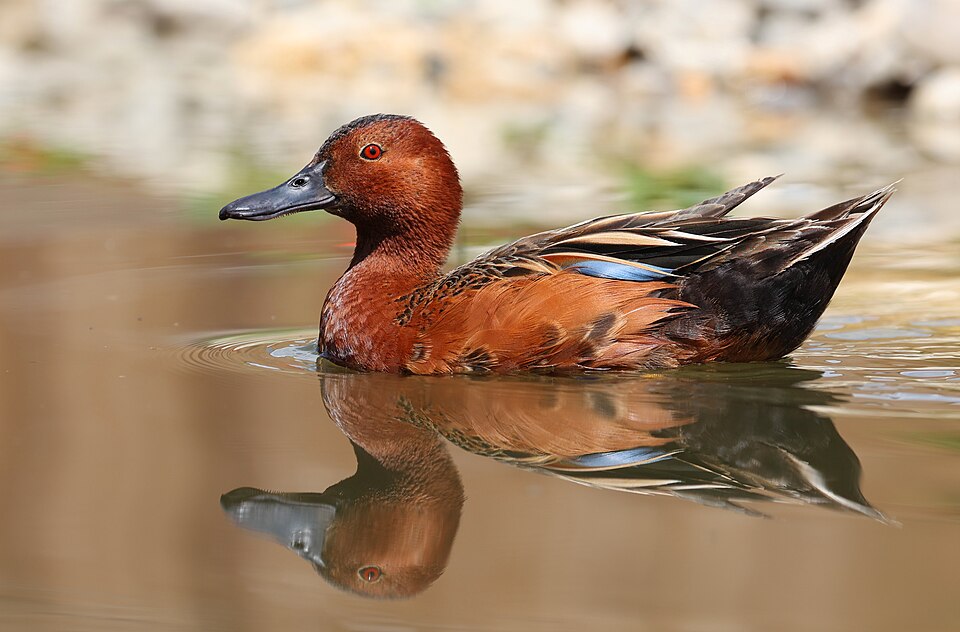
Few ducks stop a birder mid-step like a breeding male Cinnamon Teal in good light. The drake glows a deep, saturated rusty red-brown from head to flank, an almost unreal copper color set off by a glowing crimson eye. It is one of the smaller dabbling ducks of North America, a close cousin of the Blue-winged Teal, and a bird of the marshes, sloughs, and reedy pond edges of the American West.
Cinnamon Teal are primarily a western species, far more at home in California, the Great Basin, the Intermountain West, and the prairies than in the eastern half of the continent. Interestingly, the species also has a separate population in South America, making it one of the few ducks with a genuinely split distribution across the hemispheres. For backyard birders, this is a marsh and wetland bird rather than a feeder visitor, but it is a wonderful reward for anyone who scans a shallow, vegetated pond in spring.
This is a small, compact dabbling duck with a notably long, wide, spatula-like bill that looks slightly oversized for the head. In flight, all plumages flash a powder-blue forewing patch and a green speculum, much like the closely related Blue-winged Teal. On the water it sits low and sleek, often feeding with the bill skimming the surface.
| Breeding male | Deep cinnamon-rufous overall on head, neck, breast, and flanks; striking red eye; dark bill |
| Bill | Long, broad, black, slightly spatulate (shoveler-like) - larger than a typical teal bill |
| Wing patch | Chalky powder-blue forewing with a green speculum, visible in flight and on stretched wing |
| Female | Warm mottled brown, plainer face than Blue-winged Teal, with a faint eyeline and dark eye |
| Eclipse male | Resembles female but retains a reddish wash and red eye |
| Size & shape | Small and low-slung, with a flat crown and a heavy-looking front end from the big bill |
Male vs. female
The sexes look very different in breeding season. The drake is unmistakable: an even, deep cinnamon-red body and a bright red iris that almost seems to glow. The female is a much plainer warm brown, finely mottled, with a dark eye and only a soft, indistinct face pattern. The best way to nail a female Cinnamon Teal is the bill (long, broad, and slightly spoon-shaped) plus the plain, warm-toned face that lacks the crisp pale loral spot and stronger eyeline of a female Blue-winged Teal. In late summer the male molts into a female-like eclipse plumage but keeps the red eye and a warmer, more rufous cast, which gives him away.
Juveniles
Juveniles closely resemble the adult female: warm brown and finely streaked or mottled, with a dark eye rather than the adult male's red one. Young males begin showing scattered reddish feathers as they mature into their first winter, gradually filling in the rich cinnamon tones and developing the red iris. Until that happens, separating young Cinnamon Teal from Blue-winged Teal in the field can be genuinely difficult and often comes down to the warmer overall tone, the plainer face, and the slightly larger bill.
Cinnamon Teal are fairly quiet ducks, and they are heard far less often than they are seen. The drake gives a soft, low, rattling or chattering note rather than any musical song - a dry karr-karr-karr or a series of clicking, ticking sounds during courtship. It is understated and easy to miss against the background noise of a busy marsh.
Females are more vocal in the typical dabbling-duck way, giving a descending series of quacks - a quack, quack-quack-quack that fades in volume - especially when flushed or when communicating with ducklings. Neither sex produces the loud, ringing calls you might associate with a Mallard.
The North American population breeds across the western United States and into southwestern Canada, with strongholds in California, the Great Basin, the northern Rockies, and the western prairies. It is genuinely a bird of the West and is only a scarce vagrant east of the Mississippi, where a sighting often draws a small crowd of birders.
These teal are short- to medium-distance migrants. Northern breeders move south in fall to winter from the southwestern U.S. through Mexico and into Central America, while milder coastal areas of California and the Southwest hold birds year-round. Entirely separate resident populations live in South America, from the Andes to the southern cone, which is a striking quirk for a North American duck.
Cinnamon Teal are dabblers and surface feeders. They work the shallows of marshes and ponds, skimming the water with that broad bill, tipping up to reach submerged plants, and straining tiny food items from the surface film and the mud. The wide, lamellae-lined bill is well suited to filtering small particles, much like its relative the Northern Shoveler.
Their diet is a mix of plant and animal matter. They take seeds and the soft parts of aquatic plants such as pondweeds, sedges, and bulrushes, along with aquatic invertebrates - insects and their larvae, small mollusks, and crustaceans. Animal protein becomes especially important for breeding females and growing ducklings in spring and early summer.
Cinnamon Teal nest on the ground, typically well hidden in dense grasses, sedges, or other vegetation near the water's edge. The female builds a shallow bowl lined with grass and down, often tucked beneath overhanging cover so it is nearly invisible from above. Pairs form on the wintering grounds and during migration, so birds arrive on the breeding marsh already paired.
The female lays a clutch of roughly 8 to 12 pale, unmarked eggs and does all of the incubation, which lasts a little over three weeks. The drake typically departs to molt once incubation is well underway, leaving the female to raise the brood. The ducklings are precocial - downy, mobile, and able to feed themselves soon after hatching - and the female leads them to water and tends them until they fledge.
The Cinnamon Teal is a wetland duck, not a backyard or feeder bird, so you won't lure one to a seed feeder. That said, if you have land or a pond, or simply want to see them, there are reliable ways to put yourself in their path.
- Visit shallow, vegetated freshwater marshes, sloughs, and pond edges in the West - especially in spring, when breeding males are at their most colorful.
- Check national wildlife refuges and managed wetlands; well-flooded, reedy impoundments are classic Cinnamon Teal habitat.
- If you manage a pond, maintain shallow water with native emergent vegetation like bulrush and sedge, and protect undisturbed grassy edges for ground nesting.
- Avoid draining or mowing pond margins during the breeding season - dense low cover near water is what nesting females need.
- Bring binoculars or a spotting scope and scan slowly; teal often feed quietly along the edges and are easy to overlook among other dabblers.
- Avoid pesticide use near water to protect the aquatic insects that feed breeding females and ducklings.
- Blue-winged Teal: Closest look-alike and the trickiest to separate. Breeding male has a slate-gray head with a bold white facial crescent rather than an all-cinnamon body. Females are nearly identical but show a crisper face pattern and a stronger eyeline; Cinnamon females are warmer and plainer-faced with a slightly bigger bill.
- Northern Shoveler: Shares the powder-blue forewing and an even larger spatulate bill, but the breeding male shoveler has a green head, white breast, and chestnut flanks - not the uniform cinnamon of a teal. Shovelers are noticeably bigger.
- Green-winged Teal: Smaller and more compact with a short, fine bill and no blue forewing patch. Males have a chestnut head with a green eye-stripe, very different from the solid-red Cinnamon Teal drake.
- Ruddy Duck: Also rusty in breeding male, but a stiff-tailed diving duck with a blue bill, white cheeks, and a cocked tail - a completely different shape and behavior from a dabbling teal.
How do you tell a Cinnamon Teal from a Blue-winged Teal?
In breeding plumage it's easy: the male Cinnamon Teal is solid rich rusty-red with a red eye, while the male Blue-winged Teal has a gray head and a bold white crescent on the face. Females are much harder - look for the Cinnamon Teal's plainer, warmer-toned face, faint eyeline, and slightly longer, broader bill. Both flash a powder-blue forewing in flight.
Where can I see a Cinnamon Teal?
They're a western bird, most common in shallow, vegetated marshes, sloughs, and refuges across California, the Great Basin, the Intermountain West, and the western prairies. Spring is the best time, when breeding males are vivid. East of the Mississippi they're rare vagrants.
Why is it called a Cinnamon Teal?
The name comes from the breeding male's plumage - a deep, even cinnamon-rufous color across the head, neck, breast, and flanks. 'Teal' refers to the group of small dabbling ducks it belongs to.
Are Cinnamon Teal rare?
No - they're common within their western range and listed as Least Concern. They can seem rare to eastern birders simply because the species is concentrated in the West and only wanders east occasionally.
What do Cinnamon Teal eat?
They're dabblers that feed in the shallows on a mix of plant and animal matter - seeds and soft parts of aquatic plants like pondweeds and bulrushes, plus aquatic insects, small mollusks, and crustaceans. Breeding females and ducklings rely especially on insect protein.