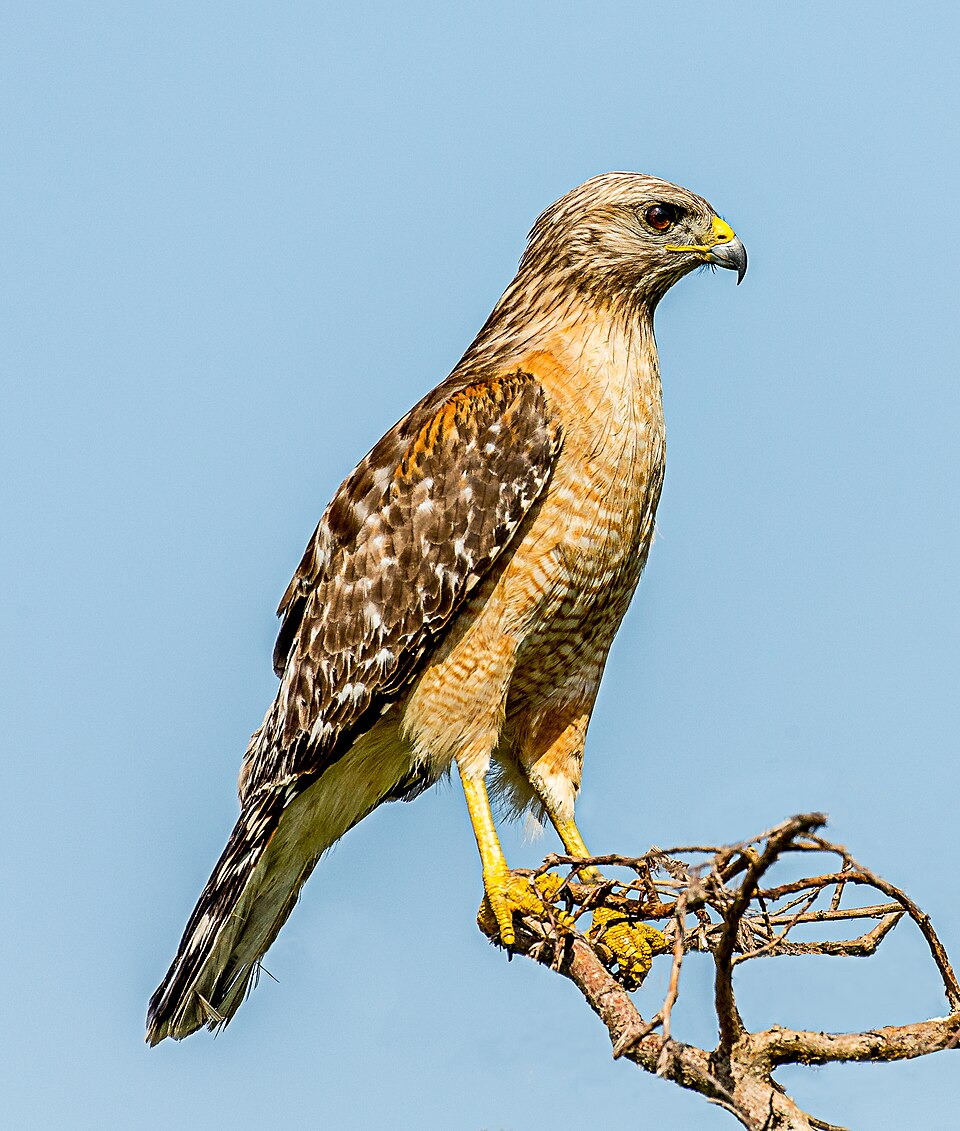
The Red-shouldered Hawk is a medium-sized, boldly marked Buteo that favors wet, leafy woodlands, river bottoms, and wooded suburbs across much of the eastern United States and a separate stretch of coastal California. It is one of the most vocal of all North American hawks, and birders often hear its loud, repeated screaming long before they spot the bird perched quietly inside the canopy. Adults are gorgeous up close: warm rusty-barred underparts, a strongly banded black-and-white tail, and the rufous "shoulders" (technically the lesser wing coverts) that give the species its name.
Unlike the open-country Red-tailed Hawk, this is a bird of the forest interior and its edges. It hunts patiently from a perch, dropping onto frogs, snakes, small mammals, and large insects below. In many leafy neighborhoods with mature trees and a creek or pond nearby, Red-shouldered Hawks have become surprisingly tolerant of people, nesting in backyard oaks and announcing their presence with that unmistakable, ringing call.
This is a fairly stocky, medium-sized hawk with a longish tail and relatively narrow wings for a buteo. In flight it looks slimmer-winged and longer-tailed than a Red-tailed Hawk, and it often flaps with quick, stiff wingbeats between glides. The combination of barred orange underparts, a black tail crossed by narrow white bands, and pale crescent "windows" near the wingtips is diagnostic overhead.
| Underparts | Warm rufous-orange with fine, dense pale barring across the chest and belly in adults |
| Shoulders | Rusty-red patch on the upper wing (lesser coverts), the field mark behind the name, best seen on a perched bird |
| Tail | Blackish with several narrow, crisp white bands and a white tip; obvious in flight and at rest |
| Wing windows | Translucent pale crescents near the wingtips, glowing when backlit, visible on every age and very useful overhead |
| Upperwing | Checkered black-and-white flight feathers; reddish lesser coverts form the shoulder |
| Size & shape | Medium buteo with longish tail and somewhat slim, squared wings; smaller and slimmer than a Red-tailed Hawk |
Male vs. female
Males and females look essentially alike in plumage, both show the rusty barred chest, banded tail, and reddish shoulders. As in most hawks, the female is noticeably larger and heavier than the male, but in the field this is only obvious when a pair is seen together. There is no reliable color or pattern difference to separate the sexes at a glance.
Juveniles
Juveniles look quite different and trip up many birders. First-year birds are brown above and creamy-white below with bold brown streaking down the breast (not the clean rufous barring of adults), and the tail is brown with many narrow dark bands rather than the adult's black-and-white pattern. They lack the strong rusty shoulder. The best clue to a young Red-shouldered Hawk is the pale, translucent crescent-shaped wing windows near the wingtips, which show at all ages and help distinguish it from young Red-tailed and Broad-winged Hawks.
This hawk is famously loud. The classic call is a clear, ringing kee-ah, kee-ah, kee-ah, with the second syllable dropping in pitch, repeated insistently in a series. It carries a long way through the woods and is given year-round but especially during courtship and around the nest. Once you learn it, you will start "hearing" Red-shouldered Hawks all over wooded suburbs.
One catch: Blue Jays are expert mimics and copy this call almost perfectly, often fooling experienced birders into looking up for a hawk that isn't there. If you hear the scream coming from low in a shrub or repeated by a small noisy bird, suspect a jay.
There are two main populations. The eastern population ranges across the eastern United States and into southern Ontario and Quebec, from the Great Lakes and New England south through the Gulf states and all of Florida. A distinct, often more richly colored population lives along the Pacific coast in California and into Oregon, separated from the eastern birds by the arid interior West.
Red-shouldered Hawks are largely resident throughout most of their range, with many pairs holding the same wooded territory year-round. Birds breeding in the northernmost areas (the upper Midwest and Northeast) are partial migrants, shifting south in fall and contributing to modest numbers seen at eastern hawk-watch sites. In the Deep South, Florida, and California they are present all year.
The Red-shouldered Hawk is a sit-and-wait predator that hunts mostly from a perch, scanning the forest floor, wetland edge, or yard below and then dropping onto prey. Its diet is broad and seasonal: small mammals like chipmunks, voles, and mice, plus frogs, toads, snakes, lizards, crayfish, and large insects. In wet woodlands amphibians and crayfish can make up a big share of the menu, which is why this hawk is so tied to damp habitats.
It will also take small birds at times and is known to hunt around backyard feeders, not for the seed, but for the songbirds, chipmunks, and rodents the feeder attracts. Near suburban ponds it readily snatches frogs and snakes, and it is one of the more reptile- and amphibian-focused of the common hawks.
Pairs are strongly territorial and often reuse the same nesting woodlot for many years, sometimes refurbishing an old nest. The nest is a bulky platform of sticks lined with bark, moss, and fresh green sprigs, usually placed in a main crotch of a large deciduous tree well up in the canopy, frequently near water. Both members of the pair build or repair it.
The female lays a typical clutch of two to four eggs, dull white blotched with brown, and does most of the incubation over roughly five weeks while the male brings food. The young remain in and around the nest for several weeks after hatching and depend on the adults for some time after fledging. Pairs raise a single brood per year, and their loud calling during the spring courtship period is one of the surest signs a pair is nesting nearby.
Red-shouldered Hawks are not feeder birds in the usual sense, they won't eat seed or suet, but in leafy neighborhoods with mature trees they are very much a backyard possibility, and some pairs become quite tame. You attract them by providing the habitat and prey they need rather than food on a tray.
- Keep mature trees standing, large oaks, maples, and other tall hardwoods give them hunting perches and nest sites
- Welcome water: a pond, creek, or wet woodland edge brings the frogs, snakes, and crayfish they love
- Tolerate a little wildness, brush, leaf litter, and undisturbed corners support the chipmunks, voles, and amphibians they hunt
- A busy songbird feeder can indirectly draw a hawk hunting the rodents and small birds it attracts; if a hawk starts patrolling, simply pause feeding for a week or two
- Avoid rodenticides, poisoned rodents can poison the hawks that eat them, a serious threat to raptors near homes
- Red-tailed Hawk: Larger and bulkier with broader wings; adults show a brick-red unbanded tail and a pale chest with a dark belly band, never the rusty barring or boldly banded tail of a Red-shouldered.
- Broad-winged Hawk: Smaller and chunkier with a short tail crossed by one wide white band; lacks rufous shoulders and the translucent wing crescents, and gives a high, thin whistle rather than a ringing scream.
- Cooper's Hawk: An accipiter with short rounded wings and a long tail; flies with flap-flap-glide through cover. Adults have a blue-gray back and rusty barred chest but lack the buteo shape and banded black-and-white tail pattern.
- Northern Harrier: Slimmer with very long wings and tail and a white rump patch; flies low over open marshes and fields with wings held in a V, unlike the woodland-perching Red-shouldered.
What does a Red-shouldered Hawk sound like?
A loud, clear, repeated kee-ah, kee-ah, kee-ah, with each note dropping slightly in pitch. It's one of the most vocal hawks and carries far through the woods. Be aware that Blue Jays mimic this call almost perfectly, so a 'hawk' screaming from a shrub may actually be a jay.
How do I tell a Red-shouldered Hawk from a Red-tailed Hawk?
Size and pattern. The Red-tailed is bigger and broader-winged with a plain brick-red tail (in adults) and a dark belly band on a pale chest. The Red-shouldered is slimmer with a longer, boldly black-and-white banded tail, rusty barred underparts, reddish shoulders, and translucent pale crescents near the wingtips.
Why is a Red-shouldered Hawk hanging around my yard?
Your yard is probably providing prey or perches. Mature trees, a pond or creek, and the chipmunks, frogs, snakes, and small birds those features support all draw them in. A busy songbird feeder can attract one hunting rodents and small birds, if that happens, just pause feeding for a week or two.
Are Red-shouldered Hawks dangerous to pets?
Very rarely. They mostly take small mammals, frogs, snakes, and large insects. A healthy cat or dog is far too large to be prey. They could in theory threaten a very small kitten, chick, or tiny pet left unattended outdoors, but attacks on pets are uncommon.
Do Red-shouldered Hawks migrate?
It depends where they live. Most are year-round residents, holding the same wooded territory all year, especially in the South, Florida, and California. Birds breeding in the far northern parts of the range (the upper Midwest and Northeast) move south in fall and can be seen at hawk-watch sites.
What is the rusty 'shoulder' on a Red-shouldered Hawk?
It's a patch of reddish feathers on the upper wing, the lesser wing coverts, that shows as a warm rufous shoulder on a perched adult. It's the field mark behind the bird's name, though juveniles lack it and the chest barring and banded tail are often easier marks to use.