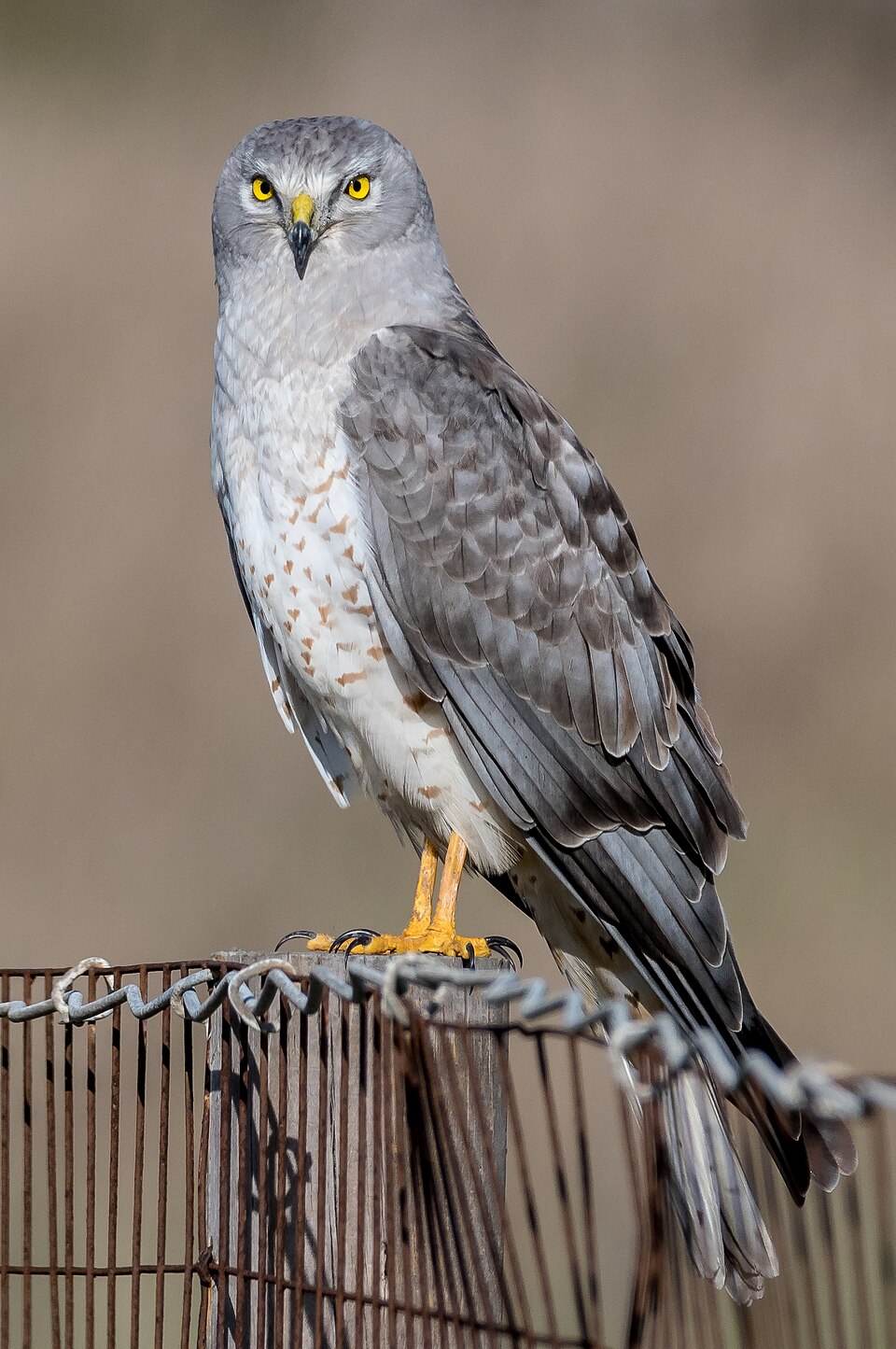
The Northern Harrier is one of the most distinctive raptors of North America's open country, and once you learn its style of flight you'll rarely confuse it with anything else. Watch a marsh, wet meadow, or grassland edge and you may spot a slim, long-tailed hawk drifting low and slow, wings held in a shallow V, tilting and rocking as it quarters back and forth just above the vegetation. That buoyant, almost moth-like coursing flight, combined with a bright white patch at the base of the tail, is the harrier's calling card.
What truly sets this hawk apart is its face. Unlike most raptors, the harrier has a pronounced facial disk of stiff feathers, much like an owl, that funnels sound toward its ears. This gives it the ability to hunt partly by sound, listening for the rustle and squeaks of voles hidden in dense grass. Formerly lumped with the Eurasian Hen Harrier and long called the "Marsh Hawk," it is now recognized as its own species, Circus hudsonius, breeding across Canada and the northern United States and wintering south into Mexico and beyond.
Harriers are built for slow, low hunting: a slender body, long narrow wings, and an unusually long tail give them a lanky, rangy look in flight. At rest they appear leggy and small-headed, but it is the airborne silhouette, wings raised in a gentle dihedral and the conspicuous white rump, that clinches the identification at a distance.
| White rump | A bright, square white patch at the base of the tail, obvious in flight on birds of every age and sex. The single best field mark. |
| Flight style | Flies low and slow over open ground, wings held in a shallow V (dihedral), rocking and tilting as it courses back and forth. |
| Owl-like face | A flat facial disk of stiff feathers rings the eyes, giving a distinctly owlish expression seen at close range or perched. |
| Shape | Long, narrow wings and a long tail; slim-bodied and small-headed, looking lankier than buteos like Red-tailed Hawks. |
| Male plumage | Pale gray above, whitish below with black wingtips, earning the nickname the gray ghost. |
| Female plumage | Brown above, streaked buff and brown below, noticeably larger and bulkier than the male. |
Male vs. female
The sexes look strikingly different, which often surprises new birders. Adult males are pale silvery gray on the head, back, and upperwings, clean whitish below, with crisp black wingtips and a black trailing edge to the wing; this ghostly, two-toned look earns them the affectionate nickname "gray ghost." Females are considerably larger and dressed in warm brown above with heavily streaked buffy-brown underparts. Both sexes share the white rump and owlish face, but if you see a gray, gull-pale harrier it is a male, and a brown, streaky one is a female. As in many raptors, the female outweighs the male.
Juveniles
Juveniles resemble adult females in being brown above, but their underparts are a rich, unstreaked cinnamon-orange (rufous) rather than streaked buff, brightest on the belly and underwing coverts and fading as the season wears on. This warm tone, combined with the white rump, makes young birds fairly easy to age in fall. By their second year, young males begin acquiring the gray plumage, so birds in transition can look mottled and intermediate.
Northern Harriers are generally silent away from the nest, so most birders rarely hear them. Around breeding territories, though, they can be quite vocal. The most frequent call is a rapid, descending chatter, a nasal kek-kek-kek-kek or ke-ke-ke-ke, given in alarm when an intruder approaches the nest or during interactions between mates.
During courtship the male performs a spectacular sky-dance, a series of steep undulating dives and climbs high over the territory, sometimes accompanied by a thin, food-begging-like whistle from the female. Females and young at the nest give sharper squealing and whistled notes when food is delivered. There is no true song in the songbird sense.
The Northern Harrier breeds widely across Canada and Alaska and through the northern tier of the United States, favoring marshes, wet meadows, prairies, and other large tracts of open habitat. It is migratory over much of its range: northern breeders pull south in fall, and in winter harriers spread across the southern United States, Mexico, and into Central America and the Caribbean, with some reaching northern South America.
In the milder parts of the country, particularly the coasts and the southern Plains, harriers can be year-round residents or abundant winter visitors. Look for them from late fall through early spring coursing over fields, airports, reclaimed grasslands, and coastal saltmarshes, often the most numerous raptor over open ground at that season.
Voles and other small rodents form the core of the harrier's diet, and the species' fortunes rise and fall with local rodent cycles. They also take mice, shrews, ground squirrels, small birds, frogs, snakes, large insects, and occasionally rabbits; some individuals specialize in catching small marsh and grassland birds. Females, being larger, tend to take bigger prey than the smaller males.
Their hunting technique is unique among North American hawks. Rather than soaring high or perching to scan, harriers fly low and methodically, using both keen eyesight and that owl-like facial disk to detect prey by sound in dense cover. When they hear or see a target they drop suddenly, sometimes hovering or making a quick twisting pounce into the grass. They may also pin prey with their feet and even drown waterfowl or other victims, behavior more typical of larger raptors.
Northern Harriers are ground nesters, an unusual trait for a hawk. The nest is built on or very near the ground, hidden in dense vegetation such as cattails, tall grass, sedges, or low shrubs, often in or near wet areas. The female does most of the construction, weaving a platform of sticks, reeds, grasses, and other plant material.
Clutches typically number four to six pale bluish-white eggs, and the female does nearly all of the incubation while the male hunts and delivers food, passing it to her in mid-air food transfers near the nest. Harriers are notable for being sometimes polygynous: a single male may provision two or more females nesting within his territory. Incubation lasts about a month, and the young fledge several weeks after hatching, often clambering about near the nest before they can fly well.
The Northern Harrier is not a backyard or feeder bird, and there is no bird food or feeder that will draw one in. It is a wide-ranging raptor of large open landscapes, so the way to "attract" harriers is really about habitat and where you choose to look rather than anything you can set up at home.
- Skip the feeders entirely, harriers eat live rodents and birds and will never visit a yard feeding station.
- If you own acreage, leave grasslands, wet meadows, or marsh edges unmowed through the breeding season, which supports the voles harriers depend on and the cover they nest in.
- Visit open habitat to find them, coastal saltmarshes, prairies, reclaimed fields, and airport grasslands are reliable, especially in fall and winter.
- Watch low and slow, scan just above the vegetation rather than the sky, since harriers rarely soar high like other hawks.
- Avoid rodent poisons on rural property, secondary poisoning harms hawks and owls that hunt the same rodents harriers do.
- Rough-legged Hawk: A winter buteo of open country that also hovers, but it is bulkier with broad wings, a dark belly band, and a white tail base with a dark band, and it lacks the harrier's slim shape and white rump.
- Red-tailed Hawk: Much chunkier and broader-winged, typically soars high or perches on poles, and adults show a rusty tail; it never courses low with raised wings or shows a white rump.
- Short-eared Owl: Shares the same marsh and grassland habitat and a similar low, floppy flight, but it is an owl with a round head, buffy plumage, and bold dark wrist patches, often active at dusk alongside harriers.
- Cooper's Hawk: Another slim hawk, but an accipiter of woodlands and yards that flies with quick flaps and glides on flat wings; it lacks the white rump and the low coursing flight over open fields.
What is the easiest way to identify a Northern Harrier in flight?
Look for the bright white patch at the base of the tail (the white rump) and the low, slow, rocking flight with the wings held in a shallow V just above open ground. Together those two features are diagnostic at a distance, regardless of the bird's age or sex.
Why does the Northern Harrier have an owl-like face?
Its flat facial disk of stiff feathers funnels sound toward its ears, just as an owl's does. This lets the harrier hunt partly by sound, detecting voles and other prey rustling in dense grass even when it can't see them clearly, which is unusual among hawks.
What is the difference between a male and female Northern Harrier?
Adult males are pale silvery gray above and whitish below with black wingtips, earning the nickname gray ghost. Females are larger and brown above with streaked buffy underparts. Both share the white rump. Brown and streaky means female; gray and pale means male.
Is the Marsh Hawk the same as the Northern Harrier?
Yes. Marsh Hawk is the older common name for the same bird, now standardized as Northern Harrier. It was also once considered the same species as the Eurasian Hen Harrier but is now treated separately as Circus hudsonius.
Will Northern Harriers come to a backyard or feeder?
No. Harriers are raptors of large open landscapes such as marshes, prairies, and grasslands, and they hunt live rodents and birds. They won't visit feeders. To see one, look over open fields and wetlands, especially in fall and winter.