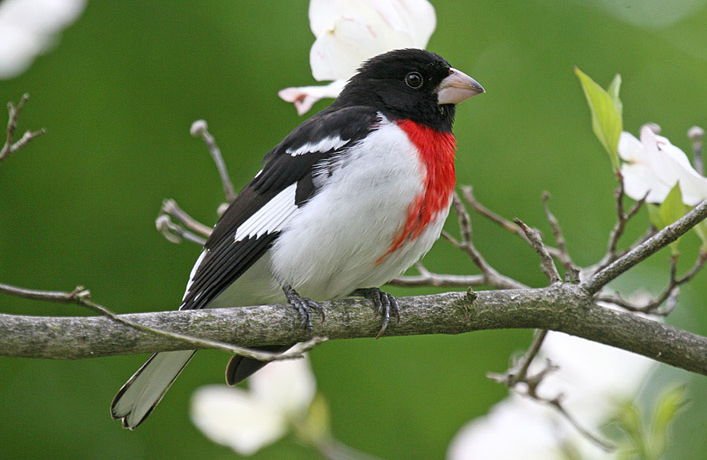
Few moments in spring birding rival the first sight of a male Rose-breasted Grosbeak at the feeder. Crisp black and white, with a bold splash of rose-red bleeding down the center of a snowy chest, he looks almost too dramatic to be real. The Rose-breasted Grosbeak is a chunky, big-headed songbird of eastern and northern North American woodlands, named for that striking breast patch and for the heavy, conical "gross beak" it uses to crack seeds and crush insects. It belongs to the cardinal family, and like its red cousin it pairs a powerful bill with a rich, musical voice.
For most backyard birders east of the Great Plains, this is a bird of passage and early summer. It sweeps north in late spring, often pausing at feeders during migration, then settles into mature deciduous and mixed forests to nest. The female and young males look entirely different from the breeding male, which fools countless new birders every year. Learning to recognize the brown-streaked females and the surprising flash of rose under the wing is one of the small rites of passage in eastern North American birding.
The Rose-breasted Grosbeak is built like a small, stocky finch on a heavy frame: a large head, short neck, and an oversized pale triangular bill that dominates the face. Roughly the size of a large sparrow or small thrush, it perches upright and looks front-heavy because of that massive seed-cracking beak. Plumage differs dramatically between adult males, females, and immatures, so identification leans on bill shape and overall structure as much as color.
| Adult male | Black head, back, wings and tail; white belly with a triangular rose-red patch on the upper breast; large pale bill |
| Bill | Very thick, conical, pale ivory to pinkish-horn, the defining structural clue in any plumage |
| Female | Heavily streaked brown above and on the breast, like a big sparrow or female finch, with a bold white eyebrow stripe |
| Wing linings | Rose-red in males, yellowish in females, a flash visible in flight or when the wing is raised |
| Wing pattern | Males show white wing patches and white rump in flight against black; females show two pale wingbars |
| Size and shape | Stocky, big-headed, upright posture; about 7-8.5 in long with a short notched tail |
Male vs. female
The sexes look strikingly different. The breeding male is unmistakable: jet-black hood, back and wings, gleaming white underparts, and that vivid rose-red bib spilling onto the chest, with matching rose wing linings that flash in flight. The female looks like a different species entirely, warm brown above with heavy dark streaking on a buffy, streaked breast, a strong white eyebrow, and a striped crown. Many people mistake her for an outsized sparrow or a female Purple Finch until they notice the huge pale bill. In hand or in flight, her wing linings are yellow rather than rose. Outside the breeding season, males molt into a more female-like pattern but keep blotchy black-and-rose hints and reddish wing linings that give them away.
Juveniles
Juveniles and first-year birds resemble the streaky brown female, with a buffy wash and a bold facial pattern. Young males are the source of much late-summer and fall confusion: they look female-ish but often show a peachy or salmon-tinted wash on the breast rather than clean rose, scattered black feathers coming in around the head and back, and telltale rosy or pinkish wing linings. By their first spring, young males begin showing patchy adult black-and-rose, and they may breed in this somewhat scruffy intermediate plumage before attaining the full crisp adult look.
The song is one of the great voices of the eastern woods: a sweet, rolling, warbled series often described as sounding like an American Robin that has taken singing lessons, smoother, more fluid, and more operatic than a robin's choppier phrases. It rises and falls in a continuous musical ramble, delivered from high in leafy canopy. Remarkably, both males and females sing, and females sometimes even sing quietly from the nest.
The contact call is unmistakable once learned: a sharp, squeaky eek or chink, like the squeak of a sneaker on a gym floor or a sharp kiss. Birders often locate grosbeaks by this distinctive metallic chink long before spotting the bird itself in the foliage.
Rose-breasted Grosbeaks breed across the northeastern and north-central United States and much of southern and central Canada, from the Atlantic provinces and New England west through the Great Lakes and into the boreal edge of the prairie provinces. They favor mature deciduous and mixed forests, woodland edges, regenerating second growth, and shaded suburbs and parks with tall trees.
They are strongly migratory and largely abandon North America in winter, traveling to Mexico, Central America, and northern South America. Migration is the prime time for backyard sightings: in spring (roughly late April into May) and again in fall (August into October), migrants drop into feeders and gardens far beyond the breeding range, including states across the southern U.S. they never nest in. A few stragglers turn up at feeders in the western states and occasionally linger into winter, drawing crowds of admiring birders.
That heavy bill is a multipurpose tool. Rose-breasted Grosbeaks eat a varied diet of seeds, fruits, buds, flowers, and a substantial amount of insects, with the balance shifting through the year. In spring and summer they take many caterpillars, beetles, and other invertebrates, they are notable predators of pest insects, and are among the relatively few birds that readily eat hairy caterpillars and even Colorado potato beetles. They also relish tree buds and blossoms, including those of elms and other early-flowering trees.
They forage deliberately, often high in the canopy, picking insects from foliage and reaching for fruit and seeds with that powerful bill. In late summer and fall they shift toward berries, wild fruits, and seeds, fueling up for the long journey south. At feeders they crack sunflower seeds with ease and will also take safflower.
Pairs nest in the fork or outer branches of a deciduous tree, shrub, or sapling, usually at low to moderate height in fairly open woodland or along edges. The nest is a loosely built, surprisingly flimsy cup of twigs, stems, and rootlets, so thin that eggs can sometimes be seen through the bottom.
The female typically lays 3-5 pale blue-green eggs spotted with reddish-brown. In a trait that delights many birders, both sexes share incubation and brooding, and the singing male will sit right on the eggs, sometimes quietly singing while he does. Incubation runs roughly two weeks, and both parents feed the nestlings, which leave the nest in another nine to twelve days. Pairs raise one or sometimes two broods per season.
Yes, this is a genuine backyard and feeder bird, especially during spring and fall migration, and through summer if you live within or near the breeding range. A feeder visit from a rose-breasted male is one of the seasonal highlights for eastern backyard birders.
- Offer black-oil sunflower seeds on platform or hopper feeders, their favorite feeder food, easily cracked by that heavy bill
- Provide safflower seed as an alternative; grosbeaks take it readily and it deters some squirrels and grackles
- Time your watching to spring (late April-May) and fall (August-October) migration, when birds far outside the breeding range stop to refuel
- Plant native fruit-bearing trees and shrubs and let caterpillars and insects persist, much of their diet, especially when feeding young, is invertebrates
- Keep tall native deciduous trees and shaded edges nearby; they prefer feeders near mature wooded cover rather than wide-open lawns
- Add a water source such as a birdbath, which can draw migrants that ignore feeders
- Black-headed Grosbeak: The western counterpart; male has a cinnamon-orange (not rose) breast and lacks the black-and-white contrast. Ranges overlap on the Great Plains, where they occasionally hybridize.
- Spotted Towhee: Also black-and-rufous, but slimmer with a long tail, red eye, and a thin pointed bill rather than a thick conical one; forages on the ground.
- Purple Finch: Streaky brown females are often confused with female grosbeaks, but Purple Finches are much smaller with a far smaller bill and a more sharply patterned face.
- Northern Cardinal: Same family and similar heavy bill, but the male cardinal is all red with a crest; useful for recognizing the grosbeak's conical bill shape.
Are male and female Rose-breasted Grosbeaks the same bird? They look so different.
Yes, they are the same species. The black-and-white male with the rose breast and the streaky brown, sparrow-like female look completely different, which fools many people. The big pale conical bill and the same chunky shape give them away as a pair.
When do Rose-breasted Grosbeaks show up at feeders?
Most backyard sightings happen during migration, spring (late April into May) and fall (August into October). If you live in the northeastern or north-central U.S. or southern Canada, they may visit through the summer breeding season as well. They largely leave North America in winter.
What do Rose-breasted Grosbeaks eat at feeders?
They love black-oil sunflower seeds, which their powerful bill cracks easily, and they will also take safflower seeds. A platform or hopper feeder near mature trees works best. In the wild they also eat many insects, fruits, buds, and other seeds.
What does a Rose-breasted Grosbeak sound like?
The song is a sweet, rolling warble that sounds like a more polished, operatic American Robin. The most recognizable call is a sharp, squeaky 'eek' or 'chink', like a sneaker squeaking on a gym floor, which often reveals the bird before you see it.
Why does the female look like a giant sparrow?
Female Rose-breasted Grosbeaks are camouflaged brown with heavy streaking and a bold white eyebrow, which helps them stay hidden on the nest. Look for the oversized pale bill and stocky build to separate her from sparrows and finches; in flight her wing linings are yellow.