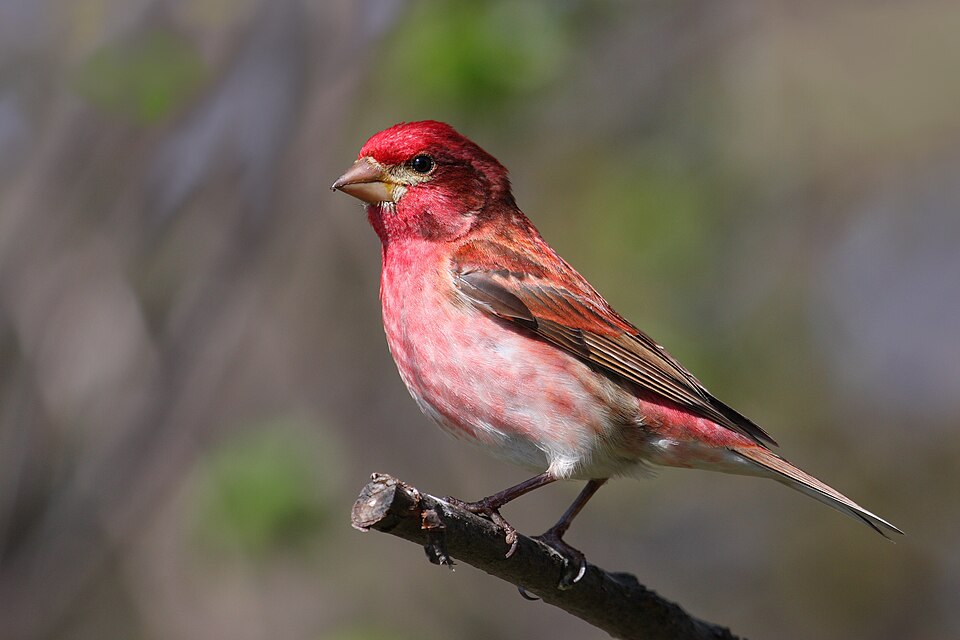
The Purple Finch is a chunky, big-headed finch of cool northern and mountain forests whose males are famously not purple at all. The naturalist Roger Tory Peterson called the bird a "sparrow dipped in raspberry juice," and that line still beats any other description: an adult male looks as though someone poured deep raspberry-red over his head, breast, and back, then let it fade into his streaky brown wings. It is one of three reddish finches in North America that constantly confuse backyard birders, and learning to separate it from the House Finch is one of the small satisfactions of paying attention at the feeder.
Once the default red finch across much of the continent, the Purple Finch has lost ground over the past several decades, partly to competition from the House Finch, which spread explosively after being released in the East. Today it is a bird of breeding spruce-fir and mixed woods in Canada, the northern states, the Appalachians, and the Pacific states, retreating south and to lower elevations in winter. When a flock drops into a feeder in cold weather, it brings a burst of color and a thick, seed-cracking bill built for serious eating.
Start with shape and the bill. The Purple Finch is a stocky finch with a notably large, blocky head, a short and clearly notched tail, and a heavy, conical bill with a fairly straight or slightly curved culmen (the top ridge). It looks front-heavy and powerful compared with the slimmer, longer-tailed House Finch, and that overall "chunky" impression is often the first clue before color even registers.
| Adult male color | Raspberry-red wash over the head, breast, back, and rump, brightest on the crown and throat, blending to whitish on the belly. Not crimson, not orange - a rosy, wine-like red. |
| Female/immature | Crisply brown-and-white streaked, with a bold whitish eyebrow and a dark cheek patch bordered by a pale jaw stripe - a strong facial pattern. |
| Bill | Thick and conical with a relatively straight upper edge; heavier-looking than a House Finch's. |
| Tail | Short with a distinct notch at the tip. |
| Undertail | Clean white, without the blurry streaks a House Finch usually shows there. |
| Size | Sparrow-sized but stocky, about 5-6 inches long. |
Male vs. female
The sexes look very different. The adult male is the raspberry-washed bird, with color spread broadly across the head, breast, and back rather than confined to a forehead and bib. Females and immatures are streaky brown and white and lack any red, but they are far from drab: look for a strong face pattern with a broad pale eyebrow stripe, a dark ear patch, and a whitish stripe along the lower edge of the cheek (the malar). That bold, contrasty face is one of the most reliable marks separating a female Purple Finch from the plainer-faced female House Finch.
Juveniles
Young Purple Finches and first-year males look just like adult females - heavily streaked brown and white with the same strong face pattern. Crucially, males do not gain their raspberry color until their second autumn, so many "females" at a winter feeder are actually young males singing and behaving like adults. If you see a brown, streaky finch singing a rich warble in spring, it is very likely a first-year male that has not yet molted into red plumage.
The song is one of the loveliest of any North American finch: a fast, rich, bubbling warble that rises and falls and tumbles along without the harsh, scratchy notes that end a House Finch's song. It has a liquid, energetic quality, often delivered from a high perch, and many listeners find it sweeter and more musical than its cousins.
The most useful field mark, though, is the flight call. Purple Finches give a sharp, dry pik or tik - a hard, metallic single note often described as a "tick" - as they fly overhead or move through the canopy. Once you learn that flat tik, you can pick out passing Purple Finches without ever seeing their color. The Cassin's Finch, by contrast, gives a more rolling, two- or three-syllabled flight call.
Purple Finches breed across the boreal forest of Canada, the northeastern and Great Lakes states, the Appalachian Mountains, and a separate Pacific population from British Columbia down through California's mountains and coastal woods. They favor cool, moist coniferous and mixed forests in the breeding season.
In winter they become wanderers. Eastern birds move south and can appear across much of the eastern and central United States, sometimes well into the Southeast, while Pacific birds drift to lower elevations. Their numbers at any given location swing wildly from year to year: in some winters they flood into feeders far south of normal, and in others they barely show up at all. These irruptions are tied to the boom-and-bust seed crops of northern trees, so a "Purple Finch winter" is always a treat and never guaranteed.
Purple Finches are heavy seed eaters, and that stout bill does most of the work. In winter they specialize in the seeds of trees and shrubs - especially conifer seeds, ash, elm, and the buds and seeds of many deciduous trees - and they readily strip seeds from weeds and from old flower heads. In spring they switch to soft buds, blossoms, and tender new growth, and in summer they fold in plenty of insects and feed insects to their nestlings.
Fruit and berries round out the diet, and they will eat the soft pulp around seeds of small wild fruits. At feeders they behave like the seed specialists they are, settling in to crack hulls methodically rather than dashing in and out, which is part of why a feeding flock can linger for long stretches on a cold morning.
Purple Finches nest in conifers most of the time, placing a neat, shallow cup well out on a horizontal branch, often fairly high in a spruce, fir, or pine. The female does the building, weaving together twigs, fine grasses, weed stems, and rootlets and lining the cup with soft material such as fine grass, moss, and animal hair.
She lays a clutch of usually four to five pale greenish-blue eggs marked with fine dark spotting and streaks, mostly toward the larger end, and she does the incubating. The male helps feed her and, later, the young. Pairs raise one brood in most areas, sometimes two where the season is long enough, and the male's bubbling song is a constant feature of the breeding woods.
Yes - the Purple Finch is a genuine feeder bird, especially in fall and winter, though whether it visits depends heavily on where you live and on the year's irruption. If you are within its winter range and have the right food, you have a real shot at drawing them in alongside the goldfinches and House Finches.
- Offer black-oil sunflower seed, their clear favorite, in a hopper or platform feeder where their stocky bodies have room to perch.
- Add nyjer (thistle) seed in a tube or sock feeder - Purple Finches use it much like goldfinches do.
- Use feeders with ample perching room; these chunky finches feed deliberately and dislike cramped, swing-style perches.
- Provide a clean source of water, including a heated birdbath in winter, which can pull in finches even when natural seed is scarce.
- Plant native seed- and fruit-bearing trees and shrubs such as conifers, ash, elm, and crabapple to offer natural food and cover.
- Don't expect them every winter - their visits are irruptive, so be patient through lean years and enjoy the good ones.
- House Finch: The most common confusion. Male House Finch is brighter orange-to-red confined to the forehead, throat, and rump with brown streaks down the flanks and belly; Purple Finch male is rosier and washed all over with clean white underparts. Female House Finch has a plain, blurry-streaked face, while female Purple Finch shows a bold pale eyebrow and dark cheek patch.
- Cassin's Finch: A western mountain bird. Male Cassin's is paler pink-red with a brighter, contrasting red cap; it has a longer, straighter bill and crisper streaking. Its flight call is a rolling two- or three-note phrase rather than the Purple Finch's flat single tik.
- Pine Siskin: Often in the same winter flocks. Much smaller and slimmer with a thin, sharply pointed bill, heavy fine streaking all over, and yellow flashes in the wings and tail - never the heavy bill or raspberry color of a Purple Finch.
Why is the Purple Finch called purple when it looks red?
The name comes from the old, broad use of the word "purple" to mean a rich, dark, reddish color - the same sense used in classical and historical descriptions of royal dye. The male's true tone is a deep raspberry or wine-red, not violet, which is why the description "a sparrow dipped in raspberry juice" fits far better than the official name.
How do I tell a Purple Finch from a House Finch?
On males, look at where the color is: Purple Finch males are washed rosy-red over the whole head, breast, and back with clean white bellies, while House Finch males have brighter orange-red limited to the forehead, throat, and rump and brown streaks down the sides. On females, the Purple Finch has a bold pale eyebrow and dark cheek patch; the female House Finch has a plain, smudgy face. Purple Finches also look chunkier with bigger heads and shorter, notched tails.
Are female Purple Finches red?
No. Females are streaky brown and white with no red at all. The same is true of immatures and first-year males, which do not gain their raspberry color until their second fall. A brown, streaky finch with a strong face pattern that is singing in spring is most likely a young male Purple Finch.
What do Purple Finches eat at feeders?
Black-oil sunflower seed is their top choice, and they also take nyjer (thistle) readily. They are deliberate, heavy-billed seed crackers, so they prefer feeders with plenty of room to perch rather than small, swinging perches. A reliable water source helps draw them in too.
Why do Purple Finches show up some winters and not others?
They are an irruptive species, meaning their winter movements track the boom-and-bust seed crops of northern trees. In years when boreal seed crops fail, large numbers push south and flood feeders well beyond their usual range; in good seed years they stay north and may barely appear at all.