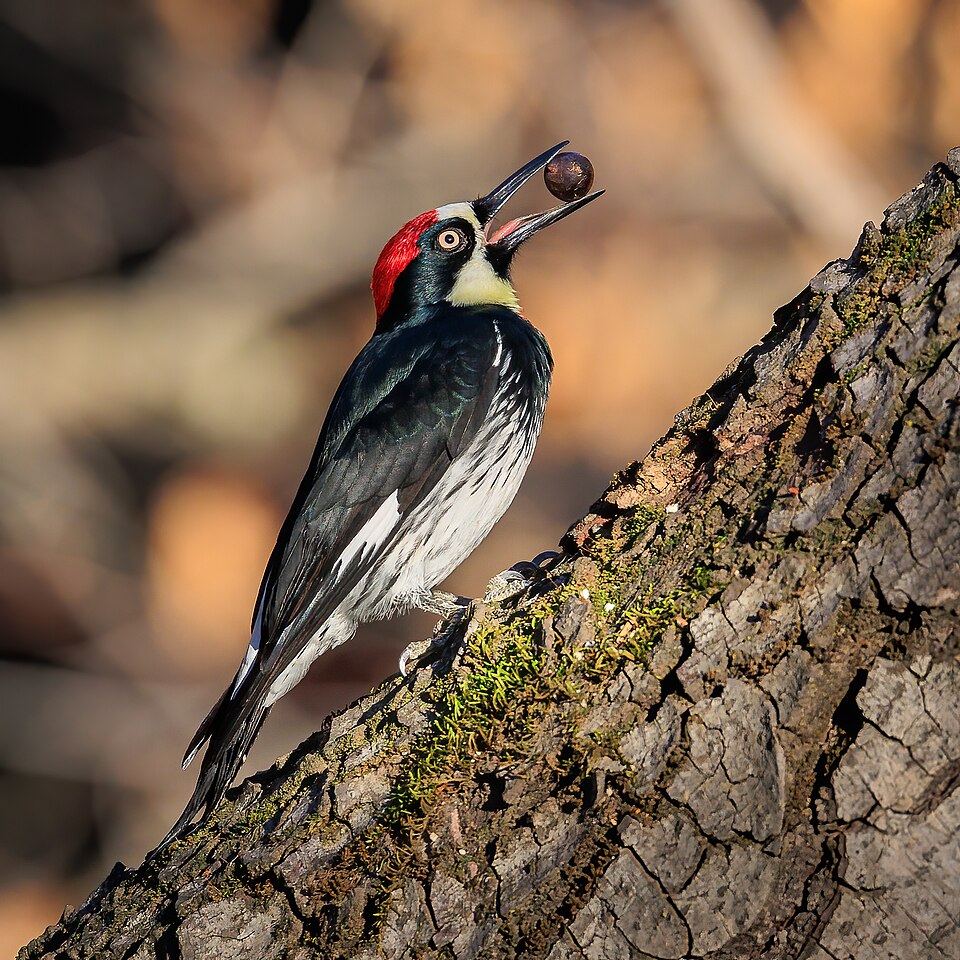
Few birds are as instantly recognizable as the Acorn Woodpecker. With its black-and-white plumage, bold red cap, and a face painted in such striking blocks of cream, black, and red that it looks almost cartoonish, this is the harlequin of western oak country. Spend a morning in an oak grove anywhere from Oregon to Arizona and you are likely to hear them before you see them: a loud, laughing chorus of waka-waka-waka ringing out as birds swoop between tree trunks.
What truly sets this species apart, though, is its astonishing relationship with acorns. Acorn Woodpeckers live in cooperative family groups and store thousands of acorns in communal larders called granaries, drilling each nut snugly into its own custom-bored hole in a tree trunk, fence post, or even a wooden building. These granaries can hold tens of thousands of acorns and may be used and defended by the same family for generations, making the Acorn Woodpecker one of the most socially complex and fascinating birds in North America.
The Acorn Woodpecker is a medium-sized, sturdy woodpecker with a rounded head and a relatively short, chisel-tipped bill. In flight it shows the typical undulating woodpecker bounce, but its bold white wing patches and white rump flashing against black wings make it easy to pick out even at a distance.
| Face pattern | Clown-like: creamy-white forehead and cheeks, black around the bill and eyes, with a staring white eye against a black face |
| Eye | Pale whitish or yellow iris that gives a wide-eyed, almost startled expression |
| Crown | Glossy red cap on the back of the head (full red in males, reduced in females) |
| Body | Glossy blue-black back, throat, and chest with white belly streaked black; black wings |
| In flight | Conspicuous white wing patches and a white rump contrast sharply with black plumage |
| Size | About robin-sized; smaller than a Northern Flicker, larger than a Downy Woodpecker |
Male vs. female
Males and females look very similar but can be told apart with a clear view of the head. In the male, the entire crown from the white forehead back is red. In the female, a band of black separates the white forehead from the red patch, so her red cap appears to sit farther back on the head with black in between. Both sexes share the same bold face pattern, white eyes, and black-and-white body.
Juveniles
Juveniles resemble adults in their bold black-and-white pattern but look duller and scruffier overall. Young birds of both sexes show a solid red crown (like adult males) early on, and their eyes are dark brown rather than the staring white of adults, gradually paling as they mature. Females develop the diagnostic black band on the crown as they reach adulthood.
Acorn Woodpeckers are famously noisy and social, and their calls carry a long way through open oak woodland. The signature sound is a loud, rolling, laughing series often written as waka-waka-waka or ja-cob, ja-cob, ja-cob, frequently given by several birds at once in a raucous chorus that sounds like a group of squabbling clowns.
They also give a harsh, scolding krrrit or rrrack in alarm, and a variety of churrs and chatters during interactions at the granary. Like other woodpeckers, they drum on resonant dead limbs and metal surfaces in spring, but their vocal chorus is far more distinctive and is one of the defining sounds of western oak forests.
The Acorn Woodpecker is a year-round resident wherever oaks grow in the western United States, including Oregon, California, the Southwest, and into the Texas Hill Country. From there its range continues south through the mountains of Mexico and Central America all the way to Colombia, making it one of the more wide-ranging woodpeckers of the Americas.
These birds are largely non-migratory and stay near their granaries year-round, fiercely defending their stored acorns. In years when the oak crop fails, however, family groups may wander or shift locally in search of food, and northern or higher-elevation birds occasionally move downslope in winter.
As the name suggests, acorns are central to this woodpecker's life, especially in fall and winter when stored nuts sustain the whole family group. Birds harvest acorns from oaks, wedge them into individually drilled holes in their granary trees, and return to crack them open later. They are meticulous about the fit, often moving a shrinking, drying acorn to a tighter hole so it cannot be stolen by jays or squirrels.
Acorns are far from their only food, though. Acorn Woodpeckers are skilled flycatchers, sallying out from exposed perches to snatch flying insects, and they also glean ants, beetles, and other bugs from bark. In the warmer months they eat sap, fruit, and flower nectar, and they readily drill rows of sap wells. This flexible, omnivorous diet lets them thrive across a wide range of habitats wherever oaks anchor the landscape.
Acorn Woodpeckers are famous for their cooperative breeding. A single nest is often the shared effort of a family group that may include several breeding males and females plus non-breeding helpers from previous years. The group excavates a nest cavity in a dead limb or trunk, and multiple females may lay eggs in the same cavity, producing a communal clutch.
The plain white eggs are incubated by group members of both sexes, and the young are fed by the entire family, including older offspring that stay on to help raise siblings. This unusually social system, with shared nests, shared parenting, and lifelong group territories centered on a granary, makes the Acorn Woodpecker one of the most intensively studied cooperative breeders in the bird world.
Acorn Woodpeckers are primarily birds of oak woodland rather than typical feeder visitors, but if you live within their range and near oaks, you have a real chance of hosting them. They respond to a few key things: oaks, dead wood, and the right foods.
- Keep oaks on your property. Mature oaks are the single most important draw, providing both the acorns and the soft dead limbs these birds depend on.
- Leave dead snags and limbs standing where it is safe to do so. Dead wood gives them nesting cavities and granary sites they cannot get from living trees.
- Offer suet, which Acorn Woodpeckers will readily visit, especially in cooler months.
- Put out shelled or whole nuts such as peanuts; some groups will hoard them in granaries just as they do acorns.
- Provide a water source like a birdbath, as they will come to drink and bathe.
- Be patient and tolerant of their noise and their habit of drilling holes in wooden structures; a dedicated nest box mounted high may help redirect them.
- Red-headed Woodpecker: Has an entirely solid red head, a clean black-and-white body with large white wing patches, and lacks the Acorn Woodpecker's clown-like white-and-black face and white eye.
- Red-bellied Woodpecker: Shows a black-and-white barred (zebra) back and a red nape or crown, very different from the Acorn Woodpecker's solid black back and bold face mask.
- Lewis's Woodpecker: A western relative but greenish-black above with a pinkish belly and gray collar; flies with steady, crow-like wingbeats rather than a bouncing flight.
- Northern Flicker: Larger and browner with a spotted belly and barred back; feeds on the ground for ants and lacks the bold face and granary behavior.
Why do Acorn Woodpeckers drill so many holes in trees and buildings?
They are creating granaries, storage trees where each hole is custom-drilled to hold a single acorn. A family group stockpiles thousands of acorns this way to get through fall and winter. They sometimes use wooden buildings, fence posts, and utility poles when natural granary trees are scarce.
What does an Acorn Woodpecker sound like?
Their best-known call is a loud, laughing waka-waka-waka, often given by several birds at once in a noisy chorus. They also give harsh scolding notes and chatters around the granary, making them one of the most vocal and recognizable birds of western oak woodlands.
How can I tell a male from a female Acorn Woodpecker?
Look at the crown. Males have red running all the way from the white forehead back across the top of the head. Females have a band of black separating the white forehead from the red patch, so the red appears set farther back with black in front of it.
Do Acorn Woodpeckers really live in family groups?
Yes. They are cooperative breeders, living in family groups that may include several breeding adults plus grown offspring that help raise younger siblings. Multiple females can lay eggs in a single shared nest cavity, and the whole group helps incubate, feed the young, and defend the granary.
Where can I see an Acorn Woodpecker?
They are year-round residents of oak woodlands across the western U.S., from Oregon and California through the Southwest to the Texas Hill Country, and south through Mexico and Central America. Look and listen for them in mature oak groves, foothill woodlands, and oak-studded parks.