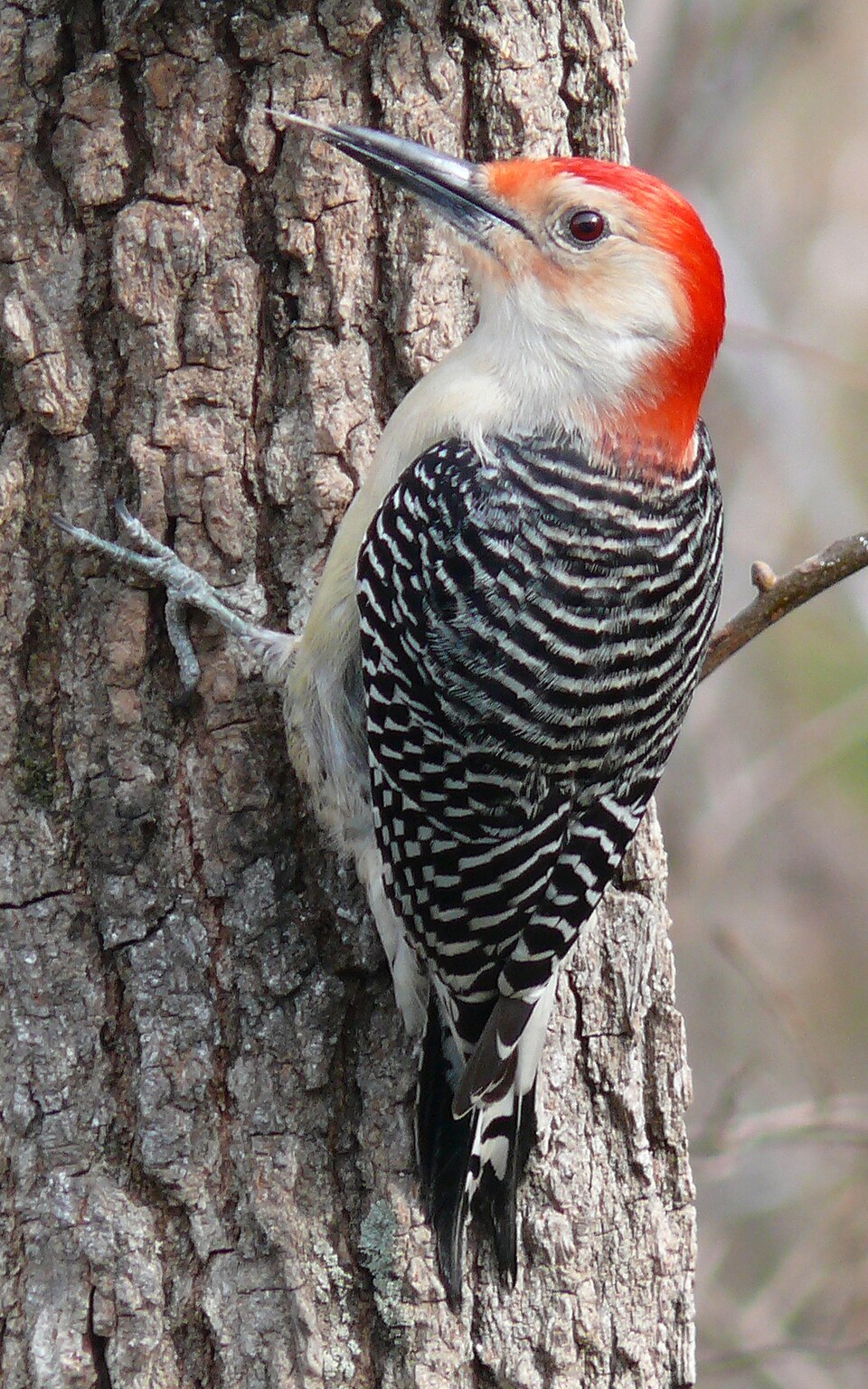
The Red-bellied Woodpecker is one of the most familiar woodpeckers of the eastern United States, a medium-sized bird with a boldly barred black-and-white back and a flash of red running over the crown and nape. Despite the name, the "red belly" is the least useful field mark on the bird, it's a faint pinkish wash low on the underparts that you'll rarely see unless the bird is clinging to a trunk at just the right angle. Far more eye-catching is the candy-cane red on the head and the crisp "zebra" pattern down the back, which is why many beginners trip over the name and call it a "red-headed" bird (a different species entirely).
This is a bird that has done well alongside people. Over the last century its range has steadily pushed northward, and it readily visits suburban yards, woodlots, and parks. Its loud, rolling calls are part of the soundtrack of southern and midwestern forests year-round, and at the feeder it's a regular, confident presence, big enough to dominate a suet cage and clever enough to wedge sunflower seeds into bark crevices for later.
A medium woodpecker with the classic chisel-tipped bill and stiff, propped tail used for climbing. In flight it shows the typical woodpecker rise-and-fall undulation and flashes a white rump and a small white patch near the wingtips. Up close, the combination of the pale gray-buff face and underparts with a finely barred black-and-white back is unmistakable in its range.
| Back | Bold black-and-white horizontal barring, a 'zebra' or ladder pattern across the upper back and wings |
| Head/cap | Red crown and nape; the face, throat, and underparts are plain pale gray-buff |
| Belly | Faint reddish or pinkish wash low on the belly, subtle and often hidden against the trunk |
| Rump | White rump conspicuous in flight, with a small white crescent near the base of the primaries |
| Bill | Long, straight, chisel-tipped and dark gray, roughly as long as the head is deep |
| Size | Noticeably larger and longer than a Downy, similar in bulk to a Hairy Woodpecker |
Male vs. female
Males and females look alike except for the extent of red on the head, and the difference is easy to read once you know it. On the male, the red runs as a continuous band from the bill up over the crown and all the way down the nape. On the female, the crown is gray and the red is restricted to the nape (back of the neck) plus a small patch just above the bill, leaving a gray "saddle" on top of the head. With a little practice you can sex these birds at a glance at the feeder.
Juveniles
Juveniles look like washed-out adults: they show the same barred back but the head lacks bright red, appearing all gray or with only a dull, smudgy reddish hint. The bill is also duller and grayer than an adult's. Young birds molt into adult-like plumage during their first fall, so by winter most are showing recognizable red on the head.
The signature call is a loud, rolling churr or quurrr, often repeated and carrying surprisingly far through the woods, once you learn it, you'll realize how common this bird is. In spring, agitated or interacting birds give a chattering, descending cha-cha-cha-cha or a more grating kwirr series.
Like all woodpeckers, it also "sings" by drumming, a steady, even roll of taps against a resonant branch, dead snag, or, to a homeowner's dismay, metal gutters and chimney caps. Drumming peaks in late winter and early spring as birds advertise territory and attract mates.
The Red-bellied Woodpecker is a resident of the eastern United States, found from Florida and the Gulf Coast north through the Mississippi and Ohio valleys and up the Atlantic seaboard, west to the eastern Great Plains. It is a year-round, non-migratory bird across nearly all of this range, the same individuals defend their territories through every season.
One of this species' great success stories is its northward expansion. Over the past several decades it has steadily colonized the Great Lakes region, New England, and southern Ontario, likely aided by maturing forests, warming winters, and the abundance of backyard feeders. Birds at the northern edge may wander a bit in harsh winters, but true migration is minimal.
Red-bellied Woodpeckers are true omnivores. They forage by hitching up and along trunks and large limbs, probing bark and gleaning rather than excavating deeply like some woodpeckers. A large share of the diet is plant matter, acorns, beechnuts, pine seeds, wild fruits and berries, and waste grain, supplemented heavily by insects, especially wood-boring beetle larvae, ants, and caterpillars pulled from bark crevices. They will also take tree sap, and occasionally even small lizards, tree frogs, nestling birds, or eggs.
This species has an unusually long, barbed tongue that can extend well past the bill tip, letting it extract prey from deep cracks. It's also a notable food-caching bird, wedging nuts and seeds into bark furrows and crevices to retrieve later, a handy strategy for a non-migratory bird facing lean winters.
Red-bellied Woodpeckers are cavity nesters that excavate a fresh hole most years, typically in a dead tree, dead limb, or fence post, though they'll reuse cavities and sometimes take a nest box. Both members of the pair chisel out the cavity, and the male often does the larger share of the digging. The interior is left bare except for a bed of wood chips on which the eggs are laid.
The female lays a clutch of about 3 to 5 glossy white eggs (white being typical of cavity nesters, since the dark hole hides them). Both parents share incubation, lasting roughly 12 days, with the male characteristically taking the overnight shift. The young are altricial and fed by both adults; they fledge at around 24 to 27 days but stay near the parents for a while after leaving the nest. In the warmer southern parts of the range, pairs may raise two or even three broods in a season.
Yes, this is a reliable and rewarding feeder bird, and one of the easier woodpeckers to draw to a yard within its range. Offer the right foods and a little structure and a resident pair will often become daily visitors.
- Put out suet in a cage feeder, it's the single best draw, especially in cold months
- Offer black-oil sunflower seeds and peanuts (out of the shell or in mesh feeders); these big birds prefer sturdy platform or hopper feeders they can grip
- Provide shelled peanuts or peanut butter mixes, which they'll readily cache in nearby bark
- Leave dead trees and snags standing where safe, they're prime foraging and nesting sites
- Plant native nut and berry producers such as oaks, beeches, and fruiting shrubs for natural food
- Mount a woodpecker-sized nest box (about a 2.5-inch entrance hole) on a tree trunk and pack it with wood shavings to encourage prospecting pairs
- Red-headed Woodpecker: Has an entirely solid red head (not just a red cap), a bold black-and-white block pattern on the body, and large clean white wing patches, far more contrasty and unmistakable than the barred-backed Red-bellied.
- Hairy Woodpecker: Similar size but black-and-white with a clean white back stripe (not zebra-barred), no red on the crown, and only a small red nape spot on males.
- Downy Woodpecker: Much smaller with a stubby bill, white back stripe, and no extensive red cap, overlaps at feeders but is obviously daintier.
- Gila Woodpecker: A close southwestern relative with the same zebra back, but ranges in desert habitats far from the Red-bellied and shows a smaller, rounder red cap.
Why is it called a Red-bellied Woodpecker when its head is red?
The name comes from the faint reddish or pinkish wash low on the bird's belly, which is hard to see in the field. Early naturalists named it from museum specimens in the hand, where that belly color is visible. The red on the head was already 'taken' by the Red-headed Woodpecker, a different species with a fully red head.
How do I tell a male from a female Red-bellied Woodpecker?
Look at the top of the head. Males have red running all the way from the bill over the crown to the nape. Females have a gray crown with red only on the nape and a small patch above the bill, leaving a gray cap in between.
What's the difference between a Red-bellied and a Red-headed Woodpecker?
They're often confused but look very different. The Red-bellied has a barred 'zebra' back, pale gray underparts, and red only on the cap and nape. The Red-headed has an entirely solid red head, a clean black-and-white body, and big white wing patches.
How do I attract Red-bellied Woodpeckers to my feeders?
Offer suet, black-oil sunflower seeds, and peanuts on sturdy platform, hopper, or cage feeders they can grip. Leaving dead trees standing and putting up a woodpecker nest box also helps draw resident pairs.
Why is a woodpecker drumming on my house or gutter?
In late winter and spring, Red-bellied Woodpeckers drum on resonant surfaces to advertise territory and attract mates, and metal gutters, flashing, and chimney caps make especially loud 'instruments.' It's usually seasonal and harmless, though you can discourage it by covering the favored spot or adding visual deterrents.