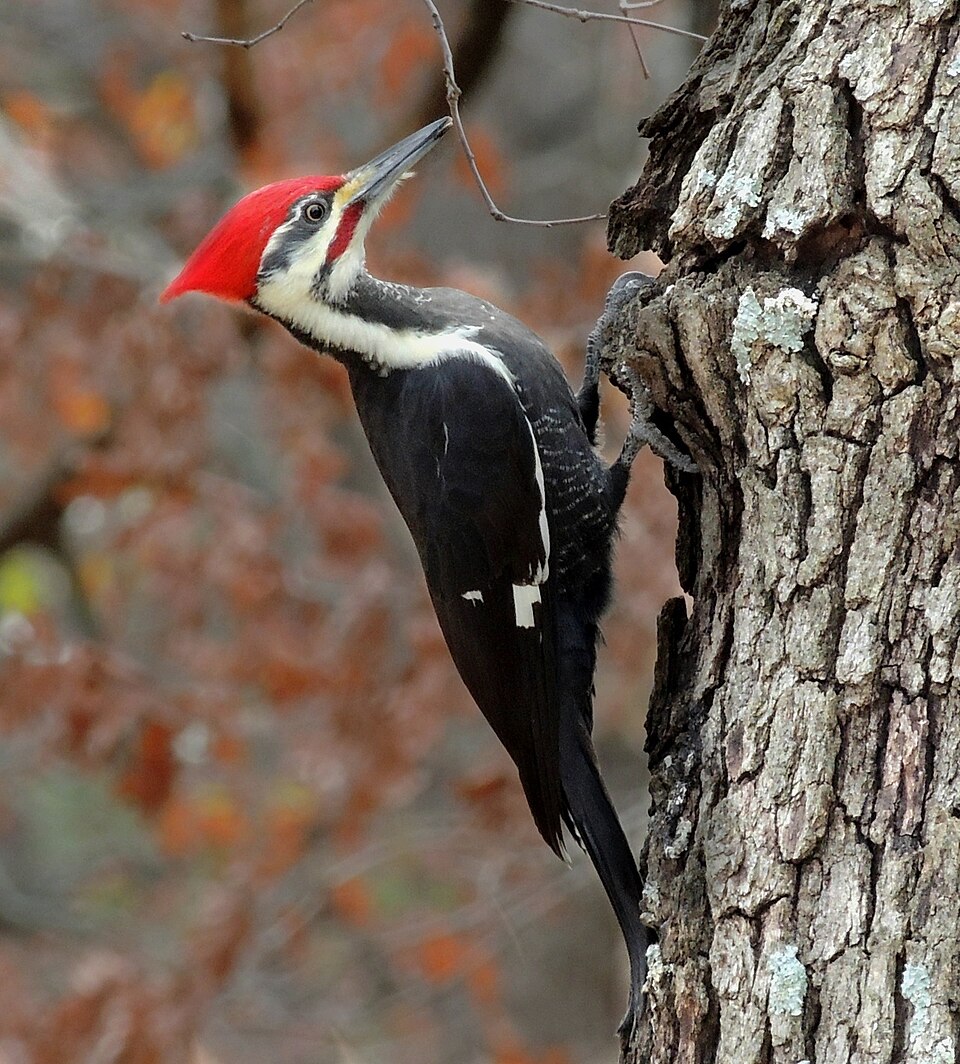
The Pileated Woodpecker is the heavyweight of the North American woodpecker world, a crow-sized bird with a flaming red crest that looks like something out of a cartoon. For many people, the first encounter is unforgettable: a big, black-and-white shape swooping through the forest on broad wings, then landing against a tree trunk and hammering away with surprising power. Wherever there are mature trees and plenty of dead wood, this woodpecker tends to make its presence known, both by its loud ringing call and by the distinctive rectangular holes it chisels into rotting trunks.
Once thought to be in decline as eastern forests were cleared, the Pileated has rebounded strongly over the past century as woodlands have regrown. Today it is a familiar resident of mature deciduous and mixed forests across much of the continent, and it has adapted remarkably well to wooded suburbs and parks where large trees remain. Because it excavates the large cavities that so many other animals depend on, the Pileated is considered a keystone species, quietly creating homes for owls, ducks, swifts, bats, and more.
Size alone usually settles the identification: this is a huge woodpecker, nearly the bulk of an American Crow, with a long neck, a powerful chisel-tipped bill, and a pointed red crest that gives the bird its unmistakable profile. In flight it shows broad, rounded wings and a slow, slightly floppy crow-like wingbeat, flashing big white patches that catch the eye even at a distance.
| Size | Very large, roughly crow-sized; the biggest woodpecker most birders will see in North America |
| Crest | Tall, pointed bright-red crest sweeping back from the crown |
| Body | Mostly sooty black with bold white stripes running down the neck and face |
| Bill | Long, heavy, dark chisel-shaped bill nearly as long as the head |
| In flight | Big white patches on the underwings and white wing linings flash conspicuously; black trailing edge and tip |
| Voice clue | Loud, ringing, irregular series of cuk notes often heard before the bird is seen |
Male vs. female
Males and females are similar in size and overall pattern, but two head marks separate them with a good look. The male has a red crest that extends all the way from the bill to the back of the crown and a red "mustache" stripe (malar) running back from the base of the bill. The female has a black forehead, with red limited to the rear half of the crest, and her malar stripe is black rather than red. In short: red mustache and fully red crown say male; black forehead and black mustache say female.
Juveniles
Juveniles look much like adults but appear slightly scruffier and duller, with a less vivid, somewhat shorter crest and softer-edged body feathers. Young birds can be sexed using the same malar and forehead marks as adults, though the colors are less saturated. By their first fall, immatures are difficult to distinguish from adults in the field.
The Pileated does not sing in the musical sense; instead it gives a loud, ringing call that carries far through the woods. The classic vocalization is a wild, slightly irregular series often written as cuk-cuk-cuk-cuk-cuk or kik-kik-kik, rising and falling in volume and pace. It resembles the call of a Northern Flicker but is deeper, louder, and more uneven, with a hollow, jungle-like quality that many people describe as laughing or maniacal.
Drumming is the other half of its acoustic signature. Both sexes drum on resonant dead limbs and hollow trunks to advertise territory, producing a deep, powerful roll that accelerates slightly and trails off at the end. The drum is loud and far-carrying, and the slow, heavy pounding of feeding excavation sounds different from territorial drumming, with deliberate, spaced-out whacks.
Pileated Woodpeckers are year-round residents across a broad range that covers much of the eastern United States and southeastern Canada, the upper Midwest and Great Lakes, the boreal forests stretching west across Canada, and the Pacific Northwest down through the forested mountains of the West Coast. They are absent from the treeless Great Plains, the arid Southwest, and the high tundra.
This is a non-migratory species. Established pairs hold large territories all year and generally stay put, though young birds disperse to find their own ground. Because they depend on mature forest with abundant standing deadwood, their local presence tracks the availability of big, old, decaying trees more than the season.
Carpenter ants are the cornerstone of the Pileated Woodpecker's diet, and the bird is superbly equipped to find them. It chisels distinctive large rectangular holes deep into infested trunks and logs, then uses an extraordinarily long, sticky, barbed tongue to probe the galleries and lap up ants and their larvae. Wood-boring beetle larvae, termites, and other insects make up much of the rest of the animal portion of its diet.
It is not strictly an insect eater, though. Pileateds readily take wild fruits and nuts, including the berries of dogwood, holly, sumac, and Virginia creeper, and they will eat acorns and beechnuts. They forage at all heights, often working low on stumps and fallen logs as well as high in the canopy, and the deep, freshly chiseled excavations they leave behind are a reliable sign that one is working the area.
Pileated Woodpeckers are cavity nesters, and the male does most of the excavation, carving a fresh cavity each year in a dead or dying tree, typically well up the trunk. The entrance is often a tall oval, and the chips are tossed out or carried away rather than lined into a nest; the eggs rest on a bed of wood chips at the bottom of the chamber.
A typical clutch is about three to four glossy white eggs. Both parents share incubation, with the male generally taking the night shift, and the eggs hatch in roughly a couple of weeks. The young are fed by regurgitation and fledge several weeks later, after which the family may stay loosely together into the fall. Pileateds raise a single brood per year, and their abandoned cavities become critical nesting and roosting sites for a long list of other forest wildlife.
The Pileated is primarily a forest bird rather than a typical feeder visitor, but if you live near mature woods you can absolutely draw one into view, and a lucky few even become semi-regular at backyard feeders.
- Offer suet in a sturdy, large feeder or smear it on a tree trunk; suet is the single most reliable way to bring a Pileated to a yard near woods.
- Leave dead trees and standing snags where it is safe to do so; these provide the carpenter ants, foraging substrate, and nesting cavities the bird depends on.
- Plant or protect native fruit and nut producers such as dogwood, holly, serviceberry, and oaks to supply natural forage.
- Use tail-prop or large platform feeders that can support the bird's size and bracing tail; small clinging feeders are often too flimsy.
- Be patient and keep feeders out year-round; a forest-edge yard near big trees has the best odds, while open suburban lots far from woods rarely attract them.
- Avoid pesticides that wipe out ants and wood-boring insects, since these are the woodpecker's staple food.
- Northern Flicker: Much smaller and browner, forages on the ground for ants, and shows a white rump in flight rather than the Pileated's all-dark back and big white wing patches.
- Red-headed Woodpecker: Far smaller, with an entirely red head and large solid-white wing patches; lacks the Pileated's crest and crow-like size.
- Red-bellied Woodpecker: Medium-sized with a black-and-white barred back and red only on the nape and crown; nowhere near the Pileated's bulk or pointed crest.
- Ivory-billed Woodpecker: A similar-shaped giant, now almost certainly extinct, that had a pale ivory bill and large white patches on the back when perched; the Pileated shows a black back at rest and a dark bill.
How big is a Pileated Woodpecker?
It is the largest woodpecker most North American birders will ever see, roughly the size of an American Crow at about 16 to 19 inches long with a wingspan around 26 to 30 inches. Its size and tall red crest make it hard to confuse with any other common woodpecker.
What makes the holes that Pileated Woodpeckers dig?
Pileateds excavate distinctive large, often rectangular or oblong holes deep into dead and dying wood as they hunt for carpenter ants and beetle larvae. Finding fresh rectangular excavations with chips piled at the base of a tree is a strong sign one is working nearby.
How do you tell a male Pileated from a female?
Look at the head. Males have a red crest reaching the bill and a red mustache stripe, while females have a black forehead with red only on the back half of the crest and a black mustache. With a clear view, these marks are reliable.
Will a Pileated Woodpecker come to a backyard feeder?
Yes, sometimes, especially if you live near mature forest and offer suet on a large, sturdy feeder or smeared on a tree trunk. They are forest birds at heart, so yards far from big woods rarely attract them, but a forest-edge yard has a real chance.
Are Pileated Woodpeckers rare or endangered?
No. They are listed as Least Concern and have actually increased over the past century as eastern forests regrew. They remain common wherever there is enough mature woodland with standing dead trees for feeding and nesting.