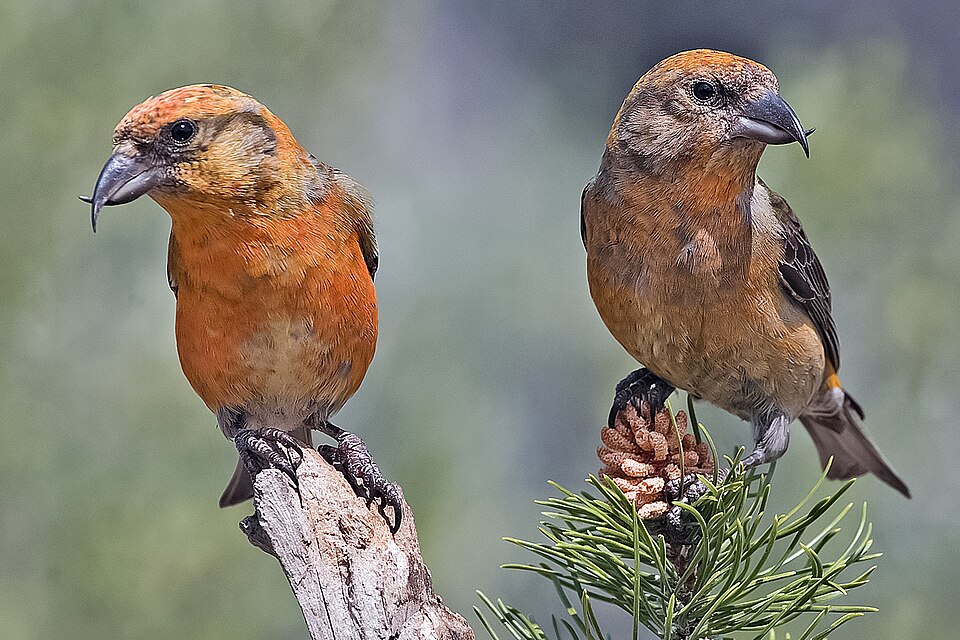
The Red Crossbill is one of North America's most specialized finches, a stocky, big-headed songbird built around a single remarkable tool: a bill whose upper and lower tips cross past each other. That oddly twisted beak lets the bird pry apart the tightly closed scales of conifer cones and lift out the seeds inside, a trick few other birds can manage. Where the cones are, the crossbills usually are, and where they're absent, the birds simply move on. This is a bird of spruce, pine, fir, and hemlock forests, and its whole life is tuned to the boom-and-bust rhythm of cone crops.
Red Crossbills are famous among birders for being unpredictable and hard to pin down. They wander widely in search of good cone years, can breed in almost any month if food is abundant, and travel in chattering, nomadic flocks that seem to drop out of the sky and vanish just as fast. Adding to the intrigue, what we call the "Red Crossbill" is really a cluster of distinct call types, each loosely tied to particular conifers and each with a slightly different bill size. To the eye they look much alike; to the ear, and to a recording app, they're a fascinating puzzle still being unraveled.
Look for a chunky, short-tailed finch about the size of a House Sparrow, with a large head, a notched tail, and that unmistakable crossed bill. At a distance crossbills look heavy-bodied and front-heavy, and they often cling to cones at odd angles like little parrots. The crossed bill tips can be hard to see unless the bird is close or you have binoculars, so plenty of birders rely on shape, color, and especially voice.
| Bill | Stout and crossed at the tips (upper and lower mandibles overlap sideways); looks twisted up close, just heavy-billed at a distance |
| Adult male | Brick-red to orange-red overall, brightest on the head, breast, and rump, with dark brownish wings and tail |
| Adult female | Olive-yellow to dull greenish-gray, often yellowest on the rump and breast, with the same dark wings |
| Wings | Plain dark wings with NO bold white wingbars (a key separator from White-winged Crossbill) |
| Tail | Short and distinctly notched |
| Shape | Big-headed, stocky, short-tailed; often hangs sideways or upside down on cones |
Male vs. female
Males and females look quite different in color. Adult males are some shade of red, ranging from rich brick-red to bright orange depending on the individual and its diet, with the color concentrated on the head, underparts, and rump and the wings staying dark and unmarked. Females and immatures are not red at all; they're olive, greenish-gray, or yellowish, usually showing the most yellow on the rump and chest. Both sexes share the same dark, plain wings and the same crossed bill, so when color is washed out by poor light, structure and voice become your best clues.
Juveniles
Juvenile Red Crossbills are heavily streaked grayish-brown above and below, looking quite different from adults and a bit like a streaky sparrow or siskin. Importantly, young birds hatch with a straight bill, and the tips only develop their characteristic cross as the bill grows over the first couple of weeks, so very young birds may not yet show the trademark beak. First-year males often look orange-tinged or patchy rather than fully red, and can be a muddle of yellow, orange, and brownish tones as they molt toward adult plumage.
The most useful sound is the flight call, a hard, emphatic kip-kip-kip or jip-jip given repeatedly as flocks pass overhead or move between treetops. These calls are clipped and metallic, and they're the single best way to detect crossbills, which often announce themselves before you ever see them. Different call types vary subtly in pitch and quality, and serious listeners record these calls to identify which type they're hearing.
The song is a more leisurely series of warbled and trilled phrases mixed with those same hard kip notes, often delivered from a high, exposed perch or in a fluttering display flight. It can sound a little disjointed, alternating sweet, finch-like warbles with sharper chips. Because crossbills can breed at almost any season, you may hear song in the dead of winter as readily as in spring.
Red Crossbills are widespread across the conifer forests of North America, from Alaska and Canada south through the Rocky Mountains, the Pacific coast ranges, the higher Appalachians, and the pine woods of the Southwest and Mexico. They also occur across Eurasia. Rather than following a tidy north-south migration, crossbills are nomads: they go where the cones are. In years when northern conifers fail to produce a good seed crop, large numbers can irrupt far south and east of their usual haunts, turning up at unexpected spots and delighting birders.
Because of this, a given forest may host noisy flocks one year and none the next. Some populations are fairly resident in reliable cone country, while others roam hundreds of miles in a season. The takeaway for birders is that crossbills can appear almost anywhere there are conifers, especially during irruption years, but they are never guaranteed in any one place.
Conifer seeds are the heart of a Red Crossbill's diet. The bird braces a cone with one foot, inserts its closed bill between the scales, then opens the bill and twists, using the crossed tips to spread the scales apart so its tongue can scoop out the seed. It's a fast, almost mechanical operation, and a feeding flock makes a steady patter of falling cone bits. Different call types tend to specialize on different conifers, with bill size matched to the cones they work best, whether that's small spruce cones or heavy ponderosa pine cones.
When conifer seeds are scarce, crossbills will take seeds of other trees, buds, and some insects, and they're well known for visiting roadsides and mineral sources to eat grit and salt, which helps them digest seeds and meet their sodium needs. They drink frequently and often gather at puddles, gravelly road edges, and the ash of old fires.
Red Crossbills are unusual in that they can nest at almost any time of year, including mid-winter, as long as the local cone crop provides enough food to raise young. This flexible timing is one of the species' most remarkable traits. The female builds a bulky cup nest of twigs, bark, grass, and lichen, lined with softer material, and places it well out on a conifer branch, often fairly high and concealed in dense foliage.
She incubates a clutch of typically 3 to 4 eggs while the male brings her food, and once the chicks hatch both parents feed them a regurgitated paste of conifer seeds. Young crossbills leave the nest before their bills are fully crossed and depend on their parents for a while afterward as they learn the demanding skill of extracting seeds for themselves.
Red Crossbills are not typical backyard feeder birds, and you can't reliably lure them in the way you might a chickadee or finch. They're conifer specialists tied to cone crops, so attracting them is mostly about habitat and luck during irruption years. That said, there are a few things that genuinely help.
- Plant or preserve conifers, spruce, pine, fir, and hemlock, since these are the birds' food source and the single biggest draw
- During irruption years, watch for flocks raiding cones in your neighborhood's conifers and listen for the hard kip-kip flight calls overhead
- Offer black-oil sunflower seed in a platform or hopper feeder; visiting crossbills will sometimes sample sunflower, though it's hit or miss
- Provide a source of grit and minerals, crossbills are drawn to gravel, salt, and ash, and may pause at unpaved drives or mineral patches
- Keep a reliable water source such as a shallow birdbath, since flocks drink often while feeding on dry seeds
- Above all, manage expectations: their presence is unpredictable and driven by regional cone crops, not by feeder offerings
- White-winged Crossbill: Has two bold white wingbars on dark wings; males are pinker-red. Red Crossbill always lacks white wingbars.
- Pine Grosbeak: Much larger and longer-tailed with a stubby, uncrossed dark bill and two white wingbars; moves more slowly and heavily.
- House Finch: Streaky brown with a small conical (uncrossed) bill and red limited to the head, breast, and rump; common at feeders.
- Purple Finch: Raspberry-washed males with a notched tail but a normal conical bill; favors mixed woods and feeders rather than working cones.
Why does the Red Crossbill have a crossed bill?
The crossed tips let it pry apart the tough scales of conifer cones to reach the seeds inside. The bird inserts its closed bill between the scales, then opens and twists it to spread them, scooping out the seed with its tongue. It's a specialized tool that lets crossbills exploit a food source most birds can't touch.
Can a Red Crossbill still eat with a bill that crosses the 'wrong' way?
Yes. Individual crossbills have bills that cross either to the right or to the left, roughly evenly split in a population, and birds feed effectively either way. They simply work cones from the side that matches their bill's twist.
When do Red Crossbills breed?
Almost any month of the year, including winter. Their breeding is triggered by abundant cone crops rather than by season, so a good seed year can prompt nesting even in January or February.
Why do Red Crossbills appear some years and not others?
They're nomadic and follow conifer seed crops. When northern cone crops fail, large numbers irrupt south and east in search of food, so a forest can be full of them one year and empty the next.
Are there really several kinds of Red Crossbill?
Yes. What we call the Red Crossbill is a complex of distinct call types that differ in flight-call sound and average bill size, each loosely tied to certain conifers. They look nearly identical, so birders identify the types by recording and analyzing their calls.