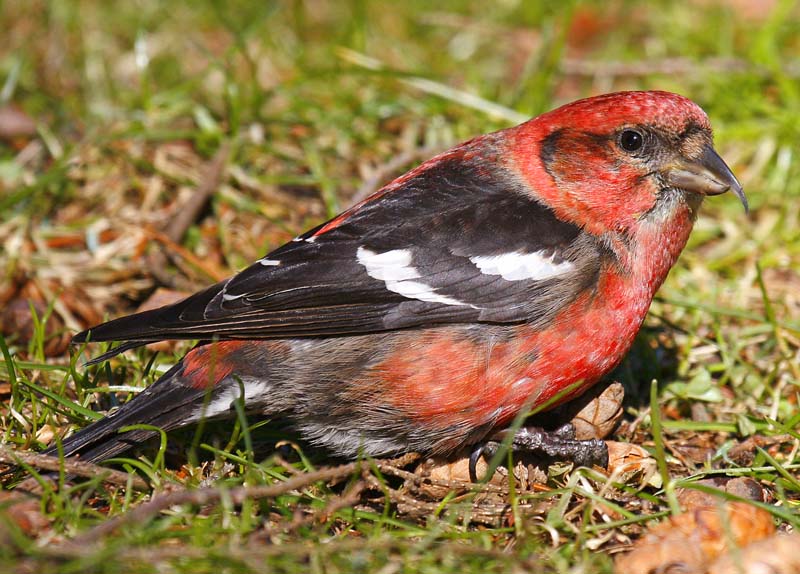
The White-winged Crossbill is one of the great nomads of the northern woods, a chunky little finch whose whole life revolves around the cone crops of spruce and tamarack. Where the seeds are plentiful, flocks descend in noisy, restless numbers; where the cones fail, the birds simply vanish and turn up hundreds of miles away. This wandering, food-driven lifestyle means you might host a flock one winter and not see another for years. They breed across the boreal forest of Canada, Alaska, and the far northern United States, and in good cone years they push south into the northern states in showy irruptions that delight birders.
What makes a crossbill a crossbill is right there on its face: the tips of the upper and lower bill cross past each other, an odd-looking tool that is in fact a precision instrument for prying apart conifer cones. The White-winged is the more delicate of the two North American crossbills, told at a glance by the two bold white wing bars that the Red Crossbill lacks. Add a rosy-pink male and you have one of the most distinctive and sought-after finches of the cold months.
This is a small, plump, large-headed finch with a short notched tail and that unmistakable crossed bill. On a feeder or a cone-laden branch it looks compact and front-heavy, often hanging sideways or upside down like a tiny parrot as it works the seeds. The clinching field marks are the two broad white wing bars set against blackish wings, visible on birds of every age and sex.
| Bill | Crossed at the tip, smaller and more slender than the Red Crossbill's; used to pry open conifer cones |
| Wing bars | Two bold, broad white bars on black wings - the single best mark separating it from Red Crossbill |
| Adult male | Rosy to raspberry pink overall, brightest on the head, breast, and rump, with black wings and tail |
| Adult female | Olive-yellow to grayish with diffuse streaking and a yellowish rump; keeps the white wing bars |
| Size and shape | Small, stocky, big-headed finch with a short, sharply notched tail |
| Tertials | Black tertials often show small white tips, adding to the bold wing pattern |
Male vs. female
The sexes look quite different. Adult males are washed in rose-pink to raspberry, deepest on the crown, breast, and rump, with contrasting jet-black wings and tail that throw the white wing bars into sharp relief. Females and immature males replace the pink with olive, mustard-yellow, and gray tones, usually showing soft streaking on the back and flanks and a brighter yellowish-green rump. Both sexes share the crossed bill and the two white wing bars, so when the color is dull, look to the wings and bill to confirm the species before sorting out the sex.
Juveniles
Juveniles are heavily streaked grayish-brown above and below, looking quite different from adults, but they already show the diagnostic white wing bars and the developing crossed bill. Young males pass through a blotchy yellow-and-pink stage as they molt toward adult plumage, so mid-process birds can appear patchy and confusing. Because crossbills breed opportunistically whenever cones are abundant - sometimes in late winter - streaky juveniles can turn up at unexpected times of year.
The song is a bright, mechanical-sounding series of warbling trills and buzzy notes, often delivered in flight or from a high spruce top, rendered something like chif-chif-chif-tzeeee-tititititi with rolling, canary-like trills strung together. It has a sweet but slightly metallic quality and can ramble on for several seconds.
More often you'll first detect a flock by its flight calls - a dry, hard chet-chet-chet or jif-jif-jif, drier and weaker than the Red Crossbill's sharper kip-kip. Listening for these rattling calls overhead is the best way to catch a passing flock, since the birds are easy to overlook as they feed quietly high in the canopy.
White-winged Crossbills breed across the vast boreal belt - through Alaska, most of forested Canada, and into the northern edges of New England, the Great Lakes states, and high mountains. Their distribution is tied tightly to spruce and tamarack, the trees whose seeds they depend on. They are irruptive rather than truly migratory: instead of moving in a fixed seasonal pattern, they roam wherever the cone crop is good and may breed at almost any time of year when food is abundant.
In winters when northern cone crops fail, flocks irrupt south and can appear well into the central and northeastern United States, occasionally reaching surprisingly far. In other winters they barely move at all. Because of this unpredictability, seeing one south of the boreal zone is always a bit of an event for local birders.
Conifer seeds are the heart of this bird's diet, and it shows a special fondness for spruce and tamarack (larch), whose smaller, softer cones suit its more slender bill. The crossed mandibles work like a tool: the bird bites between the cone scales, twists its bill to spread them apart, and then lifts out the seed with its tongue. White-winged Crossbills are remarkably efficient at this and can strip cones with impressive speed, often hanging acrobatically to reach them.
When conifer seeds run short they will take seeds of birch, alder, and weeds, along with some insects and buds, and they regularly visit the ground or roadsides for grit and minerals. Their entire breeding and movement schedule is governed by cone abundance - in a bumper spruce year a flock may settle in and nest, then move on once the crop is exhausted.
Nesting is opportunistic and can occur in almost any month when cones are plentiful, including the depths of winter. The female builds a compact open cup of twigs, grass, bark strips, and lichen, lined with softer plant down, fur, and feathers, and places it well out on a horizontal conifer branch where dense needles offer shelter from cold and snow.
She typically lays three to four pale, finely spotted eggs and incubates them alone, staying tight on the nest while the male brings her food - an arrangement that lets the pair raise young even in bitter weather. Both parents feed the nestlings a regurgitated paste of conifer seeds. When the local cone crop gives out, the family joins the wandering flocks in search of the next good stand of spruce.
White-winged Crossbills are not classic feeder birds - they are specialists of wild conifer seed and most years won't come to a yard at all. But in irruption winters there are still ways to improve your odds of a visit.
- Plant or keep conifers. Mature spruce, tamarack, and other seed-bearing conifers are the single biggest draw; a yard backed by spruce in a good cone year is your best shot.
- Offer hulled sunflower and nyjer. During irruptions, hungry flocks will occasionally sample sunflower hearts and nyjer (thistle) at platform or tube feeders, especially when wild cones run low.
- Provide grit and minerals. Crossbills crave grit; a patch of sand, crushed eggshell, or mineral grit near feeders can hold a wandering flock.
- Keep water available. A heated birdbath in winter is a genuine attractant when natural water is frozen.
- Watch and listen in irruption years. Follow finch forecasts and listen for dry chet-chet-chet calls overhead - if crossbills are in your region, conifers are where to look.
- Red Crossbill: Lacks the bold white wing bars; males are brick-red rather than pink, and the call is a sharper kip-kip.
- Pine Grosbeak: Much larger and rounder with a stubby curved (not crossed) bill; males rosier and bulkier.
- Purple Finch: Raspberry male can suggest a crossbill at a glance, but it has a normal conical bill and no crossed tips.
- White-winged x Red confusion: Redpolls share boreal flocks and white-ish wing markings but are streaky brown with a red forecap and tiny straight bill.
How do you tell a White-winged Crossbill from a Red Crossbill?
The two white wing bars are the giveaway - White-winged has bold white bars on black wings, Red Crossbill has plain wings. White-winged males are also pinker and more raspberry-toned, while Red Crossbill males lean brick-red, and the calls differ (a dry chet-chet versus a sharper kip-kip).
Why is the crossbill's beak crossed?
The crossed tips are a feeding adaptation. The bird inserts its bill between the scales of a conifer cone and twists, spreading the scales apart so it can lift out the seed with its tongue. It's a specialized tool that makes crossbills extremely efficient at extracting seeds other finches can't easily reach.
Will White-winged Crossbills come to a backyard feeder?
Not reliably. They are conifer-seed specialists and most years stay in wild spruce and tamarack forests. During irruption winters, hungry flocks will occasionally try hulled sunflower or nyjer at feeders, and grit or a heated birdbath can help, but a feeder visit is never guaranteed.
When do White-winged Crossbills breed?
Almost any time of year that cones are abundant, including mid-winter. Their nesting schedule is driven by food rather than the calendar, so you may find streaky juveniles in seasons when most birds are not breeding.
What is an irruption year and how does it affect seeing this bird?
An irruption is a winter when northern cone crops fail and finches like crossbills move far south of their usual range in search of food. In those years White-winged Crossbills can show up in the northern and central United States, so checking annual finch forecasts tells you when to start scanning local conifers.