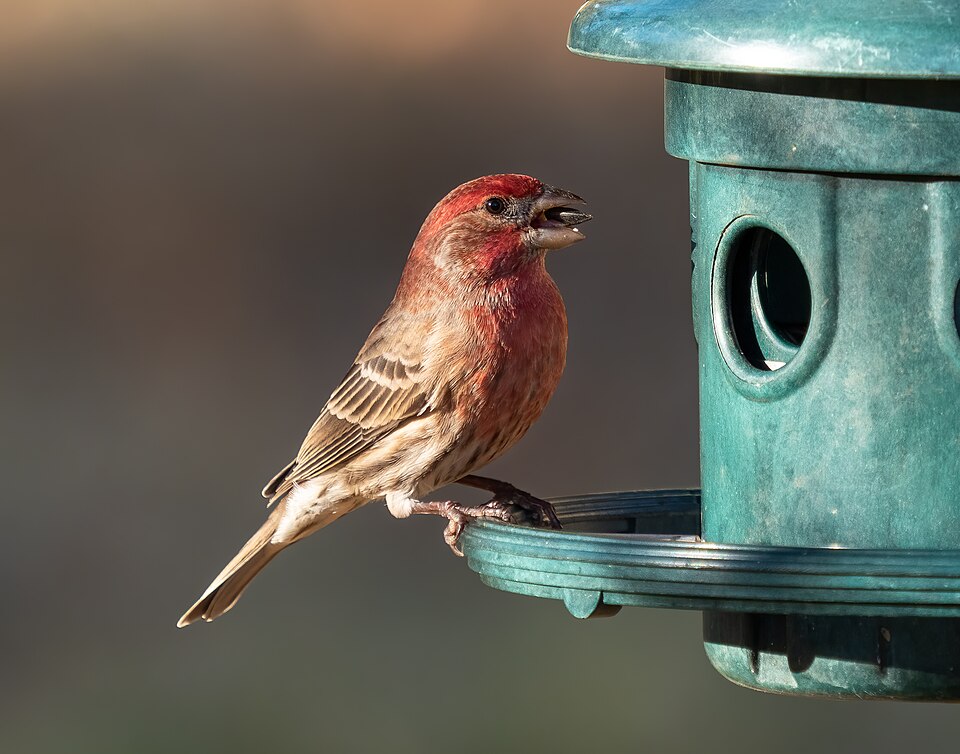
The House Finch is one of the most familiar small birds in North America, a sparrow-sized songbird that turns up at feeders, on rooftops, and in city parks across nearly the entire continent. Males wear a wash of rosy red on the head and chest, while the streaky brown females blend into the background. Originally a bird of the arid Southwest and Mexico, the House Finch has become a fixture in suburbs and downtowns alike, happily nesting in hanging plants, wreaths, and building ledges right alongside people.
What makes this finch so noticeable is its sociability and its voice. House Finches travel in loose, chattering flocks, and a small group will descend on a sunflower feeder and stay for long, unhurried visits. The males sing a long, warbling jumble almost year-round, a sound so common in American towns that many people hear it daily without knowing what it is. Their remarkable spread across the continent is one of the great range-expansion stories in modern birding.
House Finches are small, compact finches with a fairly large, conical seed-cracking bill and a notably long, square or slightly notched tail. They sit with a rounded, somewhat hunched posture and look a bit "plain-faced" compared with sharper-marked finches. Size and shape are consistent between sexes; it's the plumage and the heavy streaking on the underparts that do most of the identifying.
| Size & shape | Small finch, 5-6 in long, with a stout conical bill and a long, squared-off tail |
| Male color | Raspberry-to-orange-red on the forehead, throat, and upper breast; varies from deep red to orange or even yellowish |
| Body streaking | Brown-streaked back, wings, and belly on both sexes; flanks show blurry brown stripes |
| Female | Plain grayish-brown overall with diffuse, soft streaking below and no strong face pattern |
| Bill | Thick and conical with a curved upper edge (culmen), unlike the straighter bill of Purple Finch |
| Wings | Brown with only faint pale wingbars, never bold white wingbars |
Male vs. female
Males and females are easy to separate. The male shows red (sometimes orange or yellow) concentrated on the forehead, over the eye, on the throat, and across the upper breast, while his back, wings, and belly stay brown and streaky. The amount and shade of red depends on diet during molt, so some males are brilliant red and others are dull orange. Females are a uniform grayish-brown with fine, blurry streaks on the breast and flanks and a notably plain face lacking the bold eyebrow or mustache stripe seen on female Purple and Cassin's Finches. If you see streaking on the underparts but no red at all, you're almost certainly looking at a female (or a young bird).
Juveniles
Juvenile House Finches look much like adult females: brown above and streaky below, with a plain face. Young males do not show red in their first summer and are essentially indistinguishable from females in the field until they acquire their first colorful plumage after the late-summer molt. The takeaway for backyard watchers is that a flock of "brown streaky finches" in midsummer often includes both adult females and the year's fledglings.
The male's song is a long, bubbly, slightly hurried warble that tumbles along for two or three seconds and very often ends with a buzzy, downslurred wheeer or jeeer note. It can sound a little harsh or scratchy compared with the sweeter Purple Finch, and males sing it from rooftops, wires, and treetops through much of the year.
The everyday contact call is a sweet, rising cheep or queet, given constantly by flock members as they feed and fly. Because House Finches chatter almost nonstop, that soft, inquisitive cheep is one of the most reliable ways to notice them even before you spot the birds.
House Finches are now found across most of the United States, southern Canada, and Mexico. The western population is native and long-established in arid and semi-arid country. The entire eastern population, however, descends from caged birds (sold illegally as "Hollywood Finches") that were released on Long Island, New York, around 1940; from that toehold they spread explosively westward over the following decades until the eastern and western populations met in the Great Plains.
They are largely non-migratory, especially in milder and urban areas where feeders provide year-round food. Northern and high-elevation birds may move short distances or downslope in winter, and flocks roam locally in search of seed, but you can expect the same finches at a given feeder in summer and winter alike.
House Finches are overwhelmingly vegetarian, feeding on seeds, buds, flower parts, and fruit. They relish the seeds of weeds and grasses, and in towns they readily eat the seeds of ornamental plants and the buds of fruit trees. Unlike many songbirds, they feed their nestlings almost entirely on regurgitated plant material rather than insects, which is unusual and reflects how thoroughly seed-based their lifestyle is.
At feeders they are devoted fans of black-oil sunflower and nyjer (thistle), and a single flock can dominate a feeder for long stretches, cracking seeds in place rather than carrying them off. They feed methodically and socially, often in mixed company with goldfinches and sparrows, and will also drink and bathe eagerly at birdbaths.
House Finches are flexible, opportunistic nesters, which is a big reason they thrive around people. The female builds a shallow cup of grasses, twigs, leaves, and other fine material, frequently tucked into hanging flower baskets, wreaths, ledges, vents, dense shrubs, or old nests of other birds. She does most of the building and all of the incubation.
Clutches typically hold 3 to 5 pale bluish eggs with fine dark speckling, and pairs commonly raise two or more broods in a single season. The female incubates for about two weeks while the male brings her food, and both parents then feed the young, which leave the nest a couple of weeks after hatching. Because they nest so readily on porches and patios, House Finches are among the first wild birds many people watch raise a family up close.
The House Finch is a premier backyard and feeder bird, and attracting it is genuinely easy across most of its range. Offer the right seed and a little water and you'll likely host a chattering flock within days.
- Offer black-oil sunflower seed in a tube or hopper feeder, it is their clear favorite and brings them in fast.
- Add a nyjer (thistle) feeder; House Finches share these readily with goldfinches.
- Provide a birdbath with clean, shallow water, as finches drink and bathe frequently.
- Use feeders with multiple perches since House Finches arrive in flocks and like to feed together.
- Plant native seed-bearing flowers and weeds (such as sunflowers and coneflowers) and leave seed heads standing into fall.
- Keep feeders clean and dry, House Finches are prone to a contagious eye disease (House Finch eye disease), so scrub feeders regularly and discard moldy seed to limit its spread.
- Purple Finch: Males are more uniformly raspberry-washed over the head and back (not just the front), females have a bold whitish eyebrow and mustache stripe, and the bill is straighter. House Finch has crisper brown streaking on a whiter belly and a plainer face.
- Cassin's Finch: A western mountain finch; males have a bright red crown contrasting with a paler nape, a longer, straighter bill, and crisper markings. Cassin's looks 'cleaner' and frostier than the streakier House Finch.
- American Goldfinch: Breeding males are unmistakable bright yellow with a black cap; in winter and as females they are duller, but goldfinches always show bold black-and-white wings and an unstreaked body, unlike the streaky House Finch.
- Pine Siskin: Smaller and more heavily streaked overall, with a thin pointed bill and yellow flashes in the wings and tail, quite different from the stout-billed, plain-faced House Finch.
What's the difference between a House Finch and a Purple Finch?
On males, House Finch red is concentrated on the front (forehead, throat, breast) with brown streaks down the flanks and belly, while Purple Finch males are more thoroughly washed raspberry over the head and back. Female House Finches have plain faces, whereas female Purple Finches show a bold white eyebrow and mustache. The House Finch's bill is also more curved on top, the Purple Finch's straighter.
Why are some male House Finches orange or yellow instead of red?
The red color comes from carotenoid pigments in the foods they eat while molting. Birds with access to richer pigment sources grow brighter red feathers, while others end up orange or yellowish. Females tend to prefer the reddest males, so color is partly a signal of how well a male has been feeding.
What do House Finches eat at feeders?
They love black-oil sunflower seed and nyjer (thistle). They'll perch and crack seeds in place for long periods, often in flocks. Offering both seed types in tube or hopper feeders with several perches is the best way to keep them around.
Are House Finches native to the eastern United States?
No. The entire eastern population descends from caged birds released on Long Island, New York, around 1940. They spread rapidly westward over the following decades, eventually meeting the native western population on the Great Plains. The western birds are the original, naturally occurring population.
Why do some House Finches have crusty or swollen eyes?
That's a sign of House Finch eye disease (a form of conjunctivitis caused by a bacterium), which spreads at crowded, dirty feeders. To help, clean and disinfect your feeders regularly, discard old or moldy seed, and take feeders down temporarily if you see several sick birds so the flock can disperse.