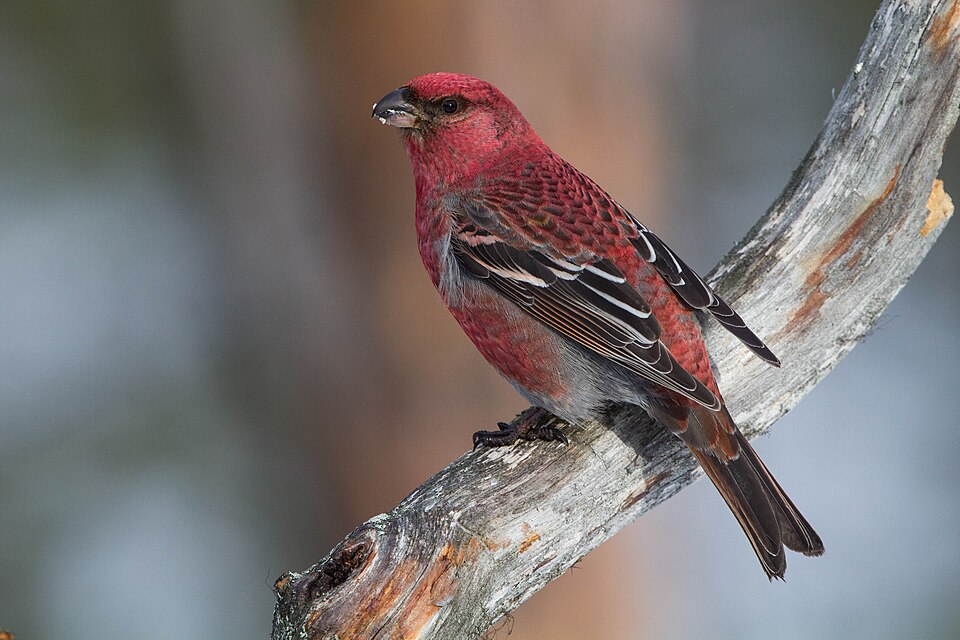
The Pine Grosbeak is the largest of North America's true finches, a plump, long-tailed bird about the size of an American Robin that drifts through the spruce and fir forests of the far north and high western mountains. Where most finches are quick, jittery, and hard to approach, the Pine Grosbeak is famously slow and confiding. Birders who find a flock feeding on crabapples or mountain-ash berries often discover they can walk right up to the birds, which barely look up from their meal. This unhurried temperament, combined with the soft rose-red of the males, makes a winter encounter feel like a small gift.
It is a circumpolar species, found across the boreal zones of North America, northern Europe, and Asia. In most years it stays well to the north, but in winters when the cone and berry crops fail across the boreal forest, flocks "irrupt" southward, sometimes reaching the northern United States in numbers. These irruption winters are when most southern birders get to see one. The genus name Pinicola means "pine dweller," a fitting label for a bird so tied to northern conifers.
Think of a finch built on a robin's frame: heavy-bodied, round-headed, with a long notched tail and a short, stubby, strongly curved bill. The Pine Grosbeak is noticeably larger and more sluggish than the redpolls, siskins, and other finches it sometimes feeds beside. At rest it often looks fluffed and front-heavy, and in flight it shows two bold white wing bars on dark wings.
| Size & shape | Robin-sized, plump and large-headed with a long tail and a short, thick, rounded bill |
| Adult male | Soft rosy red to pinkish on head, back, and breast, blending into gray flanks and belly |
| Female & immature | Gray-bodied with a warm olive, mustard-yellow, or russet wash on the head and rump |
| Wings | Blackish with two clean white wing bars; visible on perched and flying birds |
| Bill | Short, dark, deeply curved (decurved) culmen, stubbier than other large finches |
| Behavior | Slow and tame; feeds quietly, often allows close approach |
Male vs. female
The sexes look distinctly different. Adult males are washed in a soft, raspberry-rose red across the head, back, and chest, fading to gray on the belly and flanks, with the white wing bars standing out against dark wings. Females and immature males replace that red with gray bodies and a wash of color on the head and rump that ranges from olive-gray to a warm mustard-yellow or, in some birds, a coppery russet-orange. Both sexes share the same heavy shape, stubby curved bill, and double white wing bars, so on a gray-toned bird the head-and-rump color is your best clue to sex and age.
Juveniles
Young Pine Grosbeaks resemble adult females, with gray bodies and a soft wash of olive or yellowish color concentrated on the head and rump. Males take time to mature: a first-year male typically looks like a female and does not acquire full rosy plumage until his second year, so many "yellow-headed" grosbeaks in a winter flock are actually young males rather than adult females. The white wing bars are present from the first winter, helping confirm the species even on these duller birds.
The Pine Grosbeak's song is a sweet, warbling, slightly hesitant series of musical whistles, soft and rambling rather than loud or showy, somewhat like a slowed-down, mellower Purple Finch. It is heard mostly on the breeding grounds and is easy to overlook because it carries poorly through dense conifers.
More useful for finding the birds is the flight call, a clear, whistled three-note pui-pui-pui or tee-tee-tew, musical and a bit melancholy. Flocks keep up soft conversational whistles and warbles while they feed. In parts of the West the calls differ enough between populations that researchers have described distinct call "types," but for most birders the gentle whistled notes are simply a reliable giveaway that grosbeaks are overhead or in the next fruit tree.
Pine Grosbeaks breed across the boreal forest of Canada and Alaska and southward down the western mountains through the Rockies, Cascades, and Sierra Nevada, as well as across northern Eurasia. They favor open spruce and fir forest, often near treeline or in subalpine country. They are largely non-migratory in the strict sense, staying within the northern forest year-round where food allows.
Their movements are instead driven by food. In winters when northern cone and fruit crops are poor, flocks irrupt south and east, appearing at lower elevations and in the northern United States, sometimes well south of their usual haunts. These irruptions are irregular and unpredictable, varying year to year, which is part of why a Pine Grosbeak sighting feels like an event for birders living south of the boreal zone.
Pine Grosbeaks are primarily vegetarian for much of the year, feeding on the buds, seeds, and especially the fleshy fruits of northern trees and shrubs. In winter they are strongly tied to fruiting trees, working over mountain-ash (rowan), crabapple, juniper, and other berries; the stout curved bill is built for crushing seeds and snipping buds. They often pluck a fruit, crush it to extract the seeds, and let the pulp fall, so the ground beneath a feeding flock is littered with dropped fruit skins.
In the breeding season they add insects and spiders, which provide protein for growing nestlings. They forage unhurriedly, moving through a tree methodically and frequently feeding in loose, sociable flocks outside the nesting season. They will also come to the ground for fallen seed and to grit and salt along roadsides in winter.
Pine Grosbeaks nest in conifers, usually placing a bulky, loose cup of twigs lined with finer grass, rootlets, moss, and lichen on a horizontal branch or in a fork, typically not very high off the ground. Nesting comes relatively late in the short northern spring and summer. The female builds the nest and incubates the clutch, while the male helps feed her on the nest and later helps provision the young.
A typical clutch is three to four pale blue-green eggs marked with darker spots and scrawls. Like many finches, the parents feed nestlings on a regurgitated paste, including a high proportion of insects early on and plant matter later. Pairs generally raise a single brood per season given the brief northern breeding window.
Pine Grosbeaks are not classic feeder birds, and they only reach most yards during irruption winters in the north. When they do wander south, though, they can be surprisingly easy to host because they care more about fruit than about feeders.
- Plant fruiting trees and shrubs. Mountain-ash (rowan), crabapple, hawthorn, and juniper are powerful magnets; a fruit-laden tree is far more likely to pull in a flock than any feeder.
- Leave the fruit on through winter. Don't prune off or clean up berries and crabapples; persistent winter fruit is exactly what wandering grosbeaks seek out.
- Offer black oil sunflower seed. On platform or hopper feeders they will take sunflower seed, which suits their stout seed-crushing bills.
- Provide grit and a water source. Birds visit roadside grit in winter, and an open water source or heated bird bath can draw a thirsty flock.
- Watch in irruption years. If you live in the northern U.S. or southern Canada, check local birding alerts; Pine Grosbeaks tend to show up in flights, so one report often means more birds are around.
- Be patient and still. These birds are famously tame, so a feeding flock will often let you watch from close range if you move slowly.
- White-winged Crossbill: Also a rosy northern finch with white wing bars, but smaller, slimmer, with a crossed bill tip and a faster, restless feeding style in cone clusters.
- Purple Finch: Raspberry-red male recalls a Pine Grosbeak's color but is much smaller, lacks bold white wing bars, and has a straighter conical bill and streaky brown females.
- Red Crossbill: Brick-red males overlap in habitat but are smaller, lack the bold double white wing bars, and have the distinctive crossed bill.
- Evening Grosbeak: A chunky northern finch with white wing patches, but yellow-and-black plumage and a massive pale conical bill rather than rosy color and a short curved bill.
Is the Pine Grosbeak a rare bird?
It's not globally rare and is listed as Least Concern, but it lives in remote boreal and mountain forests, so many birders rarely encounter it. South of its breeding range it appears mainly during irregular irruption winters, which is why a sighting can feel special.
How do I tell a Pine Grosbeak from a Purple Finch or House Finch?
Size and shape are the giveaways. The Pine Grosbeak is much larger (robin-sized) and plumper, shows two bold white wing bars, and has a short, thick, curved bill. Purple and House Finches are small, streakier, lack the bold white wing bars, and have straighter conical bills.
Why are some Pine Grosbeaks red and others yellow or gray?
Adult males are rosy red, while females and young males are gray with an olive, yellow, or russet wash on the head and rump. Males don't reach full red plumage until their second year, so many yellow-headed birds in a flock are actually first-year males.
Will Pine Grosbeaks come to a backyard feeder?
They can, but they're not reliable feeder birds. They'll take black oil sunflower seed from platform feeders, yet they're far more attracted to fruiting trees like mountain-ash and crabapple. In most years they stay north of populated areas entirely.
Why are Pine Grosbeaks so tame?
They breed in remote northern forests with little human contact and simply haven't learned to fear people. Combined with their slow, deliberate feeding style, this often lets birders approach a feeding flock within a few feet.