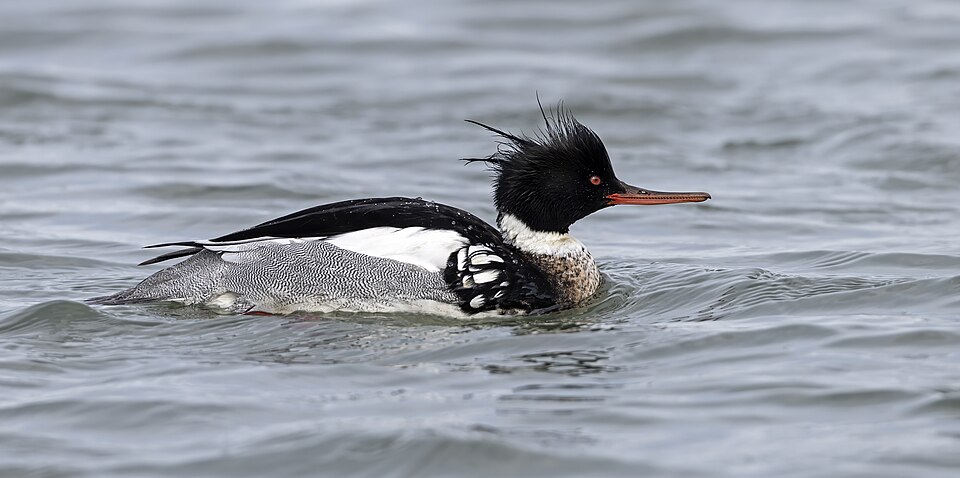
The Red-breasted Merganser is one of three North American "sawbills", fish-eating ducks named for the fine, backward-pointing serrations along their slender bills that help them grip slippery prey. With its ragged, wind-blown crest and low, torpedo-shaped body, it has a wild, slightly disheveled look that sets it apart from the tidy bufflehead and goldeneyes it often shares the water with. It is a bird of cold, open water, and in winter it becomes one of the most reliably coastal of all our ducks, riding the swells just beyond the breakers along both the Atlantic and Pacific.
While the Common Merganser favors clear lakes and rivers, the Red-breasted leans saltier, hauling its serrated bill into estuaries, bays, and surf zones where it pursues small fish with surprising speed and stamina. It is also famous among birders for sheer velocity: in level flight it is one of the fastest of all ducks, and a flock low over the water is an arrow of fast-beating wings. For most backyard birders it is a "go and find it" species rather than a visitor, but it is well worth seeking on a winter day at the coast.
Look for a slim, low-slung diving duck with a long, thin, slightly hooked reddish bill and a shaggy double crest that sticks out from the back of the head like bed-head. The body sits low in the water, the neck is long, and the silhouette is more rakish and stretched-out than the heavier, cleaner-lined Common Merganser.
| Bill | Long, thin, and serrated with a slight hook at the tip; orange-red in both sexes, narrower and more delicate than the Common Merganser's bill |
| Crest | Shaggy, spiky, double-pointed crest that flares from the rear of the head in both sexes, giving a perpetually windblown look |
| Male head | Glossy dark green (often looks black) head with a white collar separating it from a streaked cinnamon-brown breast |
| Male body | Gray flanks, a black back, and a broad white wing patch; a black-and-white patch shows at the shoulder near the waterline |
| Female head | Rusty cinnamon-brown head that blends gradually into a pale gray neck and body, with no sharp contrast |
| Size & shape | Slim, long-bodied, and low to the water; clearly larger than a Bufflehead but slimmer and rattier-looking than a Common Merganser |
Male vs. female
Breeding males are unmistakable: a dark green-glossed head with a wispy crest, a crisp white collar, a speckled rusty-cinnamon breast, and gray sides over a black back. Females (and non-breeding "eclipse" males) are much plainer, a soft cinnamon-brown head that fades smoothly into a gray body, with the same shaggy crest and thin reddish bill. The key for separating a female Red-breasted from a female Common Merganser is the head pattern: on the Red-breasted the brown of the head blends gradually into the pale throat and neck with no clean border, whereas the Common shows a sharply defined rusty head set against a clean white chin and breast.
Juveniles
Juveniles and first-winter birds closely resemble adult females, cinnamon-brown head, gray body, and a less developed, scruffier crest. They are duller overall with a paler, more washed-out face, and young males begin to show hints of adult plumage (darker head feathering and the first traces of a collar) through their first winter and spring. At a distance, immatures are best identified by structure: the slim body, thin reddish bill, and ragged crest give them away even before plumage details resolve.
Red-breasted Mergansers are mostly silent away from the breeding grounds, so winter coastal birds are usually seen and not heard. During courtship the male performs a comical "salute-curtsy" display and gives a soft, catlike or rolling yeow-yeow note that carries a surprisingly mechanical, raspy quality.
Females give a low, harsh krrr-krrr or grating croak, often when alarmed or herding ducklings. Neither sex produces anything resembling a musical song, the vocal repertoire is limited to grunts, rasps, and croaks that you are far more likely to hear on a northern nesting lake than at a winter jetty.
The Red-breasted Merganser breeds across the far north, from Alaska and northern Canada through the boreal forest and tundra, and across northern Eurasia, nesting near lakes, rivers, and sheltered coasts. It is a true Holarctic species, found across the northern reaches of both North America and the Old World.
In winter it shifts strongly toward salt water, becoming common along both North American coasts, the Gulf of Mexico, and the Great Lakes, where it favors bays, estuaries, harbors, and the open surf. Migration is concentrated in late fall and again in spring; many birds linger on the Great Lakes and coastal waters until ice or weather pushes them on. It is among the last ducks to head north in spring and one that birders count on finding in cold-weather coastal counts.
This is a specialist fish-eater. The Red-breasted Merganser dives and pursues small fish underwater, using its serrated bill to seize and hold slippery prey before swallowing it head-first. Favored foods include small schooling fish such as herring, silversides, killifish, sticklebacks, and minnows, supplemented by crustaceans, aquatic insects, and other invertebrates, especially on the breeding grounds.
It often forages cooperatively, with groups of birds swimming in a loose line and driving fish into the shallows or against a shoreline before diving in a coordinated rush. Birds frequently "snorkel," cruising with the face submerged to spot prey before slipping under. Their hunting is active and energetic, one reason they need such productive, fish-rich water.
Red-breasted Mergansers nest on the ground, unlike the cavity-nesting Common and Hooded Mergansers. The female chooses a concealed spot under dense vegetation, a log, or a rock, often on an island or near the shore of a northern lake or coastal inlet, and lines a shallow scrape with down and plant material.
She lays roughly 7 to 12 buff or olive eggs and incubates them alone for about a month. The downy ducklings leave the nest soon after hatching and are led to water by the female, where they quickly begin diving and feeding themselves. Females sometimes lay in one another's nests, and broods may merge into larger "creches" tended by one or more hens, a common strategy among northern-nesting waterfowl.
The Red-breasted Merganser is not a backyard or feeder bird, it eats live fish and needs open, cold water, so you won't lure one with seed or suet. The way to "attract" it is to go where it spends the winter and watch.
- Bird the coast in winter: Scan bays, estuaries, harbors, jetties, and the surf zone from late fall through early spring, this is by far the most reliable habitat.
- Check the Great Lakes: Large lakes and reservoirs that stay ice-free hold good numbers during migration and winter.
- Bring a scope: These ducks often sit well offshore in choppy water, so a spotting scope makes a huge difference for picking out the crest and bill.
- Look near inlets and tidal flow: Moving water concentrates small fish, and mergansers gather where the fishing is good, often foraging in loose flocks.
- Watch for the fast, low flight: A line of slim ducks streaking just above the water with rapid wingbeats is a classic Red-breasted Merganser giveaway.
- Common Merganser: Bulkier and cleaner-looking; female has a sharply defined rusty head against a clean white chin, while the Red-breasted's brown head blends into the neck. Common prefers fresh water and rivers.
- Hooded Merganser: Much smaller with a fan-shaped, collapsible crest. Male shows a bold white head patch; females are warm brown with a tawny crest. A cavity nester of wooded ponds, not coastal surf.
- Common Goldeneye: Stocky with a short bill (not thin and serrated) and a rounded head. Male has a white cheek spot; lacks the shaggy crest and rusty tones of a merganser.
- Bufflehead: Tiny and round with a short bill. Male is boldly black-and-white with a large white head patch; far smaller than a merganser and lacks the spiky crest.
What is the difference between a Red-breasted and Common Merganser?
The Red-breasted is slimmer and rattier-looking with a shaggy double crest and a thinner bill, and it favors salt water. Female Red-breasteds have a brown head that blends smoothly into a gray neck, while female Common Mergansers show a sharply defined rusty head against a clean white chin and breast. Common Mergansers also prefer rivers and freshwater lakes.
Where do Red-breasted Mergansers live in winter?
In winter they are strongly coastal, found along both the Atlantic and Pacific coasts, the Gulf of Mexico, and on the Great Lakes. Look for them in bays, estuaries, harbors, and the open surf, often sitting offshore in loose flocks.
Are Red-breasted Mergansers really one of the fastest ducks?
Yes. In level flight the Red-breasted Merganser is among the fastest of all ducks, and flocks streaking low over the water with rapid wingbeats are a hallmark of the species. They are built for speed both in the air and underwater.
What do Red-breasted Mergansers eat?
Almost entirely small fish, herring, silversides, killifish, sticklebacks, and minnows, caught by diving and pursuing prey underwater. The serrations along the bill help grip slippery fish. They also take crustaceans, insects, and other invertebrates, especially while nesting.
Why does the Red-breasted Merganser have a serrated bill?
The fine, tooth-like serrations (which earn mergansers the nickname 'sawbills') line the edges of the bill and act like a grip, letting the bird hold onto slick, wriggling fish long enough to swallow them. They are not true teeth but ridges of the bill itself.