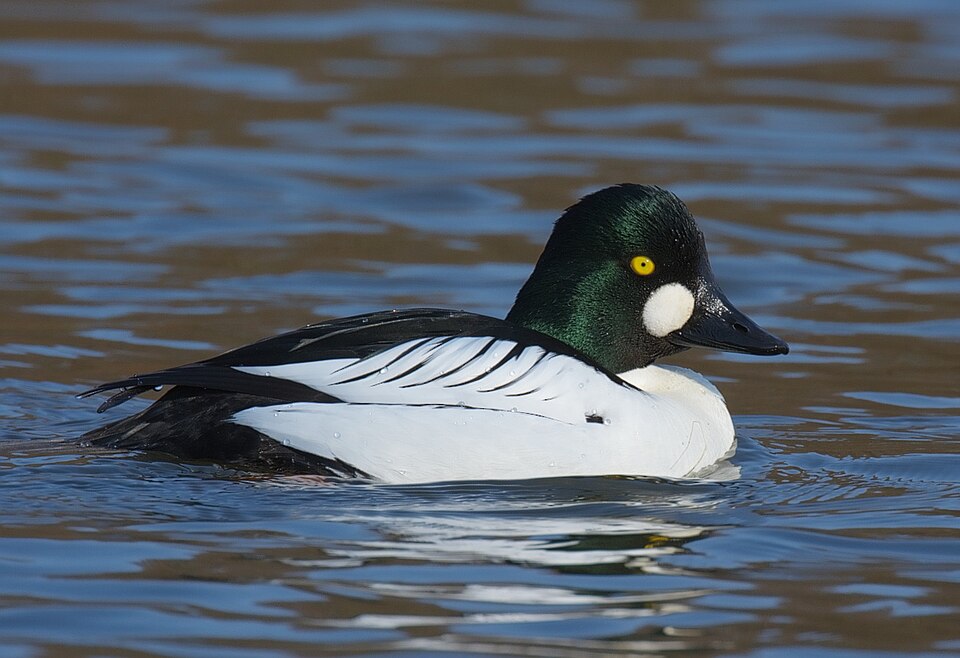
The Common Goldeneye is a compact, big-headed diving duck of the northern hemisphere, named for the brilliant yellow-gold iris that stares out from its dark face. In winter, flocks gather on cold lakes, rivers, and coastal bays across much of North America and Eurasia, where the drakes' crisp black-and-white plumage stands out sharply against gray water. They are restless, energetic divers, constantly disappearing under the surface to feed and popping back up like corks.
One of the best ways to know a goldeneye is by ear, even before you see it. Their wings produce a distinctive musical whistling in flight, loud enough that birders and hunters alike call them "whistlers." That sound, combined with their fast, direct flight and tendency to travel in tight little groups, makes them a memorable part of the cold-season birding scene on open water from late fall through early spring.
Look for a medium-sized, chunky duck with an oversized, peaked or domed head, a short neck, and a stubby bill. Goldeneyes sit fairly low and ride the water actively, often diving in unison. The combination of head shape, the bright eye, and bold black-and-white patterning on adult males makes them distinctive once you know what to scan for.
| Size & shape | Compact diving duck with a large, rounded-to-peaked head and short bill, giving a top-heavy look |
| Eye | Striking pale golden-yellow iris in adults, the field mark that gives the bird its name |
| Adult male head | Glossy dark green-black head with a bold round white spot at the base of the bill |
| Adult male body | Bright white sides and breast contrasting with a black back; white wing patch flashes in flight |
| Female | Chocolate-brown head, gray body, and a dark bill often tipped with yellow-orange |
| In flight | Fast, direct flight with loud whistling wingbeats and large white wing patches on both sexes |
Male vs. female
Adult males and females look quite different. The drake has a dark, green-glossed head that often appears simply black in poor light, a clean round white spot in front of the eye, gleaming white flanks and breast, and a black back. The female is more subdued: a rich chocolate-brown head set off cleanly from a gray body, with no white face spot. Her bill is dark and frequently shows a yellow to orange band near the tip, especially in late winter and spring. Both sexes share the golden eye, though it can look paler or duller in females and young birds.
Juveniles
Juveniles and first-winter birds resemble adult females but are drabber and grayer, with a duller brownish head and a dark, often brownish eye that has not yet brightened to gold. Young males gradually develop their black-and-white plumage and the white face spot over their first winter and into spring, so you may see awkward "in-between" individuals showing patchy dark heads, partial white spots, and a body that is neither fully female-like nor crisply adult-male. By their second fall most males look essentially adult.
Goldeneyes are not songbirds, and for much of the year they are fairly quiet. The most reliable sound is mechanical rather than vocal: the loud, fast whistling or twittering of their wings in flight, a thin musical vree-vree-vree that often announces them before they come into view.
During courtship, drakes give a sharp, nasal, almost buzzy double note sometimes written as jee-jeee or a faint rasping peent, paired with an exaggerated head-throw display in which the male snaps his head back onto his rump and kicks up a splash. Females give a low, harsh, growling cuk-cuk or grating call, most often heard around the breeding grounds.
Common Goldeneyes breed across the boreal forest belt of North America and northern Eurasia, nesting near lakes, ponds, and slow rivers in wooded country from Alaska and Canada through Scandinavia and Russia. They are cavity nesters tied to mature forest, so their breeding range follows the northern woods.
In winter they move south to ice-free water, spreading across most of the United States and southern Canada, along both coasts, and throughout temperate Europe and Asia. Look for them from late October through March on large lakes, reservoirs, rivers below dams, harbors, and protected coastal bays. They retreat north again as spring opens up the inland waters, with most gone from the southern wintering grounds by April.
Common Goldeneyes are active divers that feed by swimming underwater, propelled mostly by their feet, and gleaning prey from the bottom or from submerged rocks and vegetation. Aquatic invertebrates make up the bulk of the diet: crustaceans such as crabs, amphipods, and crayfish, along with insect larvae, mollusks, and small amounts of fish and fish eggs. On freshwater breeding lakes they take large numbers of insect larvae, while wintering coastal birds rely heavily on crustaceans and mollusks.
They also eat some plant material, including seeds, tubers, and bits of aquatic vegetation, but they are far more carnivorous than dabbling ducks. Flocks often dive together, vanishing and resurfacing in loose synchrony, and individuals typically stay under for less than a minute per dive in relatively shallow water.
Common Goldeneyes are cavity nesters, choosing natural tree hollows and old woodpecker holes, especially those made by Pileated Woodpeckers and Northern Flickers, usually within reach of water. They readily take to nest boxes, which has helped local populations where natural cavities are scarce. The female lines the cavity with wood chips and her own down rather than building a true nest.
She lays a clutch of greenish eggs and incubates them alone for roughly a month while the drake departs. Goldeneyes are known for "egg dumping," where females lay in one another's nests, so some cavities end up with unusually large mixed clutches. A day or two after hatching, the downy ducklings make a dramatic leap from the cavity entrance to the ground or water below, then follow the female to feeding areas. Young goldeneyes are independent early and can dive for their own food within days.
The Common Goldeneye is not a backyard feeder bird, so you will not lure one with seed. It is a duck of open, cold water, and the realistic way to "attract" or enjoy them is to provide or visit the right habitat rather than a feeder.
- Visit open water in winter. Scan large lakes, reservoirs, rivers below dams, and sheltered coastal bays from late fall through early spring, where goldeneyes gather in diving flocks.
- Put up a nest box if you live in the north. Near wooded lakes and rivers within their breeding range, a properly sized wood-duck-style box mounted near water can attract nesting goldeneyes.
- Protect mature shoreline trees. Goldeneyes depend on natural tree cavities, so keeping older trees standing near water supports breeding birds.
- Look and listen for the wing whistle. Their musical whistling flight often gives them away before you spot them, so let your ears help you find flocks.
- Keep some shoreline undisturbed. Quiet, low-traffic stretches of water give resting and feeding flocks the space they need.
- Barrow's Goldeneye: Very similar; the male has a crescent-shaped (not round) white face patch, a steeper forehead with a more bulging head, and more black showing on the sides. Females are harder to separate but often show a more all-yellow or mostly orange bill and a stubbier, more triangular head.
- Bufflehead: Much smaller and rounder, with a tiny bill. The male has a big white patch wrapping around the back of the head rather than a round spot at the bill base, and lacks the goldeneye's golden eye.
- Common Merganser: Larger and more elongated with a thin, hooked red bill. Males are cleaner white-bodied with a dark green head and no white face spot; the overall shape is sleek rather than chunky-headed.
- Hooded Merganser: Smaller, with a thin bill and a fan-shaped crest the male can raise and lower. Males show a white head patch outlined in black rather than a round white spot, and have rusty sides.
Why is it called a goldeneye?
Adults have a brilliant golden-yellow iris that stands out against the dark head, which gives the bird its name. The eye is pale and bright in adults but starts out dark in young birds and gradually brightens as they mature.
What is the whistling sound goldeneyes make?
The whistling comes from their wings, not their voice. In fast flight the wingbeats produce a loud, musical whistling that earned them the nickname whistler. You can often hear them coming before you see them.
How do I tell a Common Goldeneye from a Barrow's Goldeneye?
The clearest clue is the white face mark on the male: Common Goldeneye has a round white spot at the base of the bill, while Barrow's has a crescent or comma-shaped patch. Barrow's also tends to have a steeper forehead, a more bulging head, and more black along the sides. Females are trickier, but Barrow's females often show a mostly orange or yellow bill.
Where can I see Common Goldeneyes?
In winter they are widespread across the United States, southern Canada, and temperate Eurasia on large lakes, reservoirs, rivers below dams, harbors, and protected coastal bays. They breed in the boreal forest of the far north near wooded lakes and rivers.
Do Common Goldeneyes use nest boxes?
Yes. They are cavity nesters that normally use old woodpecker holes and natural tree hollows near water, and they readily accept wood-duck-style nest boxes placed near lakes and rivers within their breeding range.