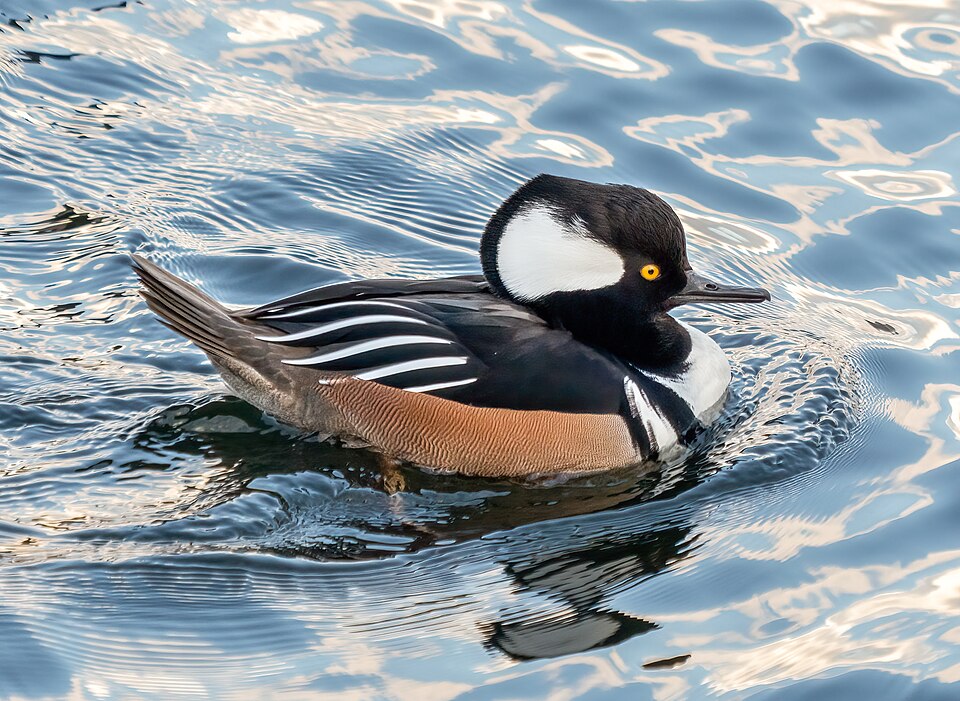
The Hooded Merganser is North America's smallest merganser and arguably its most theatrical-looking duck. Males carry a collapsible, fan-shaped crest that they can flatten into a sleek slick-back or flare into a brilliant white sail edged in black, usually while courting or feeling agitated. Even at a distance, a drake "Hoodie" raising and lowering that crest on a quiet woodland pond is one of the more memorable sights in winter birding. It is a slim, small-bodied diving duck rather than a dabbler, and it spends much of its time underwater chasing prey rather than tipping up at the surface like a Mallard.
Unlike the common and red-breasted mergansers, which favor big open water and coastlines, the Hooded Merganser is a bird of wooded wetlands: beaver ponds, swamps, sloughs, slow rivers, and tree-lined backwaters. It nests in tree cavities and readily uses nest boxes, which has made it a quiet conservation success and a favorite of people who put up Wood Duck boxes. Shy and quick to flush, it rewards patient, low-key watching from a blind, a parked car, or simply a still spot along a shaded bank.
Look for a small, slender duck with a long, thin, serrated bill and a large, mobile crest that dramatically changes the head's shape. The body sits low, the tail is often cocked slightly, and in flight the wingbeats are fast and shallow, giving a buzzy, almost frantic look compared with a dabbling duck.
| Size & shape | Small diving duck, slim-bodied with a thin spike-like bill and an oversized, fan-shaped crest |
| Male head | Black head with a huge white crest patch bordered in black; crest fans out or collapses flat |
| Male body | Black back and white breast cut by two black bars on each side; warm cinnamon flanks |
| Female | Gray-brown overall with a shaggy reddish-cinnamon crest and a dark bill |
| Eye color | Bright yellow eye in males; dark eye in females and immatures |
| In flight | Fast, shallow wingbeats; whitish wing patch and a slim silhouette with the crest laid back |
Male vs. female
Males and females look strikingly different. The breeding drake is unmistakable: a black head with a large white crest that flares into a black-bordered fan, a bright yellow eye, white breast crossed by two thin black bars, and rich cinnamon sides. The female is much plainer, a soft gray-brown bird with a warm reddish-brown shaggy crest, a dark eye, and a dusky bill often showing a yellowish or orange edge. In late summer the drake molts into a dull "eclipse" plumage and looks much like the female, but he keeps his yellow eye, which is a reliable giveaway.
Juveniles
Juveniles and immatures resemble adult females, showing the same gray-brown body and rusty, ragged crest, but they tend to look even duller and more uniform, with a smaller, less developed crest and a dark eye. Young drakes gradually acquire male features through their first fall and winter, so by midwinter you may see in-between birds with patchy white starting to show on the head and the eye beginning to pale toward yellow.
Hooded Mergansers are generally quiet, but displaying males produce a remarkable sound: a low, rolling, frog-like or growling call often written as crrrooo or compared to the croak of a pickerel frog. This courtship "pop" or rolling growl is delivered with a head-throw as the crest is flared, and on a calm late-winter day a small group of displaying drakes can fill a marsh with these odd, amphibian-like notes.
Females give a hoarse, gruff call, sometimes rendered as croo-croo-crook, especially around the nest or when gathering ducklings. Outside of courtship and family contexts, the species is mostly silent, and you are far more likely to see one than hear it.
The Hooded Merganser is found only in North America. It breeds across two broad regions: the eastern half of the continent from the Great Lakes and southern Canada down through the Mississippi Valley and into the Southeast, and a smaller population in the Pacific Northwest from southern Alaska through British Columbia into the northwestern United States. It favors forested wetlands wherever tree cavities and clear, fish- and invertebrate-rich water occur together.
In winter, northern breeders move south to find open water, spreading across much of the central, eastern, and southern United States and into the Pacific coastal states. You'll find them on ponds, reservoirs, freshwater marshes, sheltered estuaries, and slow rivers. Many birds are short-distance migrants rather than long-haul travelers, so in milder regions and along the southern edge of the breeding range they may be present year-round.
This is a pursuit-diver that hunts by sight, and it has excellent underwater vision: a special transparent eyelid (the nictitating membrane) helps it focus below the surface. It dives from the surface and swims down to chase prey, often making short, repeated dives in the same productive stretch of water. Small fish make up a large part of the diet, but Hooded Mergansers are real generalists among the mergansers.
Alongside fish, they take aquatic insects and their larvae, crayfish and other crustaceans, snails, tadpoles, and amphibians. The thin bill is lined with tiny serrations (the "saw" in the old name sawbill) that help grip slippery, wriggling prey. Crayfish are an especially important food in many freshwater wetlands, and birds will often surface and manipulate a catch at the top before swallowing it.
Hooded Mergansers are cavity nesters. The female chooses a hole in a tree, often an old woodpecker cavity or a natural hollow near water, and lines it with down. They take readily to artificial nest boxes, including boxes intended for Wood Ducks, and the two species sometimes lay in each other's nests. The female alone incubates the unusually round, hard-shelled white eggs, while the male departs early in incubation and takes no part in raising young.
A typical clutch is several to around a dozen eggs, though "dump nesting," where more than one female lays in the same cavity, can produce much larger combined clutches. About a day after hatching, the tiny, agile ducklings respond to the female's calls and leap from the cavity entrance to the ground or water below, sometimes from considerable height, then follow her to feeding water. They are self-feeding from the start and capable of diving within days.
The Hooded Merganser will not visit a seed feeder, but if you own or border wooded wetland habitat you can genuinely attract it as a nesting and visiting duck. Otherwise, the best strategy is to seek it out on the right water in the right season.
- Put up a Wood Duck-style nest box near or over clear, wooded water; Hooded Mergansers readily adopt them and a box mounted on a pole with a predator baffle is ideal.
- Protect or encourage standing wooded wetlands, beaver ponds, and snags with natural cavities, which provide both nest sites and feeding water.
- Keep water clean and fish-friendly; healthy populations of small fish, crayfish, and aquatic insects are what draw and hold these divers.
- Add coarse wood shavings (not sawdust) to the box floor for nesting material, and clean and re-bed boxes once each winter.
- If you only want to watch them, scout quiet ponds and sheltered backwaters in fall and winter and view from a distance, since they flush easily.
- Avoid disturbing nesting and brood-rearing areas in spring so females can lead ducklings to water undisturbed.
- Common Merganser: Much larger and longer-bodied with a thick orange-red bill; drake has a clean dark-green head and white body, lacking the fan-shaped crest.
- Bufflehead: Smaller and rounder with a stubby bill; male shows a big white patch on the back of a dark, iridescent head rather than a black-bordered white crest.
- Red-breasted Merganser: Larger, prefers saltwater and coasts; drake has a spiky green head, rusty breast, and shaggy double crest, not the fan-shaped white hood.
- Wood Duck: Similar swept-back crest and cavity-nesting habits, but Wood Duck has a stout duck bill and ornate, multicolored plumage rather than a thin merganser bill.
Is a Hooded Merganser a duck?
Yes. It is a true duck in the merganser group, sometimes called fish-eating or sawbill ducks for their thin, serrated, fish-gripping bills. It is the smallest of the three merganser species in North America.
What is the difference between a male and female Hooded Merganser?
The male has a black head with a large black-bordered white crest, a yellow eye, a white breast with two black bars, and cinnamon sides. The female is plain gray-brown with a shaggy reddish crest and a dark eye. Males in summer eclipse plumage look female-like but keep the yellow eye.
Can you raise the crest up and down on purpose?
Yes, the bird controls it. Hooded Mergansers can flatten the crest into a sleek shape or fan it out into a tall display, mainly during courtship or when alarmed. The male's flared white fan is a key courtship signal.
Where do Hooded Mergansers nest?
They nest in tree cavities, often old woodpecker holes near water, and they readily use nest boxes built for Wood Ducks. The female incubates alone, and the ducklings jump from the cavity within a day or two of hatching to follow her to water.
What do Hooded Mergansers eat?
They are diving hunters that eat small fish, crayfish and other crustaceans, aquatic insects, snails, tadpoles, and amphibians. They have excellent underwater vision and chase prey by swimming after it below the surface.