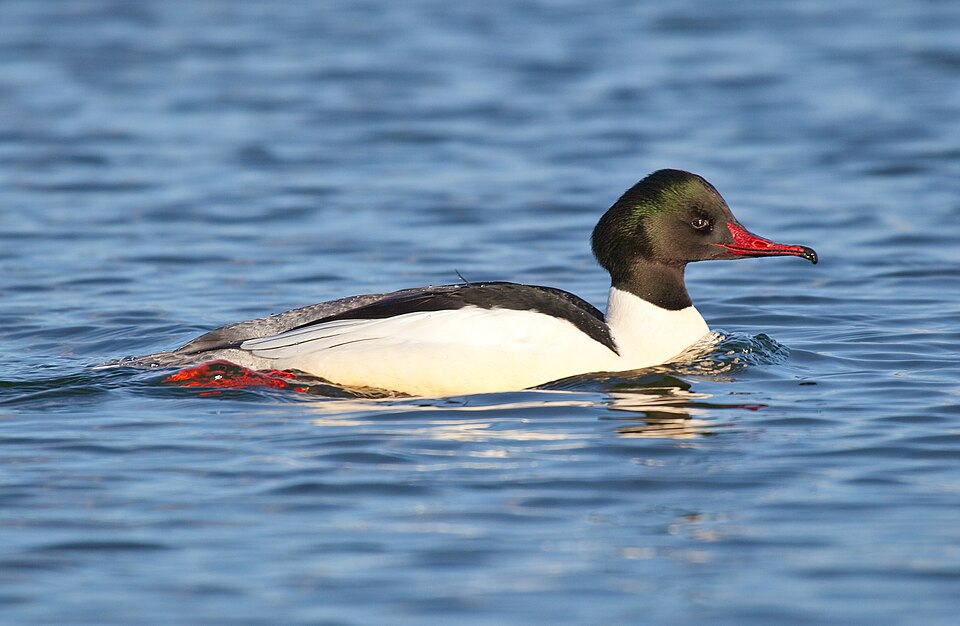
The Common Merganser is a large, low-slung diving duck built like a torpedo with a fishing spear for a bill. Where most ducks dabble for plants or strain water for tiny food, mergansers chase fish underwater, gripping their slippery prey with thin, hooked, saw-edged bills that earn the whole group the nickname "sawbills." On a winter river the drake is one of the most striking waterfowl in North America: a glossy bottle-green head, snowy-white sides, and a long, narrow blood-red bill, all riding low on the water like a sleek racing hull.
This is a bird of clean, cold water. It favors clear rivers, deep lakes, and reservoirs where it can see and pursue fish, generally avoiding the murky marshes that suit dabbling ducks. Across the Northern Hemisphere it goes by another name, the Goosander, in Europe and Asia. For backyard birders it is mostly a winter spectacle on open water rather than a feeder visitor, but few ducks reward a pair of binoculars more, especially when a tight raft of them works a riffle in synchronized dives.
Size and shape do most of the identification work here. The Common Merganser is a notably large, elongated duck that sits low in the water, with a thin neck, a long body, and a slender bill held level or slightly raised. In flight it looks stretched out and pointed front and back, with fast, shallow wingbeats and a long white wing patch flashing on the inner wing.
| Drake head | Glossy dark green, looking black in poor light, smoothly rounded with no shaggy crest |
| Drake body | Clean white sides and breast, often washed faintly peach or salmon; black back |
| Bill | Long, narrow, and bright reddish-orange with a hooked tip and fine serrated edges |
| Female head | Warm rusty-cinnamon with a shaggy crest and a crisp white chin, sharply set off from a gray body |
| Size & shape | Large and elongated, riding low; bigger and longer-bodied than a Mallard |
| Flight | Long, straight profile with rapid wingbeats; bold white inner-wing patch |
Male vs. female
The sexes look very different in breeding plumage. The drake is unmistakable: dark green head, white body, black back, and a red bill, with little or no crest so the head looks smooth and rounded. The female is gentler in tone but equally elegant, with a rich rusty-cinnamon head and a ragged crest that contrasts crisply with a clean gray body. Her sharply defined white chin patch is a reliable clue. In late summer, eclipse drakes molt into a female-like plumage but keep their darker red bill and retain white in the wing, so a "female" with extra-clean wing patches is often a drake in transition.
Juveniles
Juveniles closely resemble adult females, with rusty heads, gray bodies, and shaggy crests, so young birds in fall look like a flotilla of "redheads." A good distinguishing mark on juveniles is a short pale or whitish stripe (a loral streak) running between the eye and the base of the bill, which adult females lack. Young birds reach adult plumage over their first winter, with first-year drakes gradually showing patches of white and dark green as they mature.
Common Mergansers are largely silent, which fits their habit of quietly working open water. When they do call, the sounds are low and unmusical rather than the classic quack of a dabbling duck. Drakes give a soft, twangy, almost guitar-like or bell-like uig-a note during courtship, surprisingly delicate for such a big bird.
Females and alarmed birds produce a harsh, grating croak, often rendered as a rough karr or krrok, especially when flushing or herding ducklings. Around the nest and brood, hens use low guttural notes to keep the young together. For most observers, though, the loudest thing about a flock is the rush of wings and the splash of synchronized dives.
The Common Merganser breeds across the northern forests of North America, from Alaska and much of Canada south into the northern United States, the Rockies, the Pacific Northwest, the Great Lakes region, and New England, wherever clear rivers and forested lakes provide fish and large nesting cavities. It also ranges widely across northern Europe and Asia, where it is called the Goosander.
In winter, birds withdraw from frozen interior waters and concentrate on whatever stays open: large rivers, reservoirs, and ice-free lakes across much of the United States, with smaller numbers reaching coastal bays and estuaries. Many populations are only short- to medium-distance migrants, moving just far enough south to find unfrozen fishing water, so a hard freeze or a January thaw can shift flocks dramatically.
The Common Merganser is foremost a fish-eater. It hunts by sight, often swimming with its face submerged to scan the bottom before diving and chasing prey in fast underwater pursuit, using its serrated bill to grip slippery fish that it then swallows whole, usually head-first. It mostly takes small to medium-sized fish, frequently non-game species, and the exact menu shifts with whatever is locally abundant.
Beyond fish, mergansers will eat aquatic insects, crustaceans, mollusks, worms, amphibians, and occasionally small mammals or plant material, with invertebrates becoming especially important for ducklings. They often forage cooperatively, with a line or cluster of birds diving more or less together to herd and corner fish in a riffle or shallow run, a behavior that can make a feeding flock look almost choreographed.
Common Mergansers are cavity nesters, an unusual trait for such a large duck. The female seeks out a roomy hole in a mature streamside tree, but she will also use cliff crevices, rock cavities, undercut banks, and readily takes to large nest boxes where natural cavities are scarce. The nest itself is sparsely lined, with the hen adding her own pale down once laying begins.
She typically lays a clutch of around 8 to 12 creamy or pale buff eggs and incubates them alone for roughly a month. The drake departs during incubation, leaving family duties to the female. Within a day or two of hatching, the downy chicks make a remarkable leap from the cavity to the water or ground below and follow their mother to the river. Broods sometimes merge into large "creches" tended by one or more hens, and ducklings often ride on the female's back when small.
The Common Merganser is not a feeder bird and won't be tempted by seed, suet, or anything in a typical backyard. It needs open, fish-bearing water, so your best strategy is location and habitat rather than handouts.
- If you live along a clear river, lake, or reservoir, simply scan the open water in winter and early spring when mergansers gather.
- Put up a large wood-duck-style or oversized nest box near a clean waterway if you're in the breeding range; mergansers readily use big cavities and boxes.
- Protect mature streamside trees with natural cavities, which are essential nesting sites for this species.
- Watch ice-free stretches in winter, such as dam tailwaters and spring-fed reaches, where fish and mergansers concentrate.
- Keep water clean and unpolluted; as visual hunters, mergansers depend on clear water and healthy fish populations.
- Use binoculars or a spotting scope from shore rather than approaching, since these wary birds flush easily from disturbance.
- Red-breasted Merganser: Smaller and shaggier; drake has a spiky double crest, a dark rusty breast, and a gray (not clean white) body. Female has a blurry, gradual blend from a dingy rusty head into the neck, lacking the Common's crisp white chin and sharp head-to-body border.
- Hooded Merganser: Much smaller and chunkier with a fan-shaped crest. Drake shows a black-and-white head fan and tawny sides; female is dark with a wispy cinnamon crest. Both have a short dark bill, not the long red bill of a Common Merganser.
- Common Goldeneye: Another diving duck of cold water, but rounder-headed and shorter-billed. Drake has a dark green head with a round white cheek spot, not a long sleek green head with a red bill.
- Mallard: A green-headed drake too, but a dabbler with a broad yellow bill, a chestnut breast, and a stockier shape that sits higher on the water. Mergansers are longer, lower, and have thin red bills.
What is the difference between a Common Merganser and a Red-breasted Merganser?
The Common Merganser is larger and cleaner-looking. The drake has a smooth green head, bright white body, and red bill, while the Red-breasted drake has a spiky crest, a speckled rusty breast, and a grayer body. On females, the Common has a crisp white chin and a sharp line where the rusty head meets the gray body, while the Red-breasted's colors blur together gradually with no clean border.
Are Common Mergansers ducks?
Yes, they are large diving ducks in the same family as other waterfowl, belonging to a group called the sawbills or mergansers. Unlike dabbling ducks such as Mallards, they dive and chase fish underwater and have narrow, serrated, hooked bills instead of broad flat ones.
What do Common Mergansers eat?
They are primarily fish-eaters, diving and pursuing small to medium fish underwater and gripping them with their saw-edged bills. They also eat aquatic invertebrates, crustaceans, amphibians, and occasionally other small prey, especially while raising ducklings. Their diet is mostly small and non-game fish.
Where do Common Mergansers nest?
They nest in cavities, usually a large hole in a mature tree near clear water, but they also use rock crevices, undercut banks, and big nest boxes. The female lays roughly 8 to 12 eggs and raises the brood alone. The day-old ducklings leap from the cavity to the water below and follow her to the river.
Why is the female merganser's head reddish-brown?
The rusty-cinnamon head is the normal female and juvenile plumage, contrasting with a gray body and a shaggy crest. People often mistake these warm-headed birds for a separate species, but they are simply female or young Common Mergansers; the green-headed birds are the adult drakes.